Adin Ballou Park
Some parks are created to provide green space. Others exist to preserve the memory of the person who made the town possible.
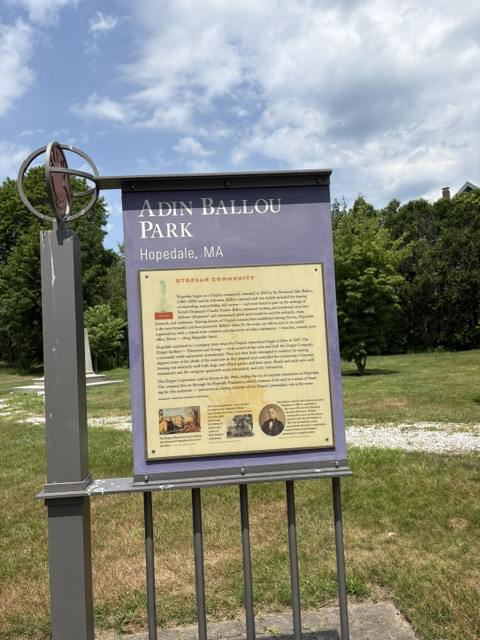
Adin Ballou Park occupies the very heart of Hopedale. It was here that Reverend Adin Ballou established the center of the Hopedale Community in 1842, one of America’s longest lasting and most influential utopian communities. Although the original buildings have largely disappeared, this quiet park marks the place where an extraordinary social experiment once flourished.
Ballou was a Universalist and later Unitarian minister, abolitionist, social reformer, and one of the nation’s earliest advocates of Christian nonresistance. He believed that faith should be demonstrated through action, leading him to establish a community founded on peace, equality, cooperation, temperance, education, and mutual responsibility. Long before these ideas became widely accepted, Ballou and his followers attempted to put them into practice in everyday life.
The Hopedale Community operated as a cooperative society. Members shared responsibilities, supported one another, and believed that economic success should never come at the expense of moral principles. Although the experiment ended in 1856 because of financial challenges, it demonstrated that people could organize a community around ideals rather than profit alone.
Ballou’s influence reached far beyond Massachusetts. His writings on Christian nonviolence were later read by the Russian novelist Leo Tolstoy, whose work influenced Mahatma Gandhi. Gandhi’s philosophy of nonviolent resistance would, in turn, inspire Dr. Martin Luther King Jr. While those connections span continents and generations, they can be traced back, in part, to the convictions of a minister who lived and wrote here in Hopedale.
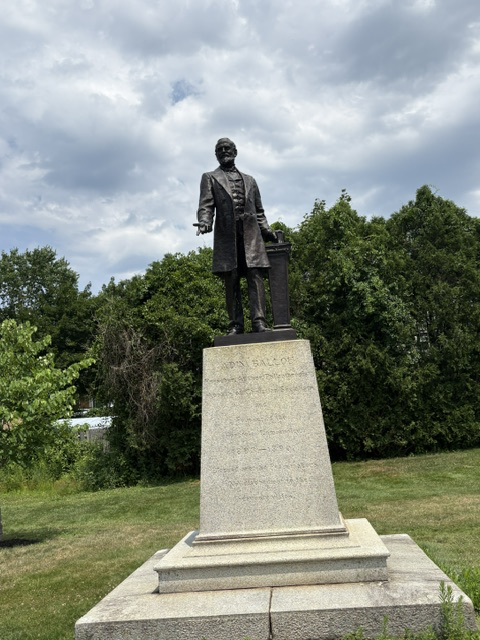
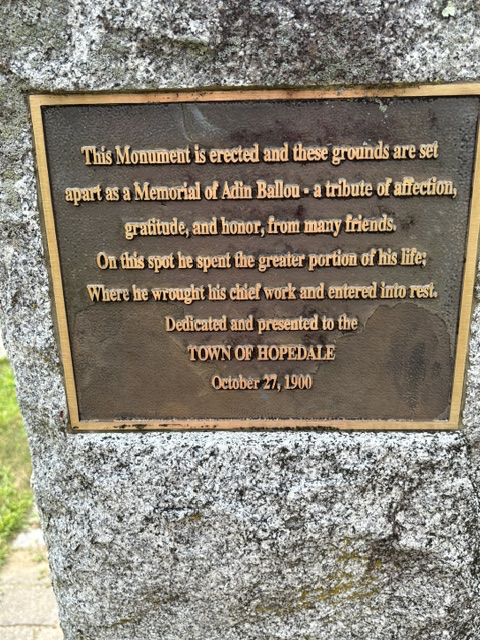
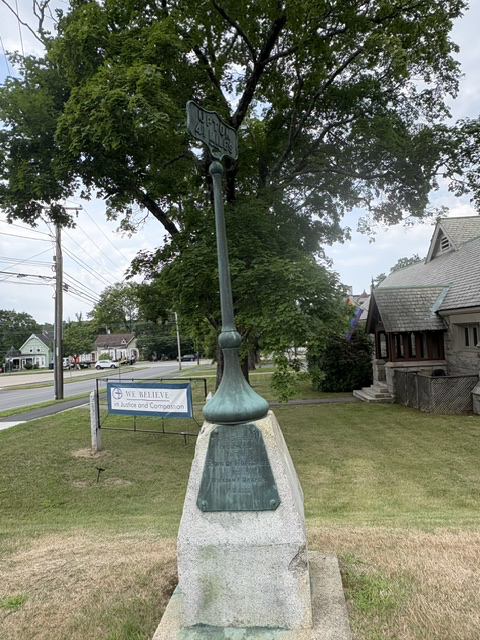
The bronze statue overlooking the park honors Ballou not simply as the town’s founder, but as the man whose vision gave Hopedale its identity. Positioned near the site of his original home, the monument invites visitors to remember that before Hopedale became known for innovation and industry, it was known for ideas.
Hopedale began because one man believed people could live differently. The industries that followed brought prosperity, but they never completely erased the values that inspired the town’s beginning.
In Hopedale, history is not divided into separate chapters of utopianism and industry. Instead, they are part of the same story. Adin Ballou imagined a community where people would care for one another. The Draper family built an industry that allowed that community to flourish. Together, they created a town unlike any other in New England—a place where ideals and innovation became lasting neighbors.
Read More From Nancy
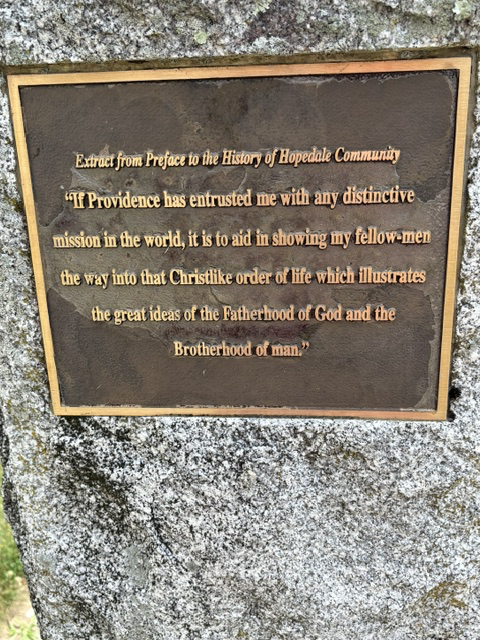
Ballou’s Mission
One of the most meaningful inscriptions on the monument comes from Ballou’s own writings. “If Providence has entrusted me with any distinctive mission in the world, it is to aid in showing my fellowmen the way into that Christlike order of life which illustrates the great ideas of the Fatherhood of God and the Brotherhood […]
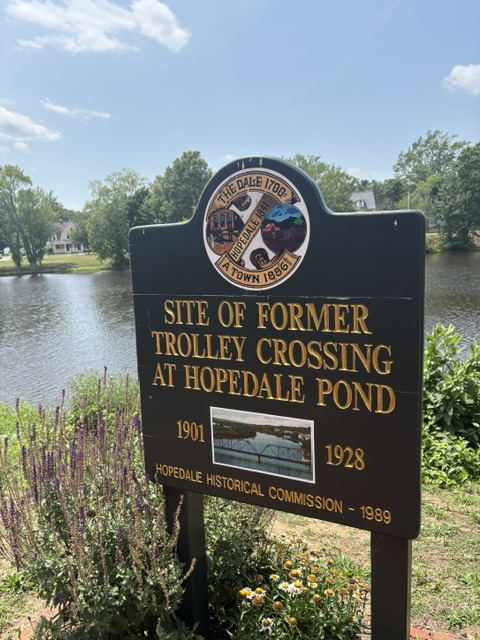
Trolley Bridge
One of the things I enjoy most when exploring a town is discovering the pieces of everyday history that have quietly disappeared. They are often overlooked because they were once so common. The Hopedale Trolley Bridge is one of those stories. Standing along the shores of Hopedale Pond today, it is difficult to imagine that […]
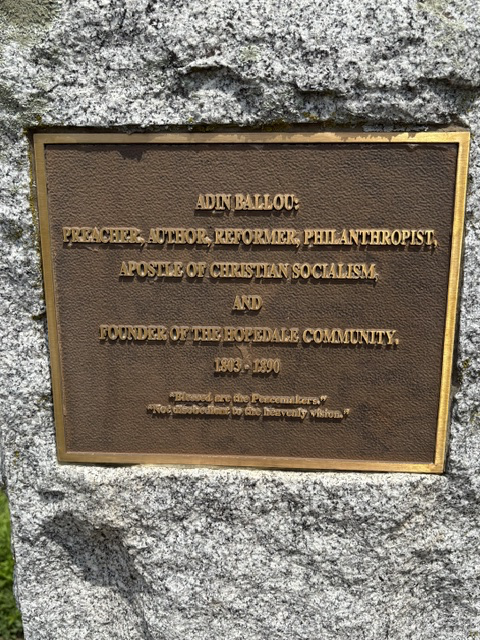
The Founder
The first plaque introduces us to the man whose vision gave birth to Hopedale. It identifies Adin Ballou as a preacher, author, reformer, philanthropist, “Apostle of Christian Socialism,” and founder of the Hopedale Community. Those titles reflect a remarkable life devoted not simply to preaching, but to putting faith into practice. Ballou believed Christianity should […]

