S.P.Q.L. – The Senate and People of Lübeck
While standing beneath the Holstentor in Lübeck, one detail caught my attention. Above the entrance are the letters S.P.Q.L., an inscription modeled after the famous Roman initials S.P.Q.R., meaning “The Senate and People of Rome.”
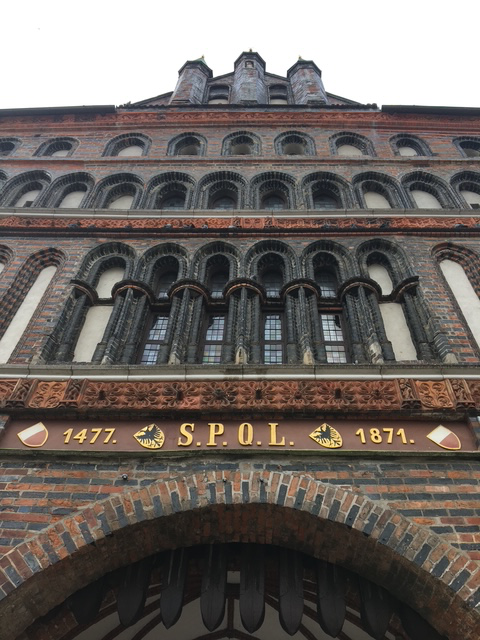
In Lübeck, the letters stand for Senatus Populusque Lubecensis—”The Senate and People of Lübeck.” The inscription reflects the city’s pride in its long history as the leading city of the Hanseatic League and its tradition of self-government.
The dates on either side tell another story. Although the Holstentor was completed in 1477, the inscription was added in 1871 during an extensive restoration. By then, medieval gates throughout Europe were disappearing as cities expanded, but the people of Lübeck chose a different path. Rather than demolishing their famous gateway, they restored it and celebrated it as a symbol of their city’s identity.
I enjoy noticing details like this because they reveal that historic buildings are not frozen in time. Each generation leaves its own mark, adding another chapter to the story. In the case of the Holstentor, a medieval city gate became not only a reminder of Lübeck’s past but also a symbol of the pride its citizens continued to hold nearly four hundred years after it was built.
Read More
Read More From Nancy
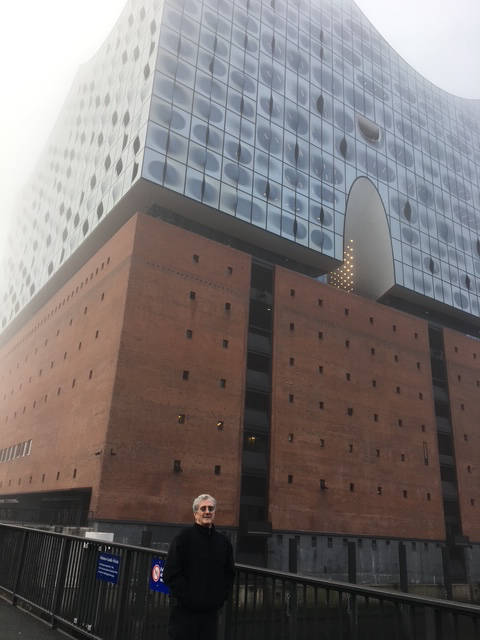
The Elbphilharmonie
We had the opportunity to explore some of Hamburg during the time we spent teaching there. Our work has taken us to cities around the world, and whenever our schedule allowed, we tried to experience something of the history and character of the place we were visiting. In Hamburg, one of the most striking sights […]
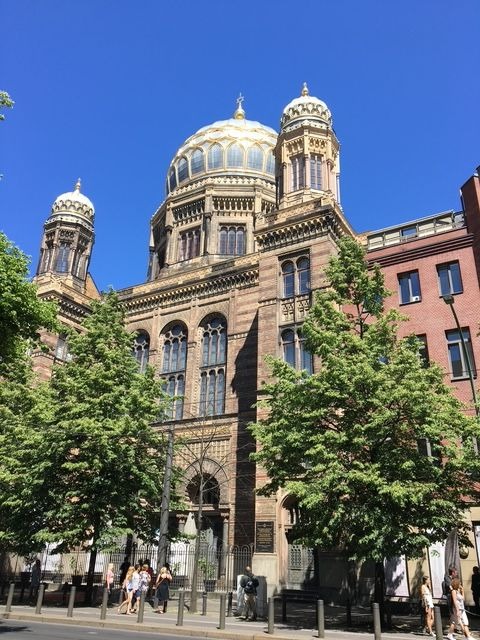
New Synagogue
With its gilded dome rising above Oranienburger Straße, Berlin’s New Synagogue was a prominent expression of Jewish communal life when it opened in 1866. Its scale and elaborate architecture reflected a community establishing a visible place within the growing capital. Built to designs by Eduard Knoblauch, the synagogue drew on Moorish architectural forms. Its richly […]
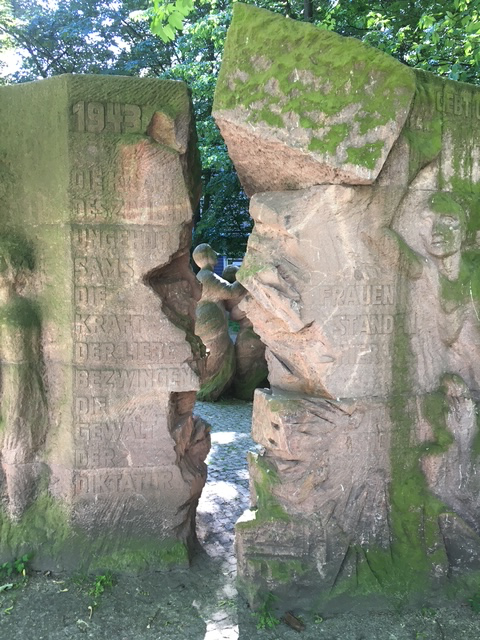
Block of Women
In a small park on Rosenstraße in central Berlin stands a group of fractured red sandstone blocks carved with human figures, Jewish symbols and German words. The monument is known as the Block der Frauen, or Block of Women. Created by German sculptor Ingeborg Hunzinger, it commemorates one of the most remarkable acts of public protest against Nazi persecution: the Rosenstraße Protest […]

