Behind the Wardrobe
At first glance, the cabinet appears unremarkable. Yet during the Second World War, it concealed the entrance to a tiny, windowless room where the Horn family—Chaim, Machla, and their children Max and Ruth—hid for nine months in 1943. The wardrobe functioned as a secret door. Behind it was just enough space for a family to survive, hoping each day that they would not be discovered.
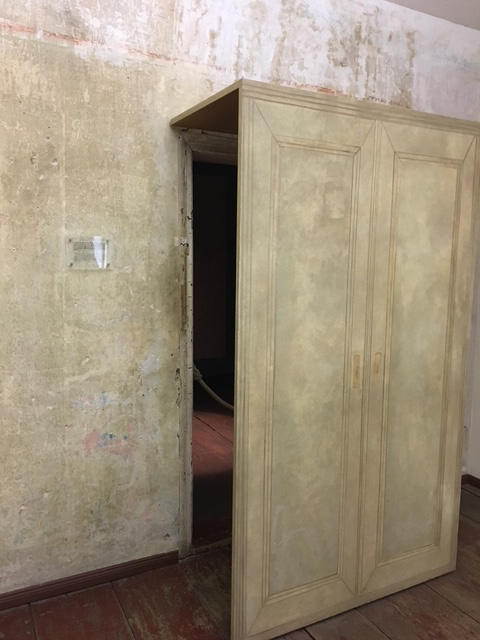
Otto Weidt, the owner of this small brush and broom workshop, had already risked everything to protect his Jewish employees. Blind himself, he employed many blind and deaf Jewish workers because his factory was considered essential to the German war effort. But when deportations intensified, employment was no longer enough. Weidt arranged false papers, bribed officials, organized food, and created hiding places like this one. He relied on a quiet network of courageous people who choose humanity over fear. Sadly, the Horn family’s hiding place was betrayed during a Gestapo raid in October 1943. They were arrested and deported to Auschwitz, where they were murdered. The room remains today not as a reconstruction, but as the actual place where they spent months living in darkness, uncertainty, and hope.
Standing before that wardrobe, it is difficult to imagine an entire family spending months hidden in such a confined space, never knowing if each sound outside the wall might be their last. The room is remarkably small, making their courage—and that of Otto Weidt—all the more extraordinary. It is one thing to read about people going into hiding; it is another to stand where they actually lived and appreciate the uncertainty they faced every single day.
Places like this remind me that history is often preserved in the quietest of spaces. Behind an ordinary wardrobe lies an extraordinary story of compassion, sacrifice, and moral courage. Long after the war ended, this hidden room continues to bear witness to those who risked everything to save others and to those whose lives were forever changed. It is a place that invites us not only to remember the past but also to consider the choices ordinary people make when confronted with extraordinary circumstances.
Read More From Nancy
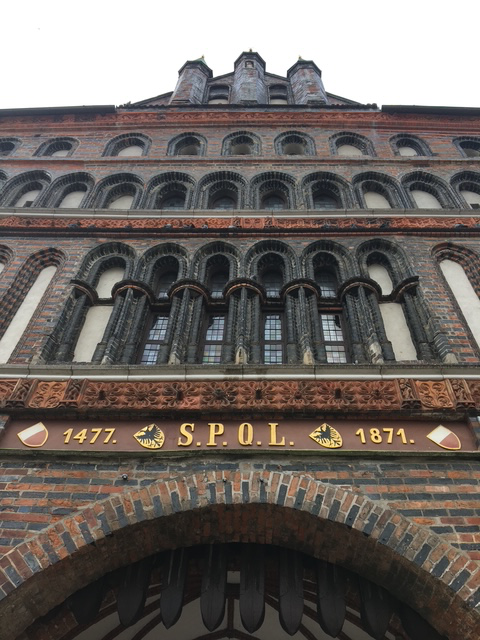
S.P.Q.L. – The Senate and People of Lübeck
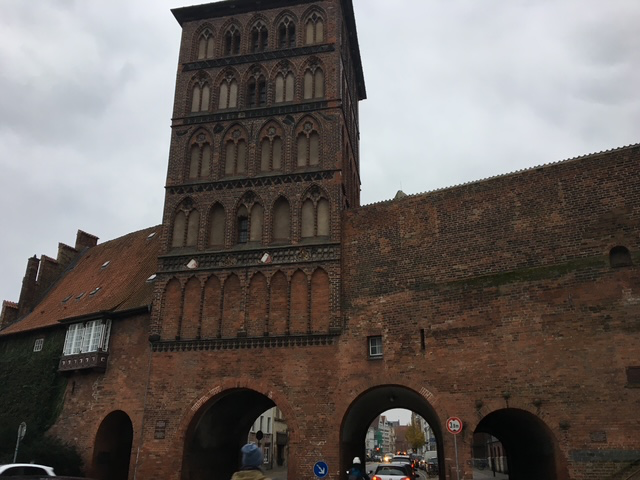
While standing beneath the Holstentor in Lübeck, one detail caught my attention. Above the entrance are the letters S.P.Q.L., an inscription modeled after the famous Roman initials S.P.Q.R., meaning “The Senate and People of Rome.” In Lübeck, the letters stand for Senatus Populusque Lubecensis—”The Senate and People of Lübeck.” The inscription reflects the city’s pride in its long […]
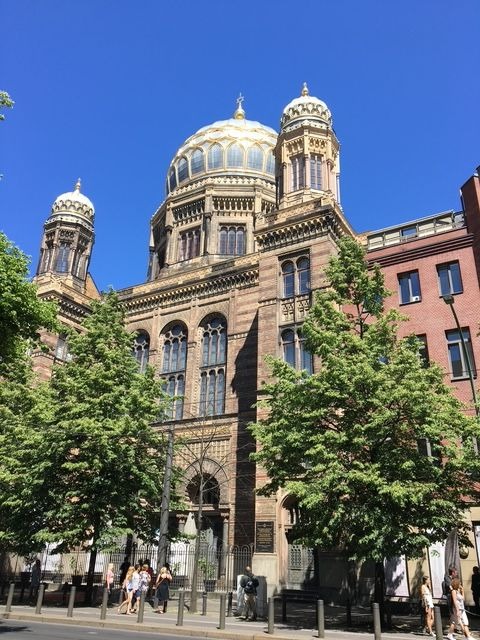
New Synagogue
With its gilded dome rising above Oranienburger Straße, Berlin’s New Synagogue was a prominent expression of Jewish communal life when it opened in 1866. Its scale and elaborate architecture reflected a community establishing a visible place within the growing capital. Built to designs by Eduard Knoblauch, the synagogue drew on Moorish architectural forms. Its richly […]
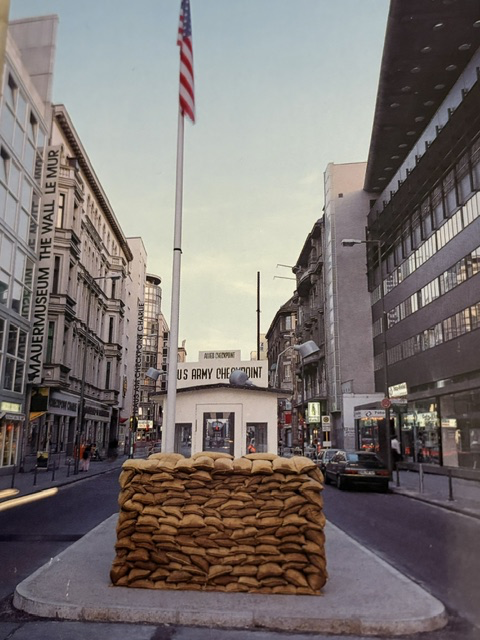
Checkpoint Charlies
The photograph captures one of the most powerful symbols of the Cold War and the division of Berlin during the twentieth century. Standing in the middle of the street is a reconstruction of the famous American checkpoint known as Checkpoint Charlie. This was once the best-known crossing point between East Berlin and West Berlin during […]

