Bible Box
While touring the Nichols House Museum in Boston, one piece in Dr. Arthur Nichols’ office immediately caught my attention. Resting on its stand was a beautifully carved oak Bible box, a reminder that even a physician’s office could contain objects that reflected an appreciation for history and craftsmanship.
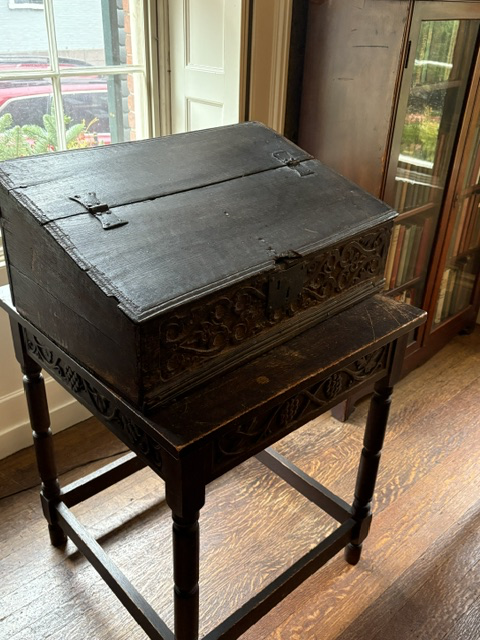
Although often called a “Bible box,” this English oak chest dates to the late seventeenth century and was designed to serve several purposes. Families used boxes like this to store not only a large family Bible but also important documents, money, letters, and other household valuables. The sloping lid could be opened to support a Bible or book for reading, allowing the box to function as a small portable writing or reading desk. The Bible box was not an original furnishing of the Nichols home. In 1912, Dr. Arthur Howard Nichols purchased it at a Boston auction as a gift for his daughter, Rose Standish Nichols, who would later become one of Boston’s leading landscape architects and preservationists. Arthur recorded the purchase in his diary, providing a wonderful glimpse into the family’s interest in collecting and preserving early New England and English antiques.
Displaying the Bible box in Dr. Nichols’ office seems especially fitting. Arthur Nichols was more than a respected Boston physician. He was an educated man with broad intellectual interests, a traveler, musician, collector, and lifelong student of history. The objects throughout the Nichols House reflect the family’s appreciation for craftsmanship, art, and the preservation of the past. This Bible box is one example of how those interests shaped the home they created on Beacon Hill.
Today, the Bible box serves as more than a beautiful antique. It represents the Nichols family’s commitment to preserving objects that connected them with earlier generations. Through pieces like this, visitors gain a deeper appreciation not only for colonial craftsmanship but also for the collectors who recognized the importance of preserving history long before historic preservation became common practice.
Read More From Nancy

The French King Bridge
Driving west along Route 2, I stopped at the French King Bridge mainly for the view. Below, the Connecticut River curved between wooded banks, with hills stretching into the distance. The setting was magnificent, but the bridge itself, with its substantial stone approaches and ornamental lamps, gave me another reason to pause. Opened on September […]
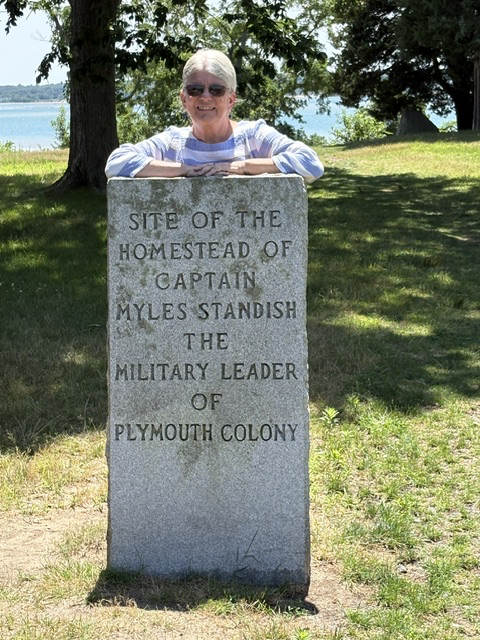
The Myles Standish Homestead
On our camping trip to Plymouth, we wanted to explore more of the Pilgrim story beyond the places we had visited in Plymouth itself. That brought us to nearby Duxbury and the homestead of Captain Myles Standish. Standish is closely associated with the founding of Duxbury, and this was the community where he established his […]
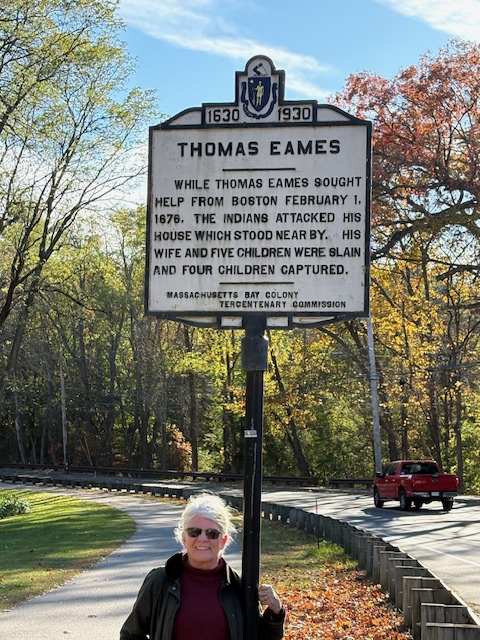
Thomas Eames Sign
Driving along a road in Framingham is this roadside sign that marks the location where the home of Thomas Eames once stood. There is no remaining structure, only the sign indicating that this was the site of a 17th century homestead. On February 1, 1676, during the King Philip’s War, the Eames house was attacked. At […]

