The Old Town Pound
While exploring the colonial cemetery in Sudbury, Massachusetts, I noticed this curious stone enclosure standing beside the old burial ground. At first glance, it appears to be a family plot or perhaps the foundation of a long-vanished building. In fact, it is the town’s Old Town Pound, an important but often forgotten feature of colonial life.
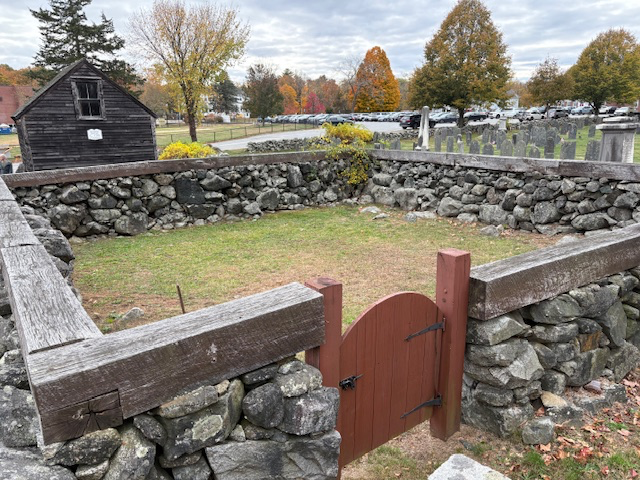
Before fences became common, livestock frequently wandered from their owners’ property. Stray animals were rounded up and confined within the pound until their owners paid a fee to reclaim them. Such pounds were once common throughout New England, serving as an early form of animal control and an important source of town revenue.
Located beside Sudbury’s historic cemetery and near the town center, the pound reminds visitors that colonial communities were concerned with the ordinary problems of daily life. Carefully restored in recent years, this simple stone enclosure offers a glimpse into the practical realities faced by the men and women who built early New England. More than two centuries later, the Old Town Pound stands as a quiet reminder that history is often found in the most unexpected places



Read More From Nancy

The Wayside Inn
On a beautiful October day (2025), I drove to Sudbury, Massachusetts. There are so many places I’ve visited without taking a photo or leaving a written memory, so this time, I set out to capture the Wayside Inn, to record its presence and share it with you. Here in New England, we are surrounded by places that […]

Colonial Militia Monument
As I have explored and shared about many of the towns in Massachusetts that have colonial roots, I have noticed how prominently they mark their connection to the start of the Revolutionary War. The monuments are often placed center stage, physical reminders of the role each community played on April 18, 1775. Acton built a […]

The Martha-Mary Chapel
Standing on a rise across from Longfellow’s Wayside Inn in Sudbury, the Martha-Mary Chapel looks as though it has been part of the New England landscape for centuries. In fact, it dates only to 1940, and its story is inseparable from Henry Ford and his remarkable effort to preserve an idealized piece of early American […]

