Haynes Garrison House
I love discovering these Massachusetts Tercentenary markers scattered across the landscape. What an ambitious historical project this must have been in 1930 as historians and towns worked together to identify and mark hundreds of important colonial sites across Massachusetts
This marker stands alongside the roadside in Sudbury. It commemorates the site of the Haynes Garrison House and the events of King Philip’s War in April 1676. The marker tells the story of Deacon John Haynes who rescued two children during the attack on Sudbury when Native warriors struck the settlement during one of the most violent conflicts in early New England history.
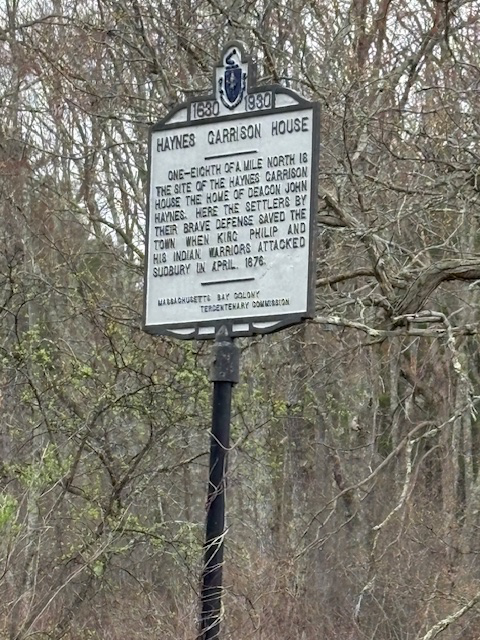
Garrison houses like the Haynes home were more than family residences. They became places of refuge and defense during periods of conflict. During King Philip’s War, settlers often gathered in fortified homes like this one when attacks were feared. This sign reminds us how exposed and uncertain life could be a seventeenth century Massachusetts.
Sudbury itself became one of the major sites of violence during King Philip’s War. In April 1676, much of the town was attacked and burned, and colonial militia suffered heavy losses during what became known as the Battle of Sudbury. The conflict left a lasting mark on both the English settlements and the Native communities throughout the region.
I enjoy these markers because they transform ordinary roadsides into connections with the seventeenth century. The markers preserve stories that otherwise might have disappeared completely from public memory.
Read More From Nancy
King Philip Historic District
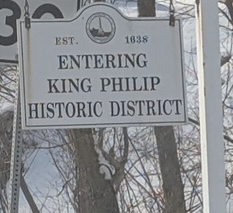
Driving west along Route 10 from Wayland into Sudbury, it is easy to miss the roadside marker that reads: “Entering King Philip Historic District“. This simple sign points to one of the oldest colonial settlement areas in Massachusetts and to events connected with one of the most significant conflicts in early New England history. The district lies […]

The Martha-Mary Chapel
Standing on a rise across from Longfellow’s Wayside Inn in Sudbury, the Martha-Mary Chapel looks as though it has been part of the New England landscape for centuries. In fact, it dates only to 1940, and its story is inseparable from Henry Ford and his remarkable effort to preserve an idealized piece of early American […]
The Red Stone School
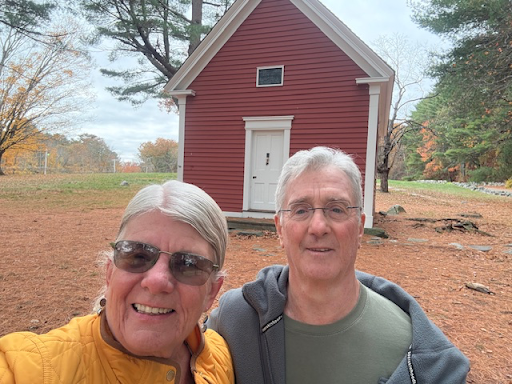
When Henry Ford purchased the Wayside Inn in 1923, he saw more than an old colonial tavern, he saw the beginnings of a “living village”. He wanted a place where the essential virtues of early American life could be preserved. He wanted a community in which each building represented a foundation value. This schoolhouse would be the place where discipline […]

