Daniel Webster
Daniel Webster was born in Salisbury and is considered by many to be one of the most prominent individuals ever to come from New Hampshire.
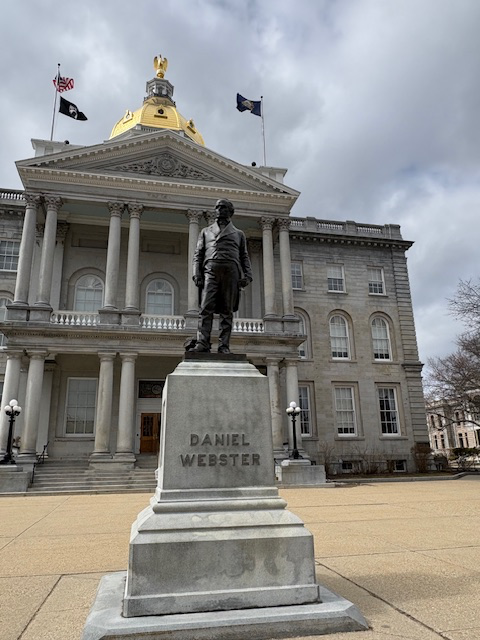
He rose from a rural New England upbringing to become one of the most influential voices in American government during the early 19th century. Webster served in the U.S. House of Representatives representing both New Hampshire and Massachusetts, before becoming a long-serving U.S. Senator from Massachusetts and twice serving as Secretary of State. He was widely regarded as one of the greatest orators of his time, known especially for his powerful defense of the Constitution and the preservation of the Union during periods of growing national tension.
More than thirty years after his death in 1852, the State of New Hampshire formally honored him with a statue placed on the grounds of the New Hampshire State House. Erected in 1886, the monument reflects how a later generation chose to remember him: as a figure of national importance whose roots remained firmly tied to New Hampshire.
Positioned at the State House, the statue connects Webster legacy directly to the center of the state’s civic life. It stands as a reminder that one of the nation’s most powerful voices began in a small New England town, and that his influence would extend far beyond it.
Read More From Nancy
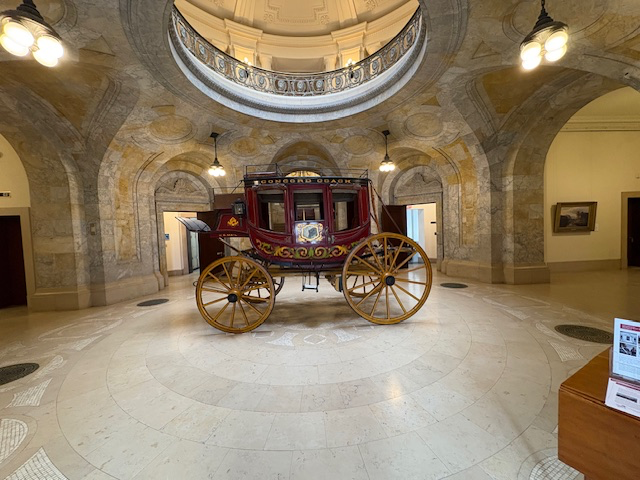
Concord Coach
Inside the Historic Museum is this beautifully preserved Concord coach, an object representing one of the most important contributions Concord made to the wider world. The Concord Coach was developed and built in the 19th century by the Abbot-Downing Company, a firm founded in the early 1800s. From this small New England city came a vehicle that would become […]
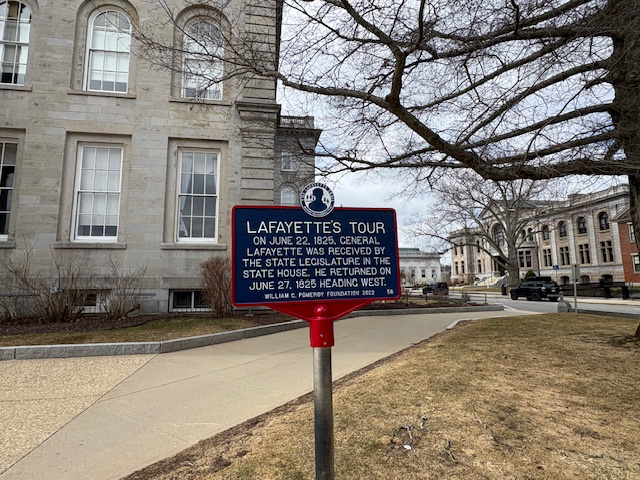
Lafayette’s Tour Sign
This simple marker, outside of the New Hampshire State House, tells the story of a visit that carried a deep meaning for a young nation finding its identity. The sign commemorates the return of Marquis de Lafayette during his grand tour of the United States in 1824-1825. Nearly fifty years after the American Revolution, Lafayette was […]
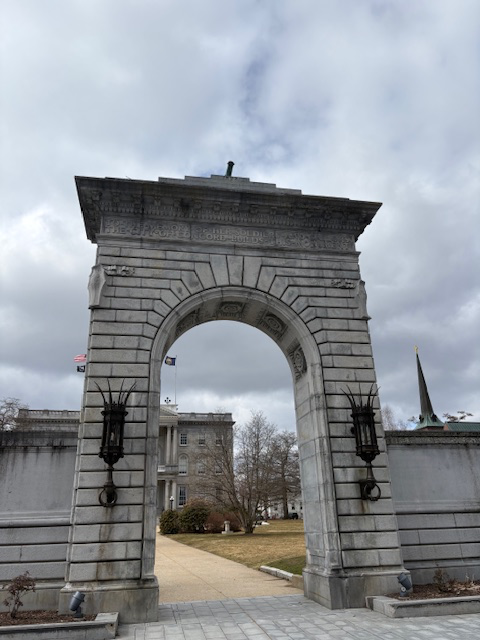
The Soldiers and Sailors Memorial Arch
At the front of the New Hampshire State House lawn stands the granite arch that quietly frames everything beyond it: The Soldiers and Sailors Memorial Arch. The State House itself was completed in 1819, built of locally quarried granite and designed to reflect both permanence and simplicity. It remains the oldest state capital in the United States […]

