The Buttrick Homestead
The red-brick house overlooking Concord’s North Bridge was once the home of the Buttrick family, whose connection to this landscape stretched back to the seventeenth century. Although visitors now enter it as the North Bridge Visitor Center, its columns, balustraded balcony, and broad façade belong to its earlier life as a substantial private residence. Construction began in 1911 for Stedman Buttrick, a descendant of Major John Buttrick, the colonial officer who ordered the militia to return British fire at the bridge in 1775.
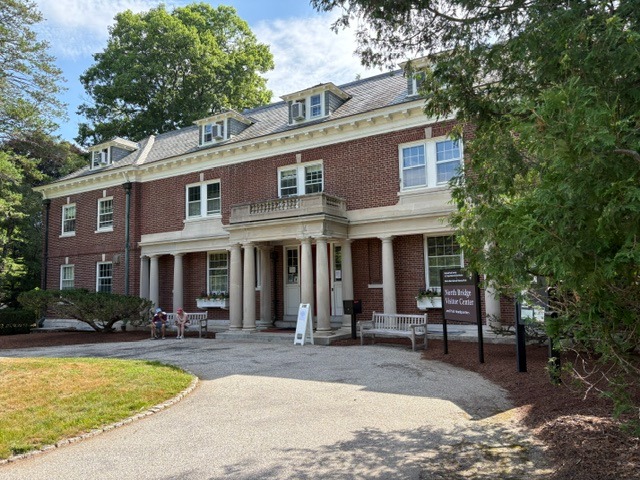
Boston architect James Purdon designed the house on the hill above the battlefield. The estate included a carriage house, a caretaker’s cottage, an orchard, gardens, and a tennis court. An older Buttrick house was moved to Monument Street as the new estate took shape. These changes transformed part of the family’s agricultural landscape into an early twentieth-century country estate.
Behind its impressive appearance lay a family story shaped by both achievement and loss. In a 1997 oral-history interview, the builder’s grandson, also named Stedman Buttrick, recalled that his grandfather had become successful in investment banking. His wife, Olive Bagley, daughter of Michigan governor John Judson Bagley, died in childbirth in 1909. His grandson associated the building of the large new home with that period of grief and intense work. A housekeeper, Miss Pride, helped run the household.
The grandson remembered the property as the family “homestead,” rather than a mansion. He grew up there, and described a socially active household where relatives came for extended stays. His aunt Olive arrived from England with her children in June 1939 and stayed about a year before moving elsewhere in Concord. He also recalled that his parents loved the grounds more than the house, whose grand proportions did not entirely suit them. His memories give the formal building a more intimate history of children, visitors, and family expectations.
The gardens became a particularly distinctive part of the property. Developed across generations, they included terraced beds filled with irises, peonies, daylilies, lilies, phlox, and other perennials. Nearly two hundred varieties of bearded iris were represented, and the family’s white and blue varieties appeared in American and British flower shows. Landscape designers Charles Wheeler and Harold Blossom contributed to the grounds at different stages.
A Concord neighbor, Pierce Browne, later remembered the gardens as a local showplace. He recalled that the younger Stedman Buttrick served as president of the American Iris Society and hosted gatherings beneath a large tent when the flowers reached their June peak. Gardeners maintained the elaborate plantings, and visitors came to enjoy a landscape that had become an attraction in its own right.
The property passed to the National Park Service in the early 1960s, bringing its years as a private family residence to a close. The house eventually became the visitor center and park headquarters. Its preservation retained another chapter of Concord’s history: the country estate created by later generations of a family whose name was already inseparable from the nearby battlefield.
Read More From Nancy
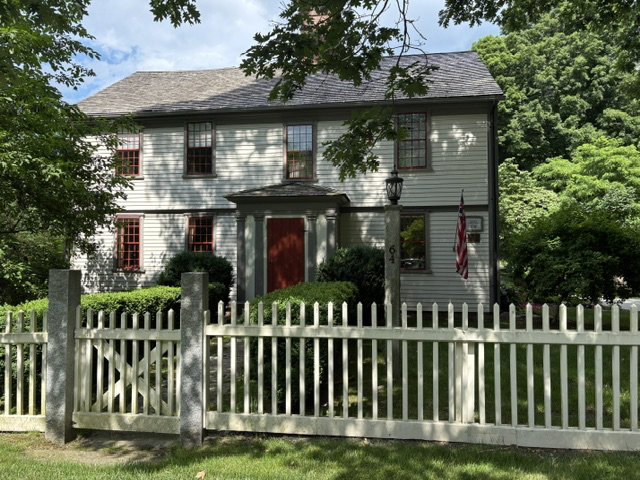
The Jonah and Elizabeth Warren House
Driving along Warren Street in Westborough, this house is easy to admire simply for its age. But its story begins even before Westborough existed as a town and, in an important way, even before European settlement of this area. Jonah Warren and his wife, Elizabeth Seaverns Warren, came from Watertown to the newly developing community […]
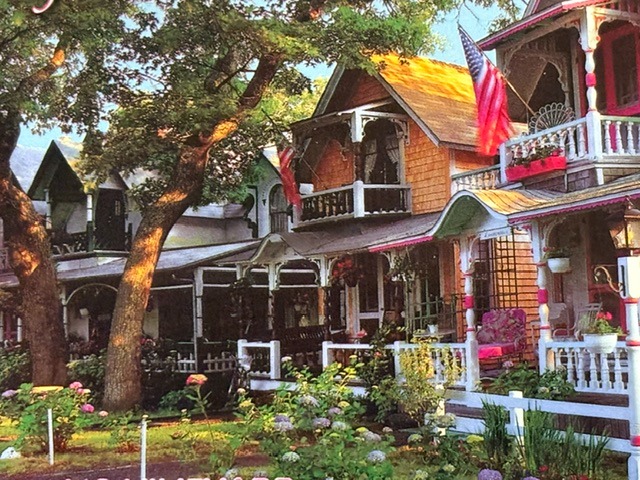
The Gingerbread Cottages
Behind the colorful cottages of Oak Bluffs lies a history that began with tents, outdoor preaching, and summer gatherings. In 1835, Jeremiah Pease and six fellow members of the Edgartown Methodist Church secured land for a religious camp meeting on Martha’s Vineyard. The gathering place became known as Wesleyan Grove, the beginning of the community […]
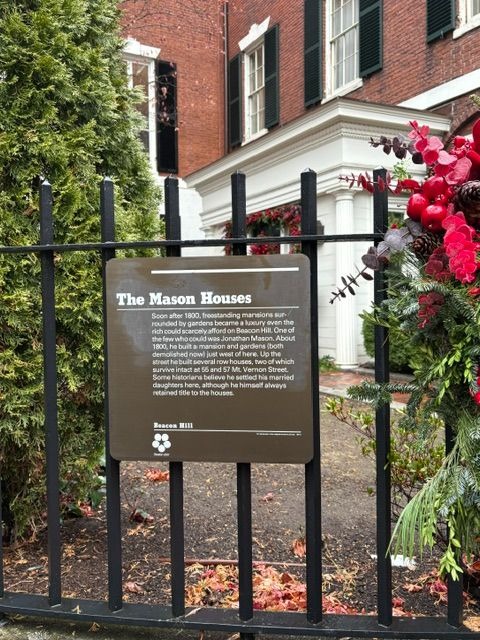
The Mason Houses
Beacon Hill’s closely spaced brick houses can make it difficult to imagine the neighborhood when freestanding mansions and gardens occupied much of the hillside. Jonathan Mason, a lawyer, politician, and real estate developer, helped shape that transformation. Around 1800, he built his own mansion on Mount Vernon Street, with grounds that offered considerably more open […]

