The Church at Auvers-sur-Oise
Erin stands outside the church at Auvers-sur-Oise, beside a reproduction of the painting Vincent van Gogh made of it in 1890. The building and its painted interpretation share the same setting, offering an opportunity to compare the place with the artist’s vision.
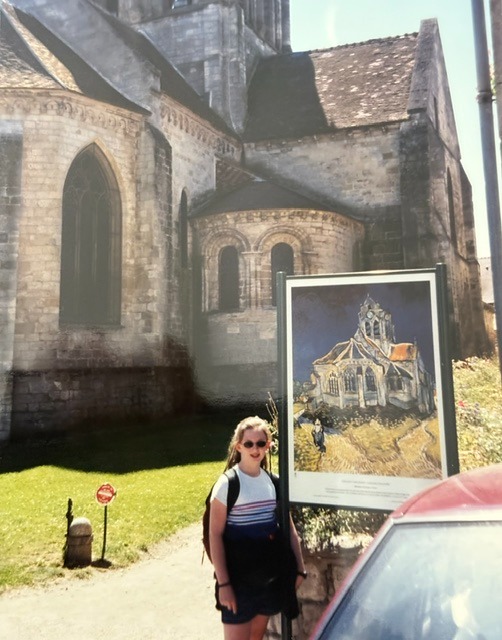
Van Gogh painted the church in June 1890, shortly after settling in the village. He had come north following his stay at the psychiatric hospital in Saint-Rémy-de-Provence. In Auvers, the buildings, people and surrounding countryside supplied subjects for an intensely productive final period of his life.
His painting presents the church as something more unsettled than a conventional architectural view. The walls appear to bend, the rooflines shift, and the windows become deep patches of blue. A dark sky rises above the building, while sunlight illuminates the grass and paths below. A woman walks along one of the paths, giving the scene a small human presence beside the imposing structure.
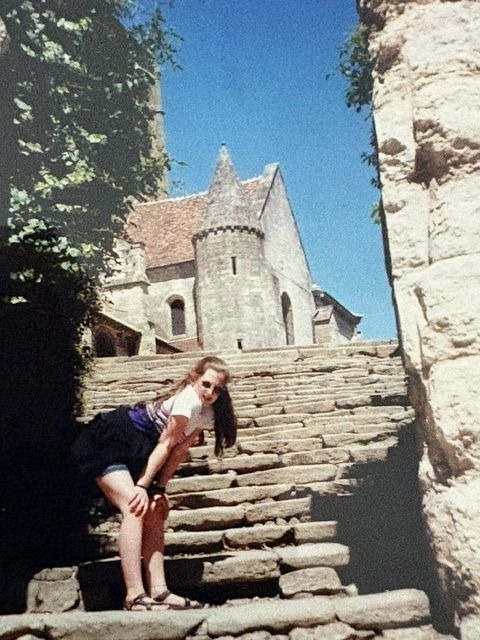
The church itself offers a different encounter. Its stonework, windows and projecting sections can be examined as parts of a physical building. Comparing those features with the painting makes Van Gogh’s choices easier to recognize: he retained an identifiable place while changing its colors, contours and atmosphere.
The original painting now belongs to the Musée d’Orsay in Paris. In Auvers-sur-Oise, the building remains part of the village that inspired it.
For our family, visiting the church connected a familiar work of art with an actual place. Erin’s presence beside it carries that connection into our own history, a moment when an artist’s view of a French village became part of our experience of it.
Read More From Nancy
Sailboats of the Tuileries
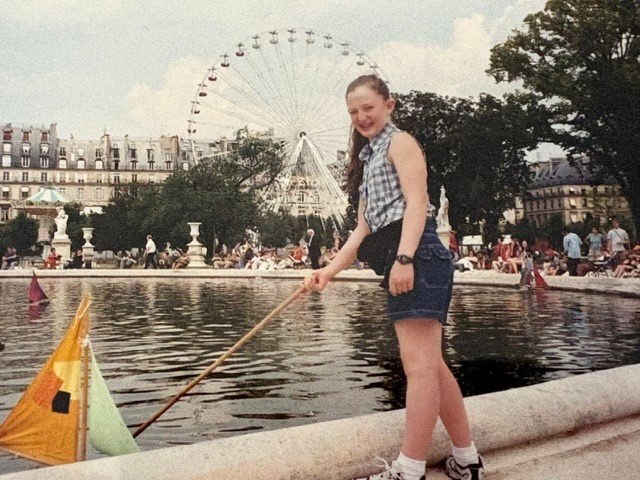
At the edge of a basin in the Tuileries Garden, children launch small wooden sailboats and watch the wind carry them across the water. A long stick helps push a boat away from the stone rim or send it off again when it returns. This simple activity has been part of the garden’s life for […]

Gravesites of Vincent and Theo Van Gogh
When we traveled as a family, we would try to find places that would spark the interests of our daughters. During a vacation in Paris, one of these special excursions was a train ride to the village of Auvers-sur-Oise, where Vincent Van Gogh spent the final weeks of his life and created many of his most famous paintings […]
Normandy Cliffs and American Cemetery
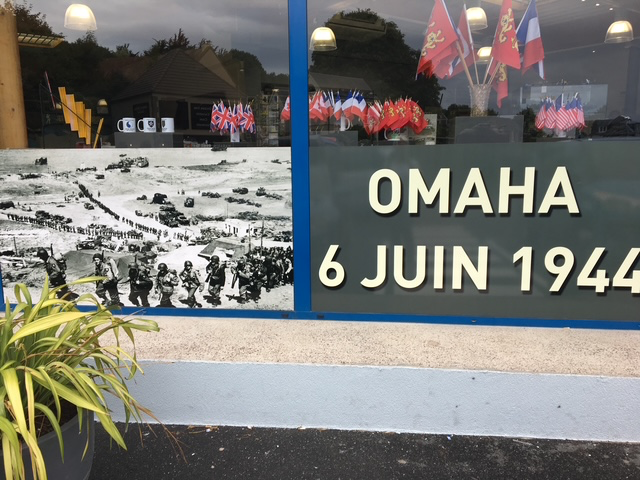
There are few places more memorable to me than our visit to Normandy. No movie, photograph or history book could prepare us for the vastness of this coastline or the weight it still carries. It is impossible not to feel the immensity of what happened across these beaches on June 6, 1944. We started at […]

