Mitchell House
At the corner of Prince and Lower Water Streets, Mitchell House preserves a chapter of Halifax’s history when a merchant’s home and business could share the same building. George Mitchell purchased the property in 1819 and, in the mid-1820s, replaced an earlier wooden house with an ironstone residence and warehouse. The location placed his family and commercial operations close to the harbour on which his livelihood depended.
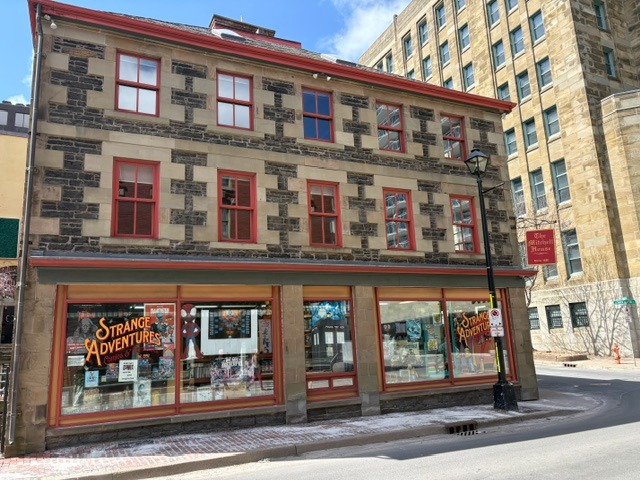
Mitchell was a shipping merchant involved in trade with the West Indies. His house belonged to a waterfront economy shaped by the movement of vessels and goods between Halifax and distant ports. Combining living quarters with storage space brought domestic life and the practical demands of commerce together under one roof.
The building’s Georgian character appears in its restrained proportions and regularly spaced windows. Dark ironstone walls contrast with the lighter stone surrounding the openings and marking the corners. Its substantial masonry and orderly exterior suited a building intended to accommodate both a household and a merchant’s business. The upper storeys retain the appearance of a residence even as the ground floor reflects its long commercial history.
After the Mitchell family moved out, the entire building was adapted for commercial use. Interior features, including trap doors associated with moving goods between floors, provide evidence of its warehouse function. By the twentieth century, it was also known as the Sperry Gyroscope of Canada building, a name recorded in a photograph held by the Nova Scotia Archives.
Recognized as a municipal heritage property in 1981, Mitchell House retains its connection to both family life and waterfront enterprise. Its significance rests in that combination: a surviving merchant’s home whose structure also records the work of storing and handling goods in nineteenth-century Halifax.
Read More From Nancy
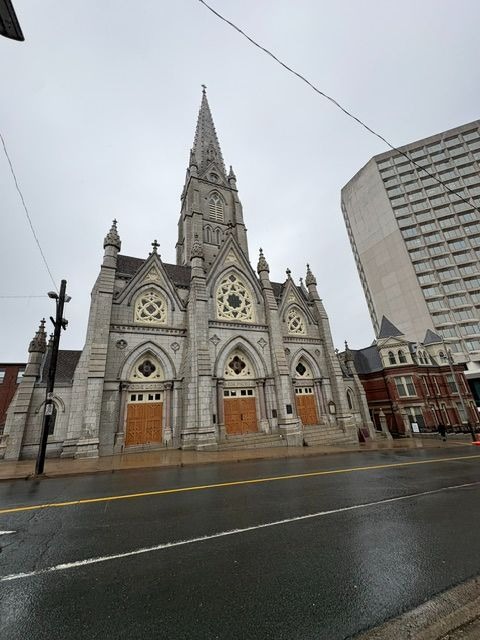
St. Mary’s Cathedral Basilica
On Spring Garden Road near its intersection with Barrington Street, St. Mary’s Cathedral Basilica rises directly from the streetline, its granite spire overlooking downtown Halifax. The three entranceways, pointed arches and elaborate stone tracery make it a prominent example of Gothic Revival architecture. Its construction and later expansion also reflect the growing presence and standing […]
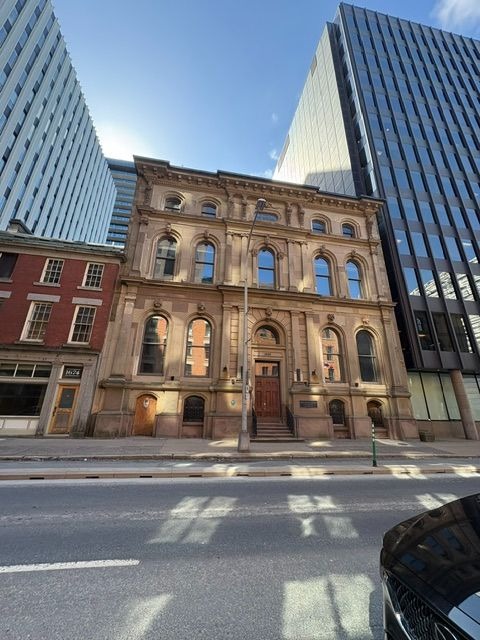
The Dominion Building
The Dominion Building on Hollis Street was conceived as a centre for the services that connected nineteenth-century Nova Scotia to the wider world. In 1863, the provincial legislature approved its construction to house the Post Office, Customs House and Railway Department. Completed in 1868, it brought together institutions responsible for communication, trade and transportation. Designed […]
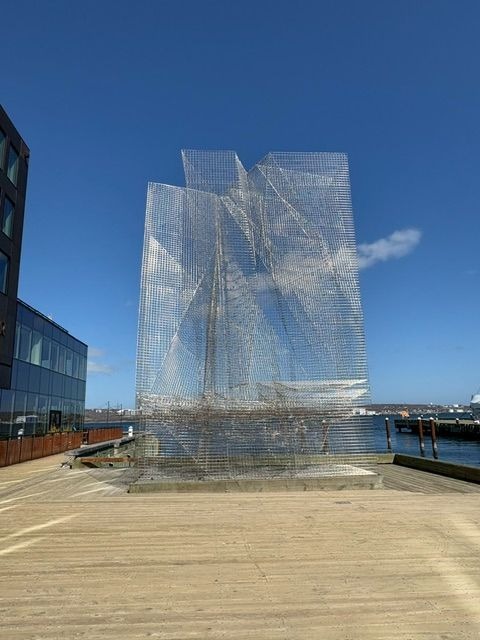
Sail
At the foot of Prince Street on Halifax’s waterfront, a ship appears to rise from a lattice of metal and light. Sail, by Italian artist Edoardo Tresoldi, is a twenty-foot-high wire-mesh sculpture at Queen’s Marque. Its transparent form evokes a ghost ship, recalling the vessels that once filled the harbour while allowing the present waterfront […]

