Old Burying Ground and Welsford-Parker Monument
Established in 1749, the same year Halifax was founded as a British settlement, the Old Burying Ground served the community until 1844. Originally located outside the fortified town, it became the resting place of people from different religious denominations. Today, its enclosed grounds preserve a chapter of early Halifax within the surrounding downtown streets.
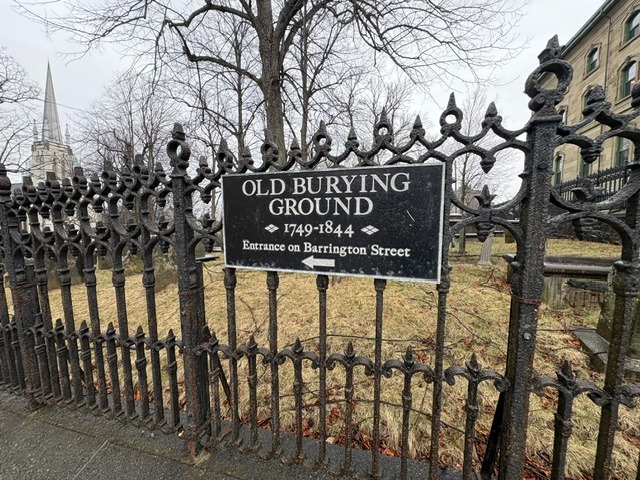
More than 1,200 surviving grave markers record individual lives and nearly a century of changing memorial traditions. Their carved lettering, decorative motifs, and varied forms reveal both the wishes of grieving families and the skills of the craftspeople who made them. Headstones, footstones, and box tombs stand in an irregular arrangement, reflecting a burial ground that developed over generations.
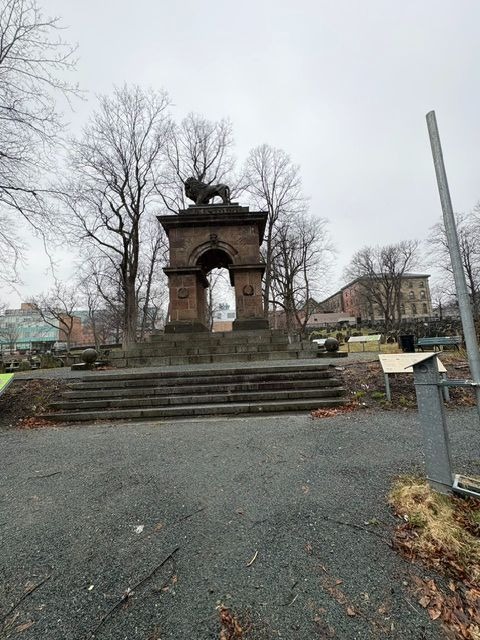
At the entrance stands the Welsford-Parker Monument, a stone arch crowned by a carved lion. Erected in 1860, after the cemetery had closed to burials, it commemorates Major Augustus Welsford and Captain William Parker, two Nova Scotians who died in the Crimean War. Both participated in the September 1855 assault on the Great Redan, part of the defenses of Sevastopol. Their memorial connects Halifax with a conflict fought thousands of miles away.
The monument’s scale and form give it a different presence from the surrounding gravestones. Raised above broad steps, the arch creates a ceremonial entrance, while the lion recalls British imperial symbolism. Its construction introduced a public military memorial into a place already devoted to personal and family remembrance. The grounds were also fenced and landscaped when the monument was erected.
Together, the cemetery and monument preserve two forms of remembrance. The gravestones record the lives of Halifax’s early residents, while the lion-topped arch honors two men whose deaths became a public cause for commemoration. Within the same small space, local family history meets the wider military history of nineteenth-century Nova Scotia.

Read More From Nancy
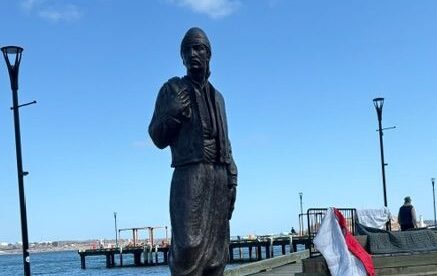
The Lebanese Emigrant Statue
On Halifax’s waterfront, a bronze figure honours the Lebanese emigrants who crossed the ocean to establish new lives in Nova Scotia. Installed in September 2018, the Lebanese Emigrant Statue recognizes their pioneering spirit and the contributions of generations of Lebanese Canadians to the province’s communities, businesses and professions. Lebanese migration to Nova Scotia began in […]
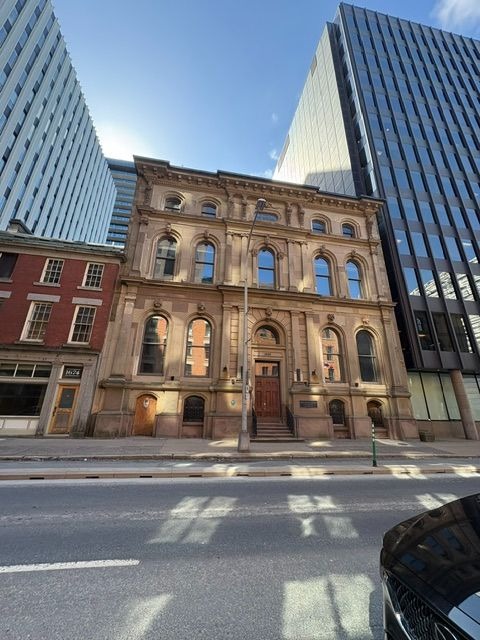
The Dominion Building
The Dominion Building on Hollis Street was conceived as a centre for the services that connected nineteenth-century Nova Scotia to the wider world. In 1863, the provincial legislature approved its construction to house the Post Office, Customs House and Railway Department. Completed in 1868, it brought together institutions responsible for communication, trade and transportation. Designed […]

The Halifax Town Clock
On the eastern slope of Citadel Hill, the Halifax Town Clock overlooks Brunswick Street and the downtown streets below. Its white tower, blue clock faces and copper dome form one of the city’s most recognizable landmarks. The clock began keeping time on October 20, 1803, providing a public reference for both the military garrison and […]

