The Custom House Tower
During our walk around Boston, the Custom House Tower rose above the surrounding buildings, its pointed roof making it recognizable from a distance. This landmark connects two periods of the city’s history: the nineteenth-century seaport and the early twentieth-century skyline.
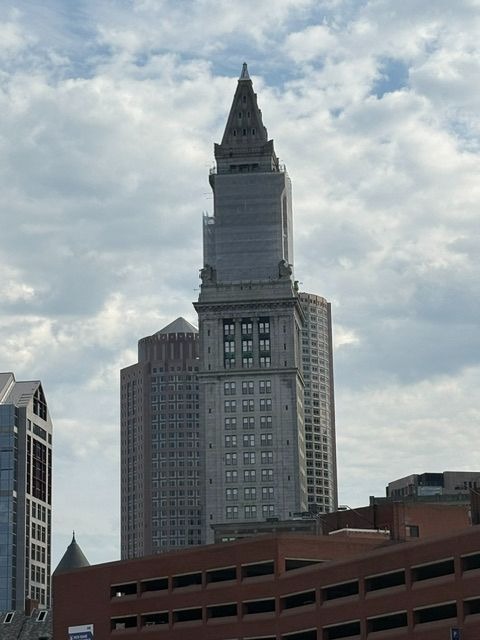
The original Custom House opened in 1847. Designed by architect Ammi Burnham Young, its Greek Revival architecture drew upon the forms of ancient temples, with substantial granite columns expressing the importance of the federal institution inside.
Its purpose was closely tied to Boston’s waterfront. Customs officials collected duties on imported goods, and inspectors worked from the building as part of the administration of the busy port. Behind its monumental architecture was the daily business of ships, cargo, and international commerce.
As the customs operation grew, more office space was needed. Rather than replace the original building, the government expanded upward. Peabody and Stearns designed the tower, completed in 1915, creating the unusual combination of a classical nineteenth-century base and a soaring office building above it.
At approximately 495 feet, the tower rose far beyond Boston’s usual 125-foot height limit. Federal ownership exempted it from that restriction, allowing it to become Boston’s first skyscraper. It remained the city’s tallest building until the Prudential Tower surpassed it in 1964. Its large clock faces became another distinctive feature of the skyline.
The Custom House Tower gives physical form to the importance of maritime trade in Boston’s development. Even among the taller buildings that followed, its distinctive silhouette preserves the presence of an institution built around the movement of goods through the harbor. Looking up during a city walk brings that history into view.
Read More From Nancy
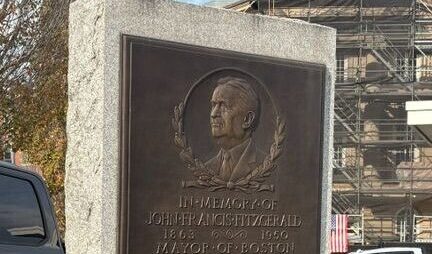
John Francis “Honey Fitz” Fitzgerald
Near St. Stephen’s Church in Boston’s North End, a bronze portrait set into a granite memorial honors John Francis Fitzgerald, remembered as “Honey Fitz”. His name connects the neighborhood with Boston’s political history and the Kennedy family, but his own story began here long before his grandson became president. Born in the North End in […]
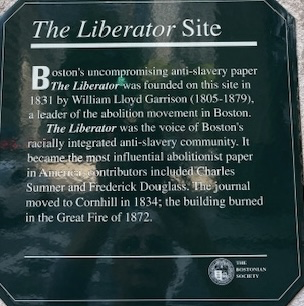
The Liberator Site
I had just stepped away from the busy Freedom Trail, when I came across the bronze plaque on a quiet Boston street. It read: “The Liberator Site – Boston uncompromising anti-slavery paper. The Liberator was founded on this site in 1831 by William Lloyd Garrison…..“ Standing at this spot, I realized that this was the birthplace […]
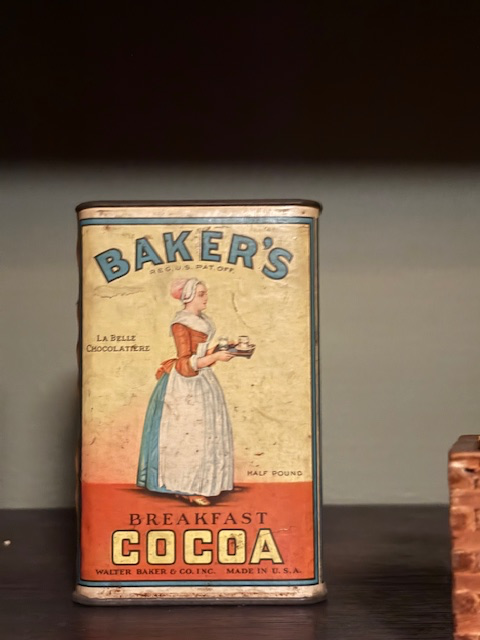
Gibson House Museum – Baker’s Breakfast Cocoa
When visiting the Gibson House Museum in Boston, this colorful tin caught my eye in the kitchen. Baker’s Breakfast Cocoa, the title sparked my curiosity. The tin was produced by Walter Baker & Co, the oldest continuously operating chocolate manufacturer in the United States. Founded in the late 1700s, in Massachusetts, Baker’s became a household […]

