Homage to the Book
At a busy intersection in Barcelona, an oversized book rises above the pavement. Its red cover opens around a fan of pale pages, balanced on a blue rounded base. Surrounded by traffic, pedestrians, and substantial stone buildings, it brings an unexpected touch of playfulness to the street. Looking more closely reveals that this unusual sculpture belongs to a larger celebration of books, writers, and the city’s literary life.
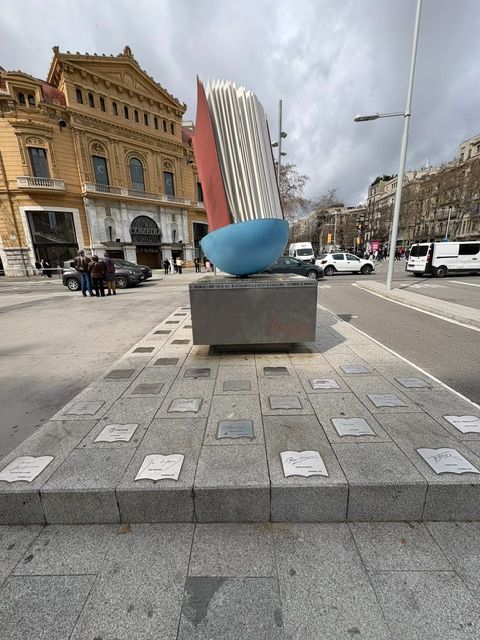
The monument was created in 1994 by Catalan poet and artist Joan Brossa, with the collaboration of artist and graphic designer Josep Pla-Narbona. It was commissioned by the Gremi de Llibreters de Vell, the association of antiquarian and secondhand booksellers, whose book fair had long been held along Passeig de Gràcia. Its installation coincided with the fair’s forty-third edition.
Brossa approached poetry as something that could extend beyond words printed on a page. Objects, shapes, and unexpected arrangements could also communicate an idea. His works in Barcelona’s public spaces are often described as visual or urban poems. Here, the familiar form of a book becomes a sculpture large enough to interrupt an ordinary walk and invite a second look.
The rounded base gives the book the appearance of a rocking toy, something that might tip and then return upright. Its open pages suggest movement rather than a volume closed and put away. To me, that makes it an especially fitting tribute: a book becomes meaningful when someone opens it, allowing its stories and ideas to enter another life.
The monument’s location connects it directly to the bookselling tradition it honors. The fair brings old, used, and collectible books into the public street, where people can browse, discover an unfamiliar author, or find a volume that has already passed through other hands. The sculpture gives that recurring event a permanent presence at the intersection.
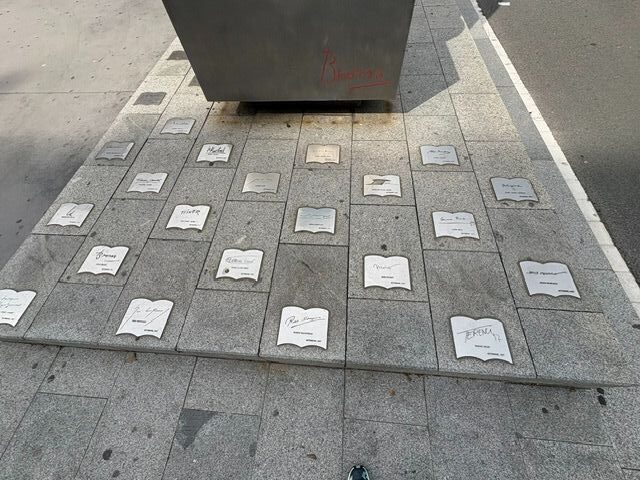
Around its base, small metal plaques shaped like open books extend the tribute. Beginning in 1997, plaques were added to honor writers working in the Catalan language, incorporating their names and signatures. What first appears to be decorative paving becomes a collection of individual literary recognitions. The large book draws attention from a distance; the smaller books encourage people to pause and read.
I enjoy discoveries like this because they add another layer to a city. Barcelona’s architecture may draw our eyes upward, but here there is also something worth noticing beneath our feet. A colorful sculpture leads to the history of a book fair, an artist’s approach to poetry, and the writers whose work forms part of Catalan culture. Together, they make this small stretch of pavement a place where literature has stepped out into everyday life.
Read More
Read More From Nancy
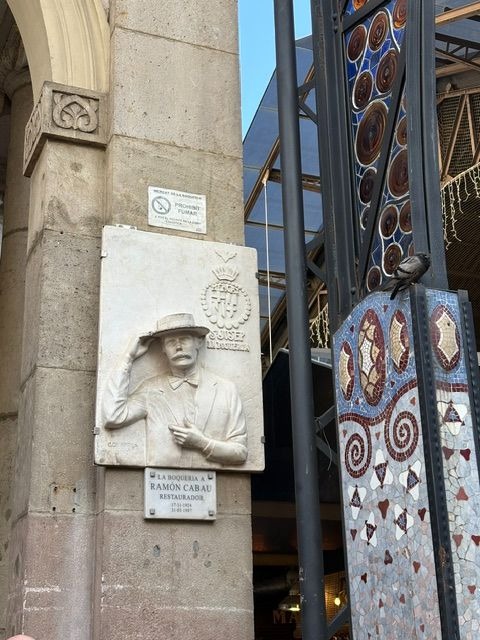
Ramon Cabau
At an entrance to Barcelona’s La Boqueria market, a sculpted relief depicts a man lifting his straw hat in greeting. The inscription identifies Ramon Cabau, a restaurateur whose close relationship with the market made him one of its memorable personalities. Born in 1924, Cabau became known through Agut d’Avinyó, a restaurant in Barcelona’s old city. […]
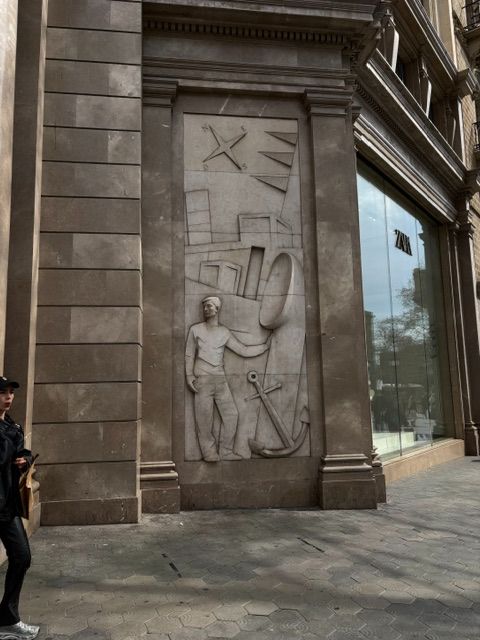
The Sailor in Stone
Walking through Barcelona, I noticed a carved stone panel beside a storefront entrance. A sailor stood next to a large anchor, with the outline of a ship rising behind him and a star above. The relief was incorporated into the building itself, an architectural detail that could easily be overlooked while passing the shop windows. […]
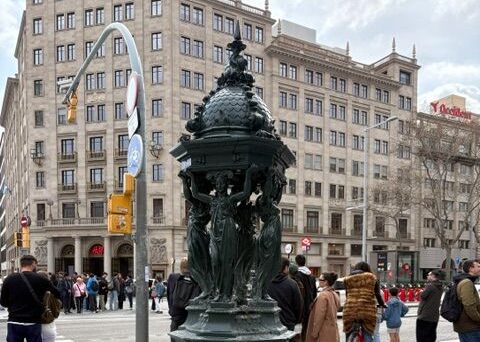
The Wallace Fountain
Among Barcelona’s grand buildings and busy streets, a small drinking fountain carries a story of public service expressed through art. At the intersection of Passeig de Gràcia and Gran Via, four sculpted women support an ornamental dome above a cast-iron pedestal. Its dark green surface and elaborate decoration make an everyday necessity into something worth […]

