Billy Elliot’s House: A Place of Refuge
Following Greenfield’s sidewalk art led me to a portrait of a man standing before a house. The lettering identified him as abolitionist Billy Elliot. Here was another person whose name I had not known, but whose story connected an ordinary Main Street home with the struggle for freedom.
Artist Robert Markey created this mural for Greenfield’s Abolitionist and Underground Railroad Downtown Art Walk. It depicts William “Billy” Elliot and his home at 473 Main Street, a building that survives today. The house gives the story a physical connection to the neighborhood where Elliot lived and worked.
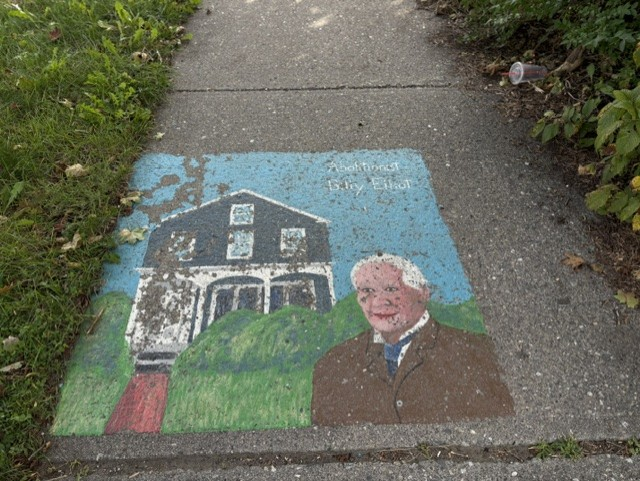
Elliot was a merchant who later entered the insurance business. For years, he worked at Lyman Kendall’s store at the corner of Main and Federal streets, then operated his own business at what is now 310 Main Street. His working life placed him within the everyday commercial activity of Greenfield, but he also devoted time to organized opposition to slavery.
He served as secretary and treasurer of the Franklin County Abolition Society and joined the Free Soil Party in 1848. His involvement reflected a belief that political participation could help challenge slavery, particularly its expansion into western territories.
The story of his home adds a more personal dimension. A 1934 “Old Timer Remarks” column in the Greenfield Recorder remembered it as a frequent refuge for people escaping slavery and continuing toward Canada. This account, preserved in Greenfield’s historical guide, is a later recollection rather than a contemporary record of individual journeys. It nevertheless provides an important part of the local memory surrounding Elliot and the house.
Offering such help carried consequences. The Fugitive Slave Act of 1850 strengthened federal efforts to capture people who had escaped enslavement, even in states where slavery had ended. Those who knowingly sheltered or assisted freedom seekers could face substantial fines and imprisonment. Crossing into Massachusetts did not guarantee safety, which made the journey onward to Canada especially important for some
The Underground Railroad depended on people making difficult decisions about whom to trust, where to stop, and when to move. Freedom seekers undertook the greatest risks; assistance along the way could offer a chance to rest and continue.
Learning about Elliot changed how I understood this stretch of Main Street. A house that might otherwise have blended into the streetscape became a place associated with refuge, political conviction, and the possibility of a safer future.
Read More From Nancy
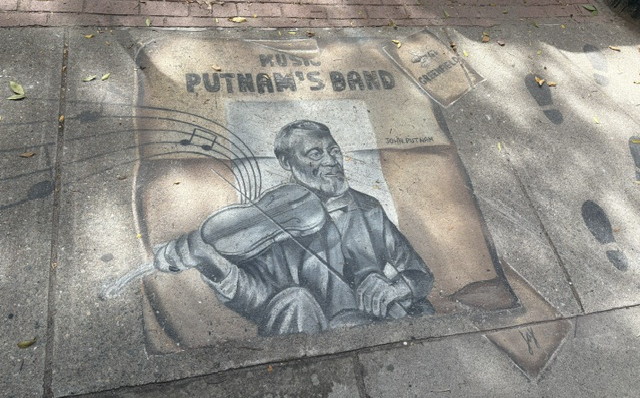
Music and the Road to Freedom
Once I knew Greenfield’s sidewalk art existed, I went looking for more. The next mural introduced me to John Putnam, shown holding a violin beneath the words “Putnam’s Band.” Musical notes curve through the artwork, inviting a closer look at a man whose story connects the town’s musical life with its history of resistance to […]
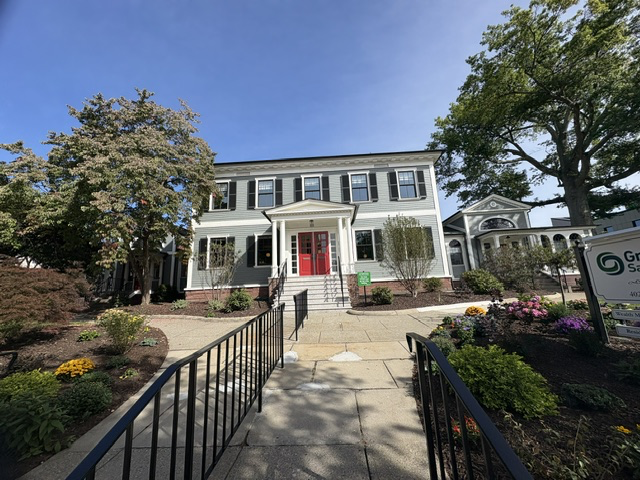
The Leavitt-Hovey House
A sidewalk sign is always a reason to stop and explore. In Greenfield, one pointed me toward the Leavitt-Hovey House, a building whose story reaches back to 1797. Its white clapboards, dark shutters, and columned entrance caught my attention, but the name on the marker introduced something more: a connection to Asher Benjamin, an architect […]
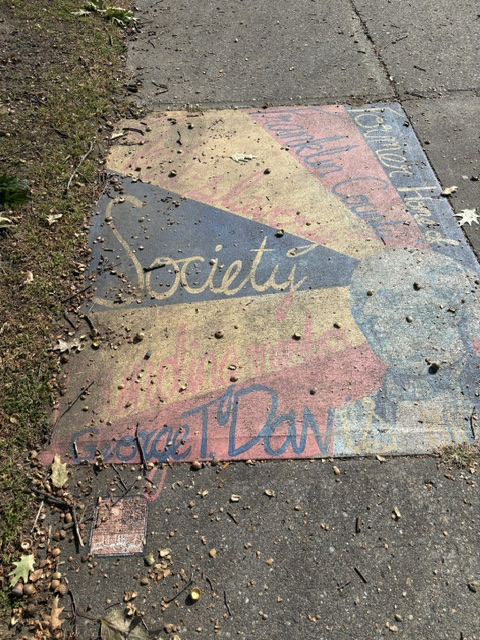
George T. Davis: Working for Freedom
Once I discovered Greenfield’s sidewalk art, I began looking for the next piece and the story it might reveal. This mural carried the name George T. Davis among colorful shapes and lettering referring to the anti-slavery movement. It introduced me to a man whose work connected Greenfield’s local history with the larger struggle to end […]

