John Brown’s Desk
I stood beside John Brown’s desk at the Lyman and Merrie Wood Museum of Springfield History. It is a large, dark piece of furniture, made for the practical work of keeping accounts and handling correspondence. Brown used it during the years he worked as a wool merchant in Springfield. The museum also identifies it as a place where he helped conceal people escaping slavery. That connection gives an ordinary business object a far more consequential history.
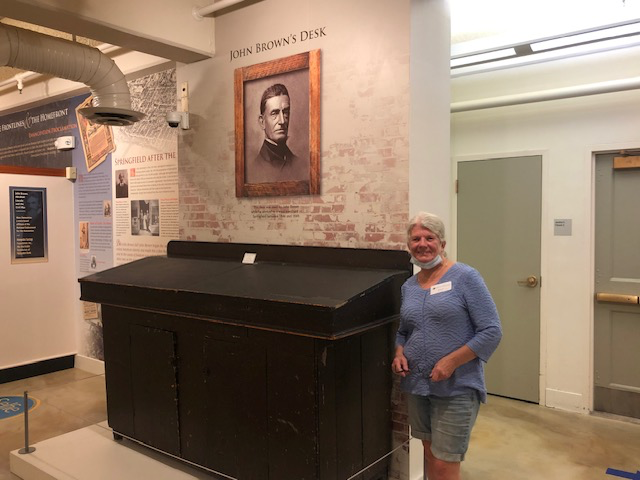
Brown came to Springfield in the 1840s to work with Simon Perkins in a wool business. Their warehouse stood near Water and Railroad Streets, where wool could be received, sorted, and sold. Brown hoped to obtain fairer prices for the growers whose wool he represented. He and his family lived nearby, in a house on what later became Franklin Street. The warehouse and home were part of Springfield’s network of places that sheltered and assisted freedom seekers traveling north.
The exhibit places Brown within a larger abolitionist community. Springfield’s Free Church was an important center of antislavery activity and later became St. John’s Congregational Church. Brown formed relationships with Black residents who were doing the dangerous work of protecting people fleeing slavery. Among them was Thomas Thomas, who worked at the wool business and became Brown’s friend. In 1847, Brown also met Frederick Douglass in Springfield. They spoke about slavery and Brown’s increasingly militant ideas for ending it.
After Congress passed the Fugitive Slave Act of 1850, the danger increased even for people who had reached a free state. In Springfield, Brown joined members of the Black community in organizing the League of Gileadites to resist attempts to seize people and return them to slavery. The museum’s research identifies forty-four members associated with the group and emphasizes the risks its Black members took in defending their neighbors. Their actions are essential to this story; Springfield’s antislavery work did not rest on Brown alone.
Brown’s wool business ultimately failed, and he left Springfield. A decade later, his 1859 raid on the federal armory at Harpers Ferry ended in his capture and execution, intensifying the national conflict over slavery before the Civil War. The museum connects those later events to the convictions and relationships Brown developed during his Springfield years. It preserves other belongings and documents from his life, but the desk held my attention.
Seeing it brought the history down to the scale of a room and a piece of furniture. Brown conducted business at that desk while people in Springfield were organizing, sheltering freedom seekers, and deciding what they would risk for another person’s liberty. The surrounding exhibit helped us understand the desk as part of that wider network of courage and resistance.
Read More From Nancy

The Canals of Lowell
Walking through downtown Lowell, it is almost impossible not to encounter the canals. They pass beneath streets, alongside sidewalks and between the enormous brick mill buildings that still dominate parts of the city. On this day, we were simply walking through Lowell when we stopped along one of them for this photograph. The canals are […]
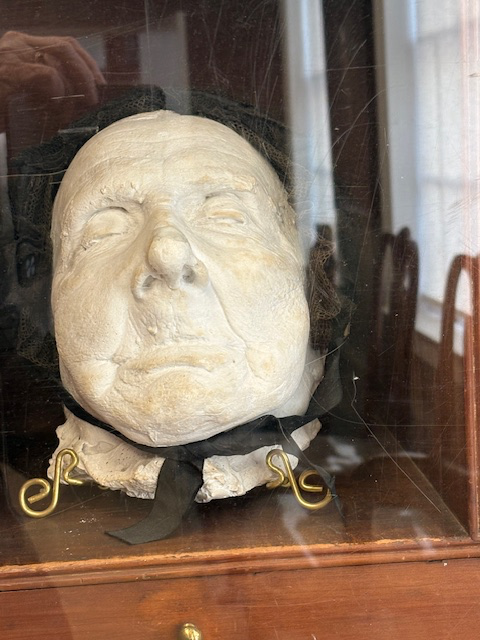
Death Mask
In the Dedham History Museum, is this death mask. An intimate impression of a person’s face taken shortly after death. The practice of creating death masks has a long history. In ancient Egypt, masks were place with the dead, though they were often idealized. In ancient Rome, families preserved wax masks of ancestors as a way to honor lineage […]
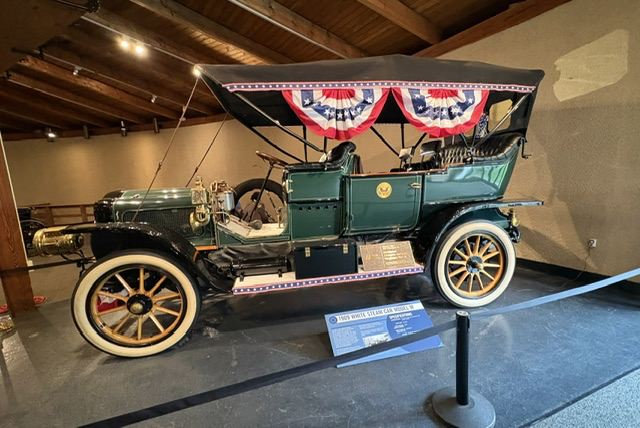
President Taft’s White Steam Car
One of the exhibits I most enjoyed at the Heritage Museums & Gardens in Sandwich was its impressive collection of antique automobiles. While every vehicle tells part of the story of America’s transportation history, this 1909 White Steam Car Model M immediately caught my attention because of its connection to the presidency. I have always […]

