The Stone Church
At the end of Wellington Row, the narrow spire of St. John’s Anglican Church rises above one of Saint John’s oldest surviving places of worship. Commonly called the Stone Church, it has stood on Carleton Street for two centuries, witnessing the city’s growth, its devastating fires, and the many changes that have reshaped the surrounding neighborhood.
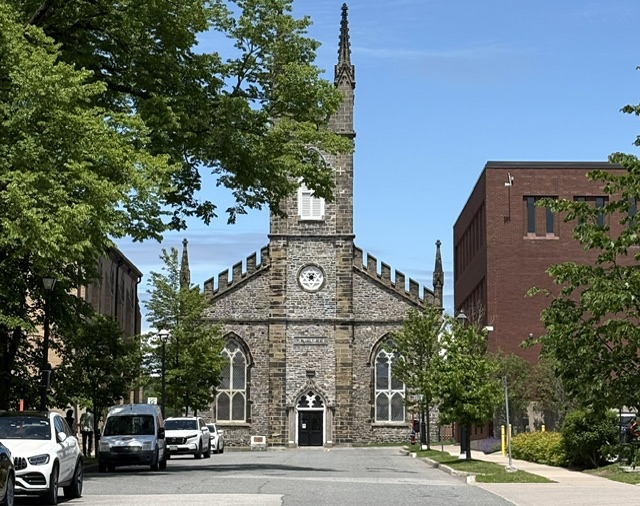
The church grew out of Saint John’s early Anglican community. Trinity Church had served the city since the arrival of the Loyalists, but by the early nineteenth century, Saint John’s population was expanding beyond the original center of settlement. In 1822, the congregation of Trinity approved the construction of a chapel of ease and an additional place of worship intended to serve residents living farther from the parish church, as well as members of the British garrison stationed in the city.
Architect John Cunningham designed the new church in the Gothic Revival style. Construction began in 1823, the first service was held on September 11, 1825, and the building was completed the following year. Its pointed windows, crenellated roofline, narrow pinnacles, and slender central spire recalled the appearance of medieval English churches. These features distinguished it from the classical architecture that remained common in early nineteenth-century North America.
The building’s stone construction gave it the familiar name that has endured for generations. Its sturdy exterior also created a striking contrast with the many wooden buildings that once surrounded it. As Saint John expanded, the Stone Church became a permanent landmark, visible along the steep approach of Wellington Row and closely associated with the city’s growing northern neighborhoods.
When the Great Fire swept through Saint John on June 20, 1877, it destroyed more than 1,600 buildings and left much of the central city in ruins. Numerous churches, businesses, and homes were lost, including the original Trinity Church. The Stone Church survived, preserving an important example of the city as it appeared before the fire and providing continuity for Saint John’s Anglican community during the difficult period that followed.
St. John’s Anglican Church is now recognized as one of the earliest surviving Gothic Revival churches in Canada. It was designated a National Historic Site of Canada in 1989 because of its architectural importance and its place in the development of Gothic Revival church design. Unlike many historic religious buildings that have been converted to other purposes, the Stone Church continues to serve as an active place of worship.
Read More From Nancy
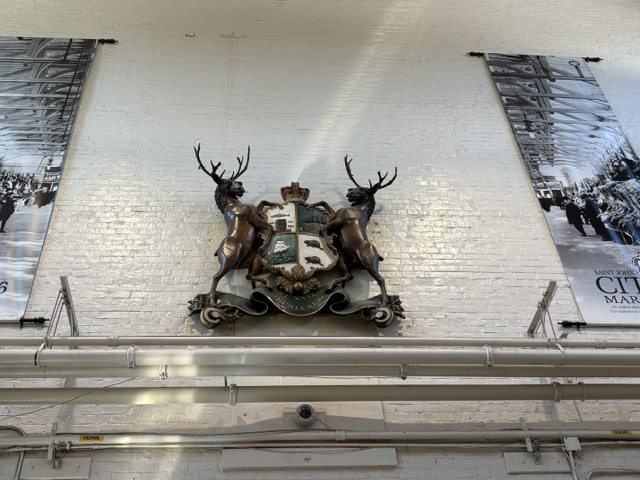
Saint John Coat of Arms
Mounted high upon the wall inside the Saint John City Market is the city’s historic coat of arms. Surrounded by two antlered moose and topped by a crown, the emblem brings together symbols representing the natural resources, maritime industries, and British institutions that shaped Saint John. The shield is divided into sections containing images associated […]
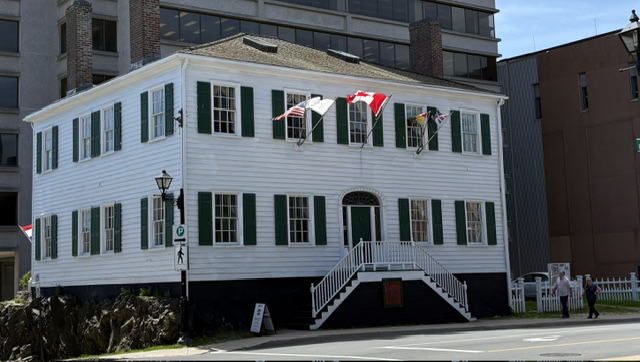
Loyalist House
Surrounded by the larger buildings of modern Saint John, Loyalist House appears almost out of place. Its white wooden walls, green shutters, and balanced rows of windows preserve the appearance of an earlier city and one that largely disappeared in the Great Fire of 1877. The story of the house begins with Thomas and Amy […]
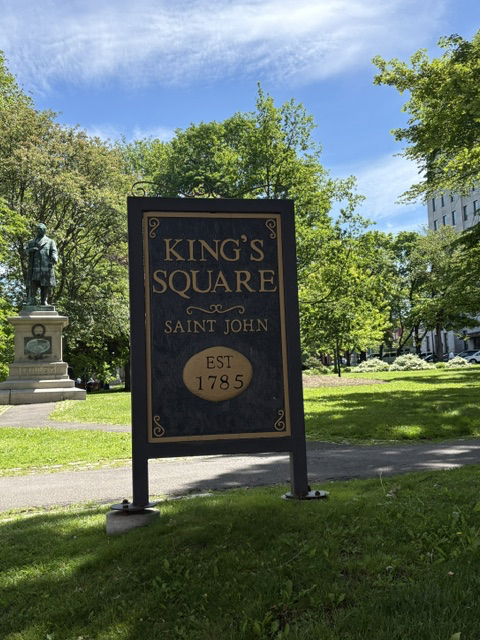
King’s Square
At the center of Uptown Saint John is King’s Square, a public space that has served the city since its earliest years. Named for King George III, the land was granted to Saint John through the royal charter that incorporated the city in 1785. Its history therefore began alongside that of Saint John itself, which […]

