Saint John Coat of Arms
Mounted high upon the wall inside the Saint John City Market is the city’s historic coat of arms. Surrounded by two antlered moose and topped by a crown, the emblem brings together symbols representing the natural resources, maritime industries, and British institutions that shaped Saint John.
The shield is divided into sections containing images associated with the city’s early economy. The sailing ship represents Saint John’s harbor, its connection to international trade, and the shipbuilding industry that became one of the foundations of its nineteenth-century prosperity. The fish refers to the waters of the Bay of Fundy and the importance of fishing, while the trees recall the forests of New Brunswick and the timber trade that supplied both local shipyards and overseas markets.
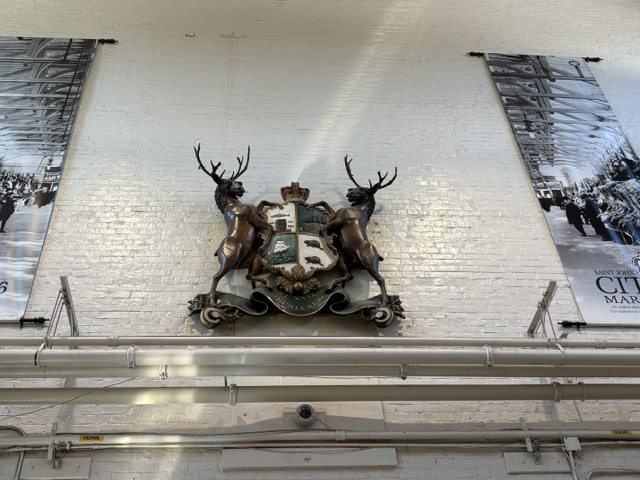
The two moose supporting the shield represent the wildlife and forests of New Brunswick. Above the shield is a crown, reflecting Saint John’s establishment under British authority. The city was incorporated by royal charter in 1785, uniting the settlements of Parrtown and Carleton on opposite sides of the harbor and making Saint John the first incorporated city in what is now Canada.
Beneath the shield appears the Latin motto “O Fortunati Quorum Jam Moenia Surgunt.” Drawn from Virgil’s Aeneid, it is commonly translated as “O fortunate ones, whose walls are now rising.” In the poem, the words are spoken as Aeneas looks upon the construction of a new city. The motto would have carried particular meaning for the Loyalists who arrived after the American Revolution and began constructing a new community at the mouth of the Saint John River.
Its placement inside the City Market is appropriate. Public markets had been part of Saint John since the city received its charter in 1785, and the present market building has served the community since 1876. The coat of arms overlooks a space where the city’s maritime connections, local products, commerce, and civic traditions continue to come together.
Read More From Nancy
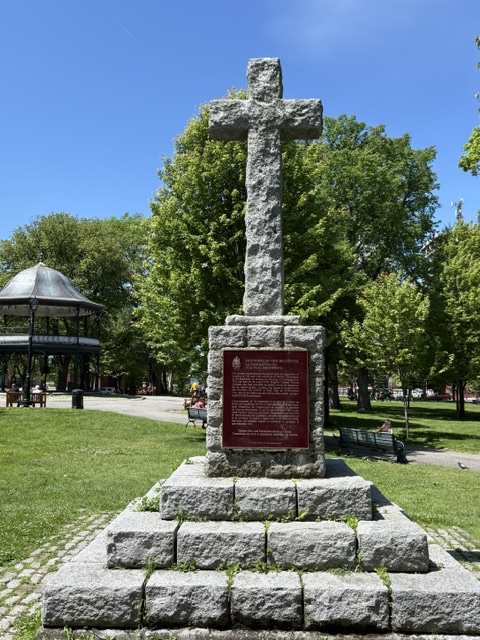
Founding of New Brunswick Monument
A tall granite cross in Saint John’s King’s Square marks the political events that created the Province of New Brunswick. Its story begins with the conclusion of the American Revolution, when thousands of people who had remained loyal to the British Crown left the newly independent United States and traveled north. In 1783, approximately 14,000 […]
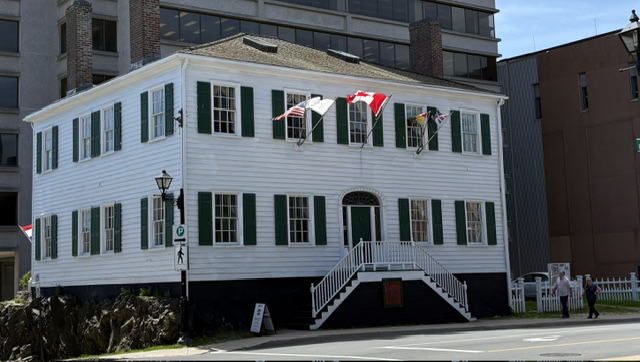
Loyalist House
Surrounded by the larger buildings of modern Saint John, Loyalist House appears almost out of place. Its white wooden walls, green shutters, and balanced rows of windows preserve the appearance of an earlier city and one that largely disappeared in the Great Fire of 1877. The story of the house begins with Thomas and Amy […]

Saint John City Market
One year after the Saint John City Market opened, fire swept through the city. The Great Fire of 1877 destroyed hundreds of acres, leaving much of Saint John in ruins. Yet the new market, protected by its solid brick-and-stone construction, survived. Its exterior therefore represents more than nineteenth-century architecture. It is one of the buildings […]

