Samuel Eliot Morison Memorial
Walking along the Commonwealth Avenue Mall reveals a series of monuments honoring people connected to Boston and the wider world. Among them is a particularly distinctive sculpture of Samuel Eliot Morison. Rather than placing him formally on his feet or astride a horse, sculptor Penelope Jencks portrayed him as a sailor seated on an enormous piece of granite, wearing a windbreaker and captain’s cap, with binoculars resting in his hand.
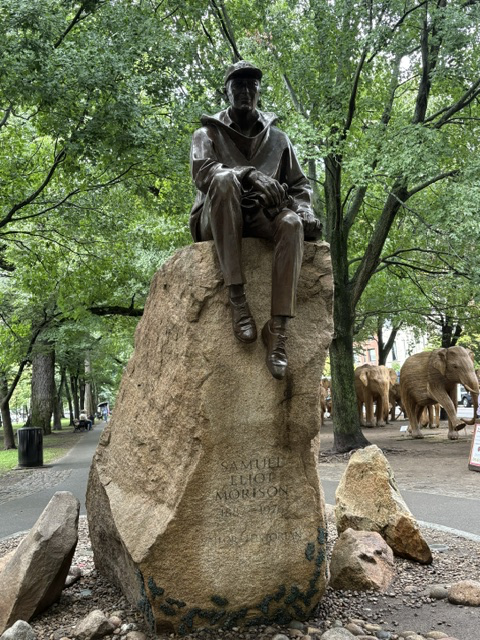
Samuel Eliot Morison was born in Boston in 1887 and grew up in a family with deep New England roots. He attended the Noble and Greenough School before studying at Harvard University, where he earned his undergraduate degree in 1908 and later completed his doctorate. He became a member of the Harvard faculty and taught history there for approximately forty years.
Morison believed that history should be experienced as well as studied. He did not want to write only from documents preserved in libraries and archives. Whenever possible, he traveled the routes, sailed the waters, and visited the places connected to the events he described. His approach gave his writing a sense of movement and immediacy that helped bring the past to life for his readers.
That philosophy was especially important in his research into maritime history. While working on his biography of Christopher Columbus, Morison organized expeditions that followed portions of Columbus’s voyages across the Atlantic and through the Caribbean. He wanted to understand the winds, currents, distances, and challenges faced by the original sailors. The resulting work, Admiral of the Ocean Sea, received the Pulitzer Prize for Biography in 1943.
During World War II, Morison proposed writing a history of United States naval operations from the perspective of someone who had witnessed them. President Franklin D. Roosevelt supported the idea, and Morison received a commission in the United States Naval Reserve. He went to sea aboard naval vessels, observed military operations, interviewed participants, and recorded events while they were still unfolding.
His experiences became the foundation for the fifteen-volume History of United States Naval Operations in World War II. The series combined military history with firsthand observation and reflected his conviction that historians should come as close as possible to the people, places, and conditions they were writing about. Morison eventually achieved the rank of rear admiral and became widely known as both a sailor and a historian.
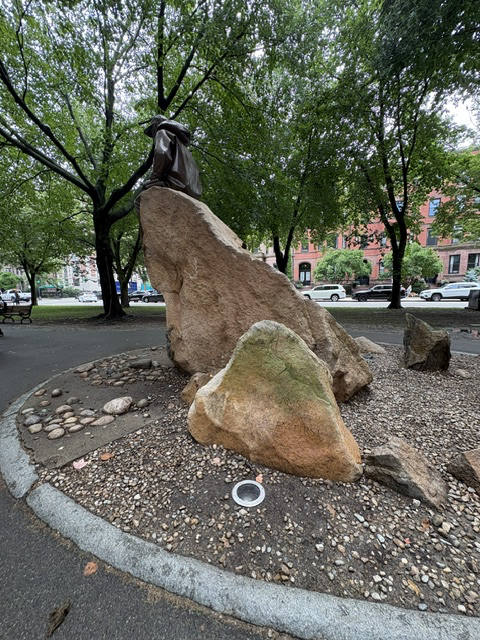
The memorial was created by sculptor Penelope Jencks and installed on the Commonwealth Avenue Mall in 1982, six years after Morison’s death. The bronze figure sits upon a large natural granite boulder, appearing to look beyond the surrounding trees and buildings toward an imagined sea. Around the base are bronze representations of shells, crabs, and starfish, quietly extending the maritime setting into the middle of Boston.
Two inscriptions express the connection between Morison’s life and work. One offers a wish to his readers for a flowing sheet, a fair wind, and a favorable voyage. The other conveys the philosophy that shaped his approach to history: “Dream dreams, then write them—aye but live them first.”
That second inscription explains why the monument feels so different from many of the more formal memorials along Commonwealth Avenue. Morison is not represented primarily as an academic seated behind a desk. He is shown outdoors, dressed for the water, prepared to observe the world for himself. His books grew from scholarship, but they were also informed by experience.
The sculpture honors a man who did not believe history should remain distant or confined to the written page. Samuel Eliot Morison went in search of it, sailing into the places where earlier voyages and more recent battles had occurred. Sitting on his granite outcrop in the center of Boston, he continues to look outward—historian, sailor, and explorer.
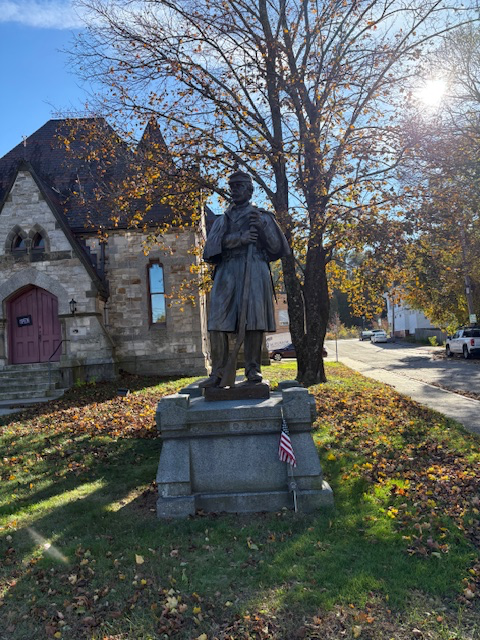
Read More From Nancy
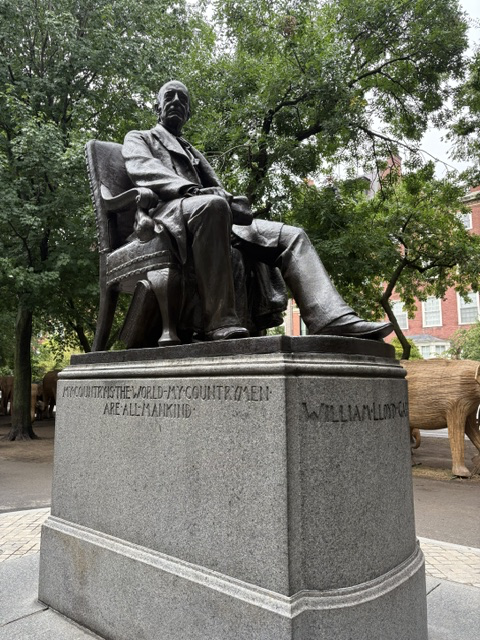
William Lloyd Garrison Memorial
I love walking along Commonwealth Avenue in Boston and stopping at the different sculptures and memorials placed along its tree-lined central mall. Each one introduces another person or event connected with the city’s history. Among them is the seated bronze figure of William Lloyd Garrison, one of the nation’s most influential voices against slavery. Born […]
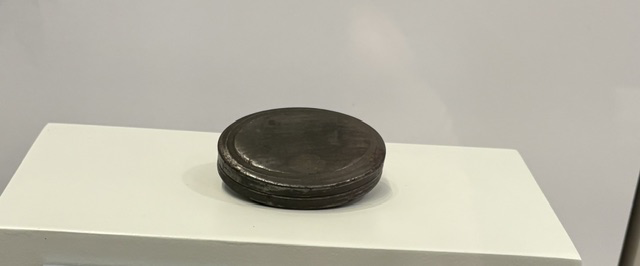
Caleb Harrington’s Tobacco Box
Among the artifacts preserved in Lexington is this small tobacco box, an ordinary object made extraordinary by the events of April 19, 1775. This box belonged to Caleb Harrington, one of the eight militiamen killed by British troops on Lexington Common during the opening moments of the American Revolution. The box was found in his pocket […]
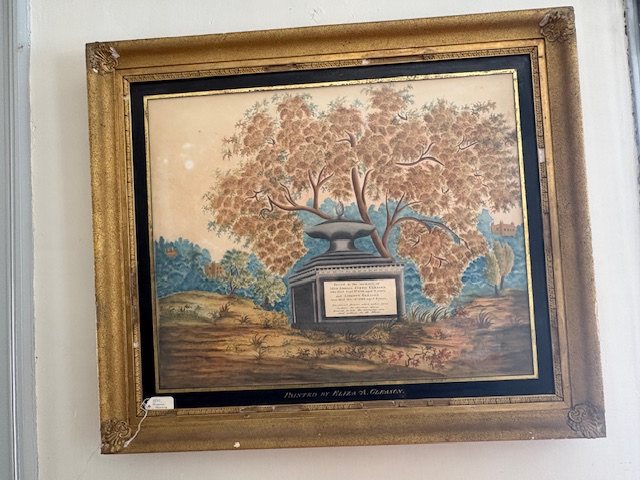
Mourning Painting
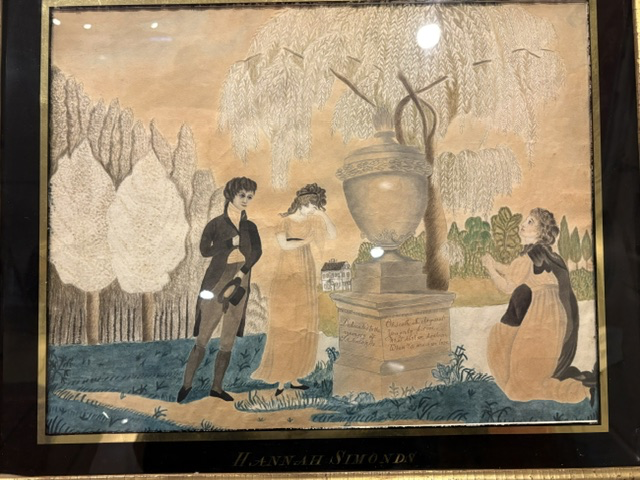
One of the unexpected discoveries during our visit to the Dedham Museum was this small watercolor known as a mourning painting. At first glance, it appears to be a peaceful landscape—a willow tree shading a funerary urn and memorial tablet. Looking more closely, however, it becomes a deeply personal expression of love and loss. The […]

