Caleb Harrington’s Tobacco Box
Among the artifacts preserved in Lexington is this small tobacco box, an ordinary object made extraordinary by the events of April 19, 1775. This box belonged to Caleb Harrington, one of the eight militiamen killed by British troops on Lexington Common during the opening moments of the American Revolution. The box was found in his pocket after he fell.

Caleb Harrington was only twenty-four years old. A fifer in the Lexington militia, he had spent the evening of April 18th playing his instrument at a gathering before responding to the alarm that British regulars were marching toward Concord. At dawn, he stood with Captain John Parker and the other Lexington militiamen on the Common. When the shooting began, Harrington became one of the first Americans to lose his life in the struggle for independence.
This tobacco box was not a weapon or a symbol of military service. It was a personal possession, something Harrington carried with him in his daily life. Its survival provides a poignant reminder that those who stood on Lexington Green were ordinary men—farmers, tradesmen, husbands, brothers, and sons—whose lives were suddenly swept into history.
More than 250 years later, Caleb Harrington’s tobacco box serves as a tangible connection to one of the individuals whose sacrifice marked the beginning of the American Revolution.
Read More
Read More From Nancy
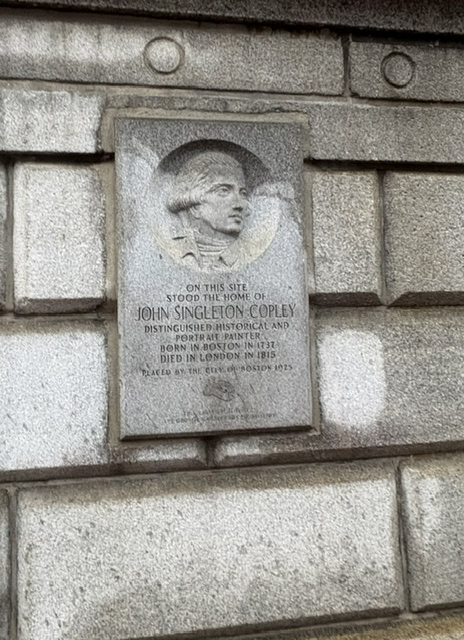
John Singleton Copley
Walking through Boston, I came across this plaque marking the site where the home of John Singleton Copley once stood. The house itself is gone, but the plaque preserves the connection between this location and one of the most important artists of colonial America. Copley was born in Boston in 1738, although the plaque gives […]
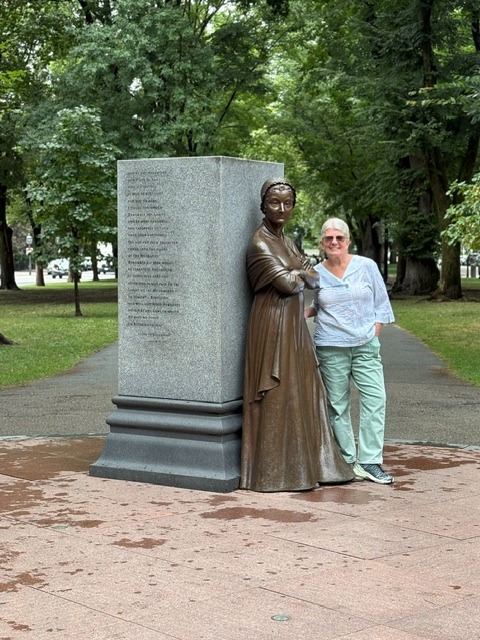
Abigail Adams: Wife of a President, Mother of Another
On Boston’s Commonwealth Avenue Mall, Abigail Adams stands beside a granite pedestal, her arms folded and her expression resolute. Part of the Boston Women’s Memorial, her figure honors a woman whose life connected the American Revolution with two generations of presidential leadership. She was the wife of John Adams, the second president of the United […]

The Canals of Lowell
Walking through downtown Lowell, it is almost impossible not to encounter the canals. They pass beneath streets, alongside sidewalks and between the enormous brick mill buildings that still dominate parts of the city. On this day, we were simply walking through Lowell when we stopped along one of them for this photograph. The canals are […]

