Palmer Memorial Hall
Standing prominently on Woodstock Hill, Palmer Memorial Hall is distinguished by its pale yellow brick, symmetrical design, and tall arched windows. Constructed at a time when most buildings in Woodstock were made of wood or darker brick, its unusual color and Classical Revival architecture made it an immediate landmark within the village.
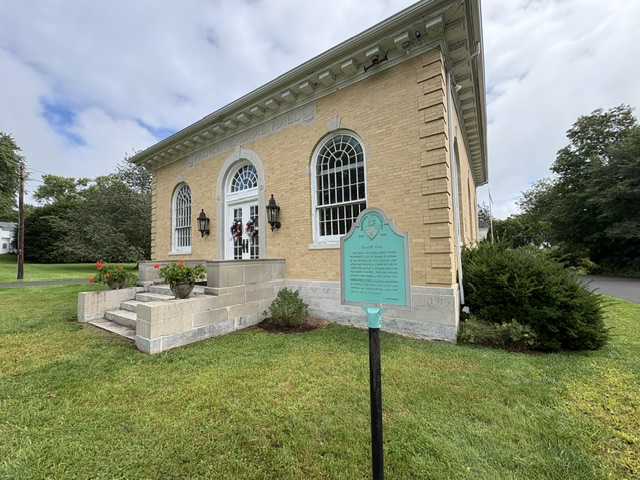
The story of the hall began in 1914, when Minnie Palmer Dean purchased the property as the site of a memorial to her father and grandfather, Samuel and Hezekiah Palmer. She spent approximately $22,000 to construct a building that would honor her family while also serving the people of Woodstock. The cornerstone, visible at the base of the building, is dated 1915, and construction was completed in 1916.
Palmer Memorial Hall was designed as a gathering place for lectures, performances, meetings, and other community activities. Inside, a sloping wooden floor faced a raised presentation area with a backstage space. Two hundred folding chairs could be arranged theater-style, while the large windows filled the room with natural light. The hall opened to the public on May 2, 1916, with an illustrated lecture titled “The Lure of the Colonial New England Period”.
When Minnie Palmer Dean died in 1925, she left the building to the Town of Woodstock. As the town needed more space for its government, Palmer Memorial Hall was adapted to hold municipal offices, public records, meeting rooms, and a secure records vault. Additions and alterations were made over the following decades as Woodstock’s administrative needs increased.
By the late twentieth century, the town had outgrown the building. A new town hall was completed in 1990, and the Palmer Memorial Hall complex was transferred to the Woodstock Historical Society for one dollar. It now serves as the Center for Woodstock History, preserving documents, photographs, artifacts, and other materials connected to the community’s past. The property also provides an entrance to the Palmer Arboretum; another gift associated with the Palmer family.
Our visit offered an opportunity to see how one building has served Woodstock in several different ways. Created as a family memorial, it became a place for public programs, town government, and the preservation of local history. More than a century after its completion, Palmer Memorial Hall continues to fulfill Minnie Palmer Dean’s original purpose by remaining a building dedicated to the community.
Read More From Nancy
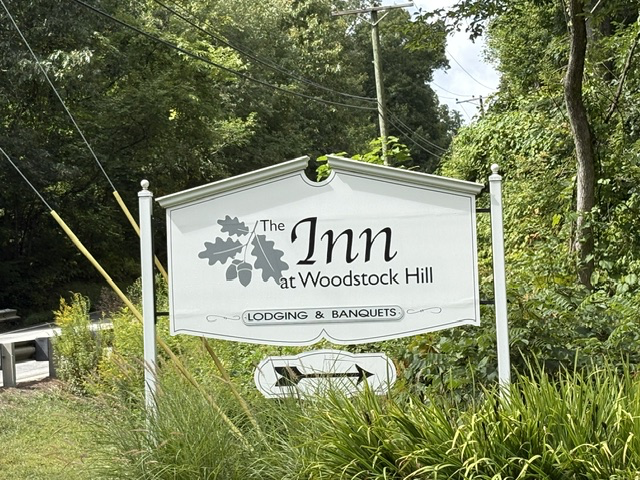
The Matthew Bowen Homestead / The Inn at Woodstock Hill
The house now known as the Inn at Woodstock Hill was constructed in 1816 by William Bowen and later became known as the Matthew Bowen Homestead. Located on Plaine Hill Road, it was part of a working farm owned by generations of the Bowen family, one of Woodstock’s most prominent early families. The original house […]
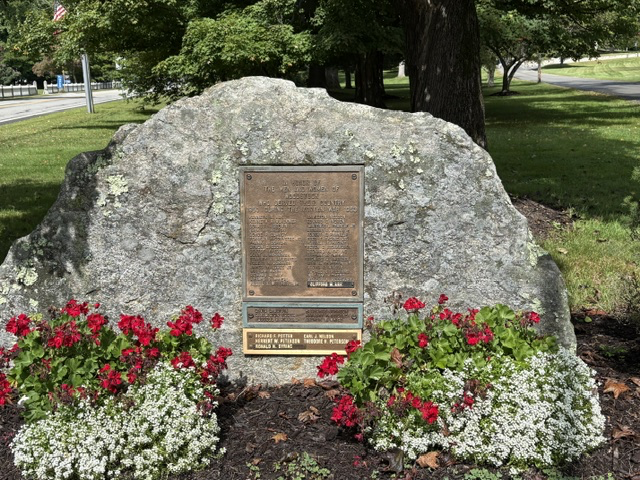
Woodstock Veterans Memorial
At the intersection of Route 169 and Academy Road, a large fieldstone bears the names of Woodstock residents who served their country during the twentieth century. The principal bronze plaque honors the men and women of the town who served during the Second World War from 1941 to 1945. The names represent local people who […]
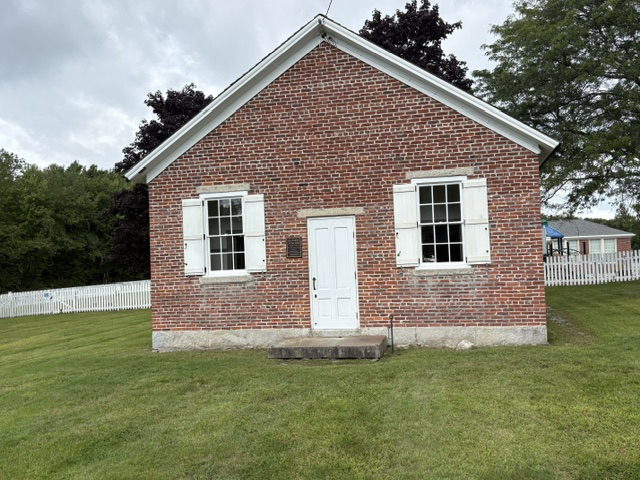
Quasset School
The history of Quasset School began in 1748, when a small district school was established to educate children living in this rural section of Woodstock. The surviving brick schoolhouse was constructed in 1854, replacing an earlier building while continuing a local educational tradition that had already existed for more than a century. Like other district […]

