Fossar de les Moreres
Beside the Basilica of Santa Maria del Mar is the Fossar de les Moreres, a former burial ground that has become one of Barcelona’s most important places of remembrance. The memorial honors those who died defending the city during the final siege of Barcelona in 1714.
The siege occurred during the War of the Spanish Succession, a European conflict that began after King Charles II of Spain died without an heir. Catalonia eventually supported Archduke Charles of Austria against the Bourbon claimant, Philip of Anjou. When Archduke Charles’s allies withdrew from the conflict, Barcelona continued its resistance against Philip’s forces.
After a siege lasting more than a year, Barcelona fell on September 11, 1714. Many of those killed while defending the city were reportedly buried in the parish cemetery beside Santa Maria del Mar. Following the defeat, Philip V abolished Catalonia’s traditional institutions and laws through the Nueva Planta decrees and brought the region under a more centralized Spanish government.
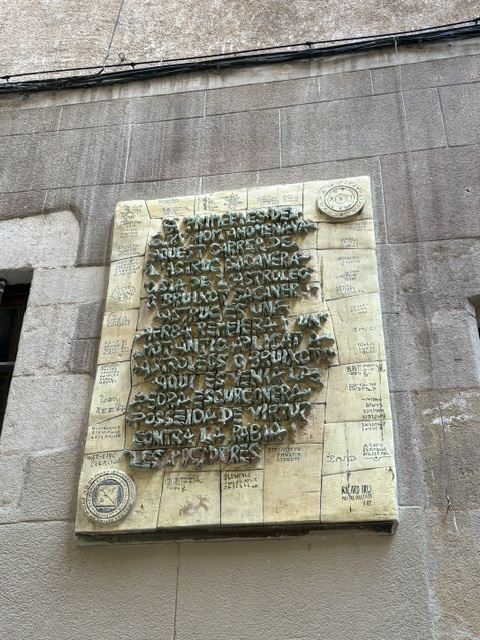
The plaque displays a verse written by Catalan playwright and poet Frederic Soler, who was also known by the name Serafí Pitarra: “At the Fossar de les Moreres no traitor is buried. Even though our flags were lost, it remains an urn of honor.”
The verse transformed the former cemetery into a symbol of sacrifice, loyalty, and the defense of Catalan liberties. A commemorative plaque bearing Soler’s words was first installed during the early twentieth century. It disappeared following the Spanish Civil War and the rise of Francisco Franco’s government, which restricted public expressions of Catalan identity. The inscription was restored in 1977 as Spain began its transition to democracy.
The surrounding square was redesigned as a memorial in 1989. Its red-brick surface symbolizes the blood shed during the siege, while an eternal flame added in 2001 continues to honor those who died. Each September 11, the anniversary of Barcelona’s fall is observed as the National Day of Catalonia, and the Fossar de les Moreres becomes a gathering place for remembrance.
Encountering this memorial revealed a chapter of Barcelona’s history that is still closely connected to the identity of Catalonia. The plaque is more than a marker of an old burial ground. Its survival, disappearance, and restoration reflect the continuing effort to preserve the memory of those who defended the city in 1714.
Read More From Nancy
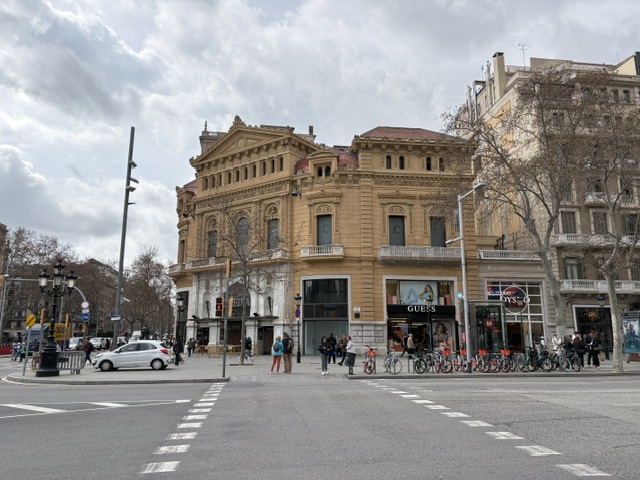
Palau Marcet: From Private Palace to Cinema
While walking through Barcelona, we came across a building whose ornate façade stood out against the activity of the surrounding streets. Tall arched windows, carved decoration, and a triangular pediment gave it the appearance of a grand residence. The Comèdia name above the entrance suggested another purpose. This was Palau Marcet, a private palace that […]
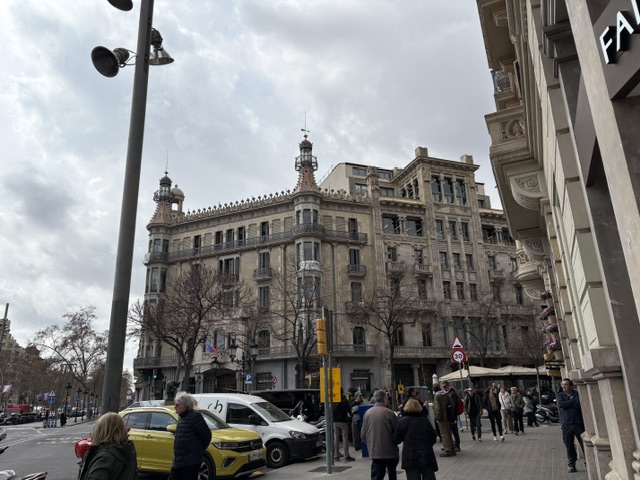
Cases Rocamora
Walking along Passeig de Gràcia, we noticed a building whose slender turrets and reddish roofs gave it an almost castle-like appearance. Rows of balconies stretched along the stone façade, while projecting windows and carved ornament added detail above the busy sidewalk. These were the Cases Rocamora, a group of residences that reflect the ambitions of […]
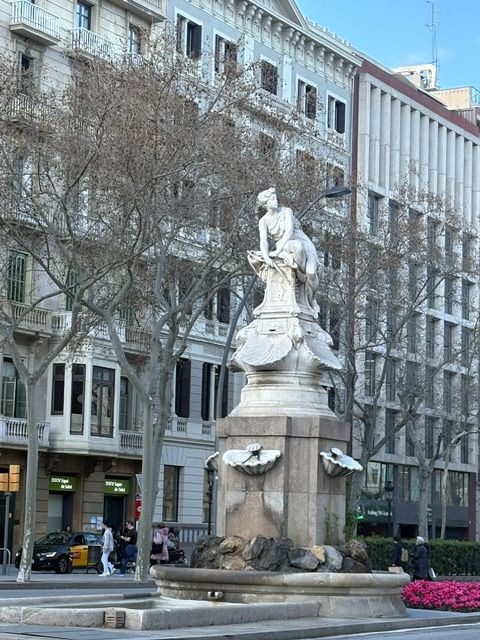
Diana Fountain
At the intersection of Gran Via de les Corts Catalanes and Carrer de Roger de Llúria, the Diana Fountain brings a figure from Roman mythology into Barcelona’s everyday streetscape. Seated above the fountain, the goddess holds the bow that identifies her as Diana, traditionally associated with hunting and the natural world. The sculpture is the […]

