The Washington Kerchief
A printed cotton kerchief preserved at the Needham History Center & Museum carries a bold Revolutionary message. George Washington appears on horseback, surrounded by military imagery and words identifying him as the founder and protector of America’s liberty and independence. An everyday textile became a declaration of political allegiance.
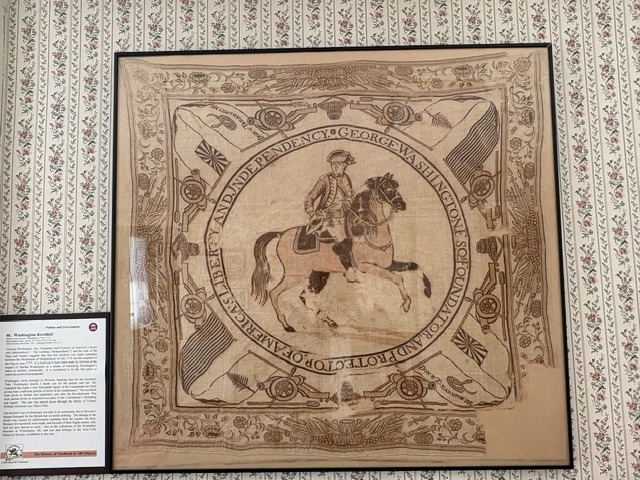
The museum dates the kerchief to about 1776–1777 and attributes it to Philadelphia textile printer John Hewson. Its imagery helped present Washington as a commanding figure at a time when the outcome of the Revolution remained uncertain. According to the museum’s account, Martha Washington encouraged its production to strengthen her husband’s public image.
The design brought political expression into a portable, personal object. Its owner could display support for the American cause through something that could be carried, shown, and eventually preserved as a keepsake.
This particular kerchief descended through the family of Colonel William McIntosh, a Needham resident who served during the Revolutionary War and held numerous public offices. His connection with Washington gives the textile a local significance beyond its patriotic design. In 1911, McIntosh’s descendant Timothy Otis Fuller donated it to the newly established historical society.
Its survival is remarkable. Cotton is vulnerable to wear, and the museum identifies deterioration associated with the dyes used in printing. Preserved through generations, the kerchief connects the public language of the Revolution with one family’s memory of service and friendship. It also shows how political messages circulated through objects long before modern campaign advertising.
Read More From Nancy
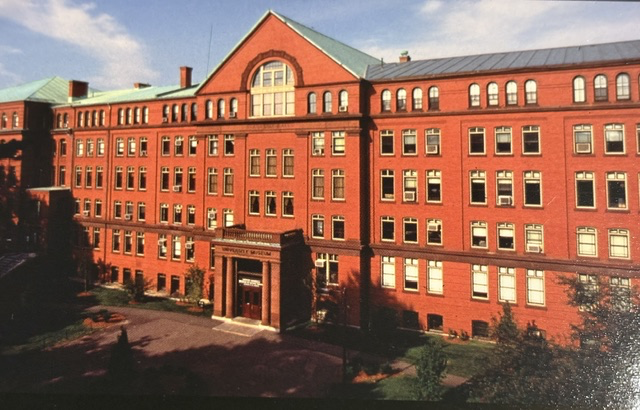
Harvard Museum of Natural History
The Harvard Museum of Natural History is one of those museums I have returned to a few times over the years. Located on the Harvard University campus in Cambridge, it is not simply a collection of natural curiosities. It brings together specimens and objects from Harvard’s enormous scientific collections and provides a public window into […]
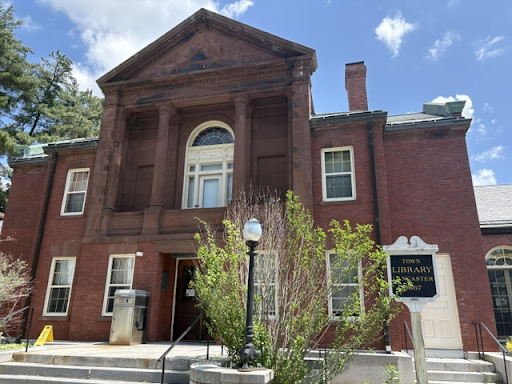
Thayer Library
Another impressive building in the center of Lancaster is the Thayer Memorial Library. During our tour, we learned that the institution’s roots extend far beyond the beautiful structure that stands today. The town’s first library organization, known as the Lancaster Library and later the Lancaster Social Library, was established in 1790. In 1862, residents voted […]
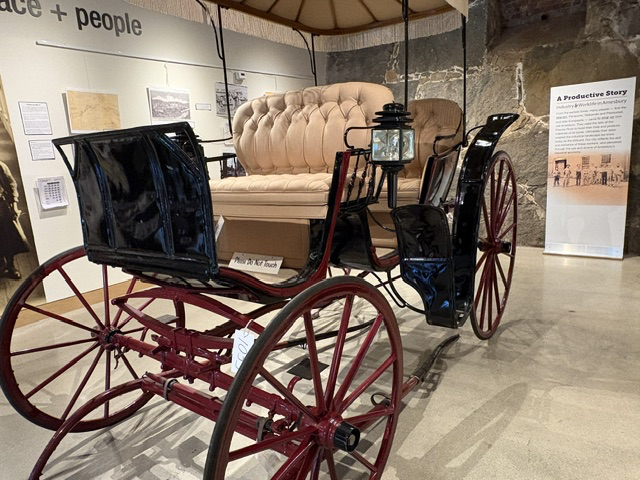
Amesbury Carriage Museum
Every town has a story that shaped its identity. For Amesbury, that story was built on wheels. Long before automobiles transformed the American landscape, Amesbury was recognized around the world as one of the finest centers of carriage manufacturing. During the nineteenth century, the city’s factories produced elegant coaches, family wagons, commercial vehicles, and luxury […]

