The War Memorial
At Market Square on the St. Andrews waterfront, a rough stone arch shelters a granite memorial carved in the shape of an open book. A lantern hangs beneath the arch, while the book’s pages carry the names of people from the community who died in war. Across its base, the words “LEST WE FORGET” state the purpose of this small public place of remembrance.
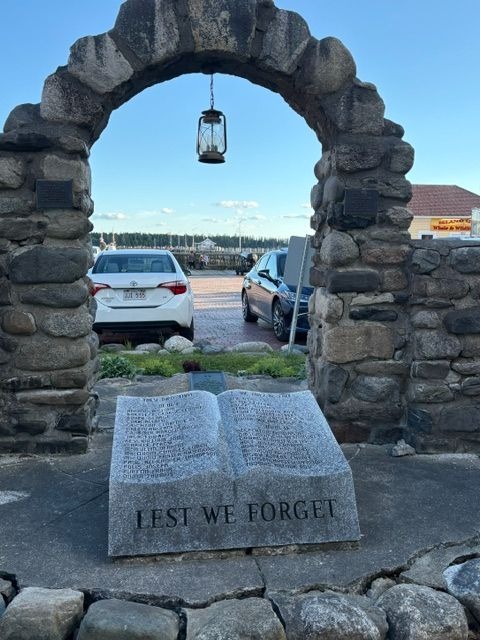
Erected by the town and the families of veterans, the memorial honours the local dead of the First World War, Second World War and Korean War. Its inscriptions connect these international conflicts to the families and neighbourhoods of St. Andrews and the surrounding district. The names give individual form to losses that might otherwise be understood only through distant battles and national statistics.
The memorial brings several forms of commemoration together. A bronze plaque mounted on a rounded stone remembers those who died in the Great War of 1914–1918. Additional plaques commemorate the Second World War and Korean conflict. The open book places the names at a height where visitors can approach and read them, while the irregular stones of the arch create an enclosing frame around the central monument.
The site also remains a gathering place for remembrance. During local Remembrance Day observances, participants lay wreaths and poppies at the cenotaph. For some families, these ceremonies carry memories of relatives who served, including veterans who returned with lasting injuries. At the centre of town, the memorial gives those personal histories a shared public setting, where successive generations can continue to remember the people behind the names.
Read More
Read More From Nancy
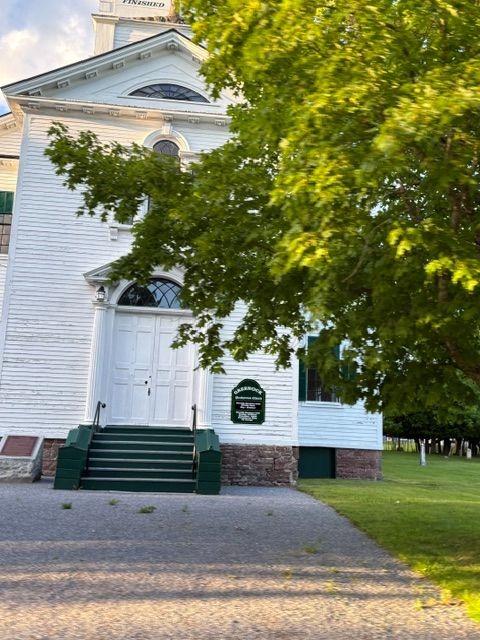
Greenock Presbyterian Church
On Montague Street in St. Andrews, Greenock Presbyterian Church preserves a connection between the town’s early religious life and its Scottish heritage. Built between 1821 and 1824 by local builder Donald D. Morrison, the wooden church combines the straightforward form of an American meetinghouse with the classical details of British Palladian architecture. Its entrance, arched […]
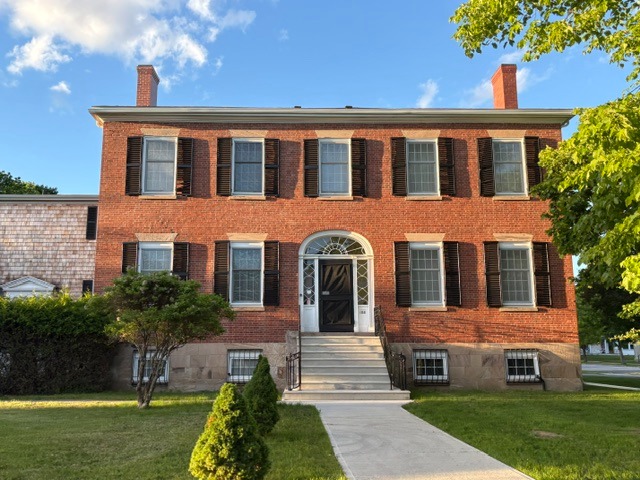
Chestnut Hall and the Ross Memorial Museum
Built in 1824, Chestnut Hall has served as a private residence, a center for regional crafts, and a museum. The red-brick house on Montague Street was constructed for Harris Hatch, an attorney and prominent Charlotte County resident. Its symmetrical windows, dark shutters, and central entrance reflect its classical design. A patterned fanlight and sidelights surround […]
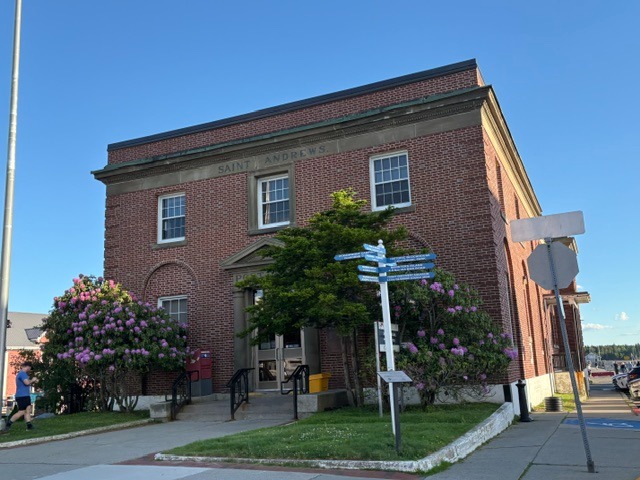
The Post Office and Customs Building
Overlooking Market Square near the waterfront, the St. Andrews Federal Building was constructed in 1936 to accommodate the town’s post office and customs services. Bringing these functions together placed two important connections with the wider world under one roof: the movement of correspondence and the regulation of goods entering the country. Its prominent location made […]

