The Peake-Carvell Building
While walking near the Charlottetown waterfront, we passed this large brick building at the corner of Queen and Water Streets. Today, part of it is occupied by Merchantman Fresh Seafood & Oyster Bar, but the name “Carvell” still visible on the building hints at a much older story. It turns out that this building is a survivor from the period when Charlottetown’s economy revolved around ships, wharves, merchants and the harbor.
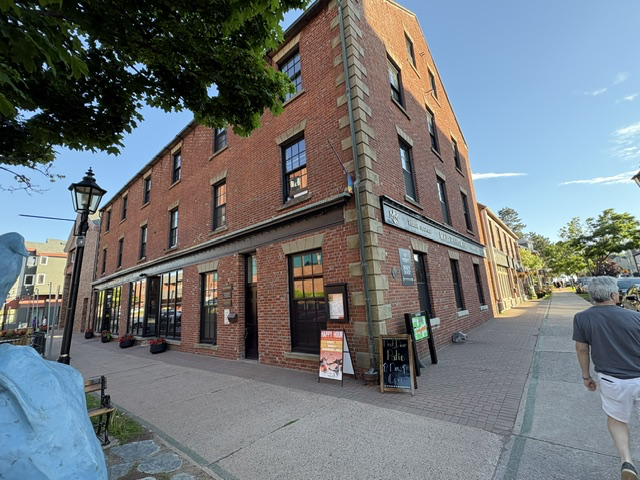
Known as the Peake-Carvell Building, it was constructed in 1856–1857 for James Ellis Peake, one of the most successful businessmen in 19th-century Prince Edward Island. Peake had arrived from Plymouth, England, in 1823 and built a remarkable career as a merchant, shipbuilder, ship owner, banker and politician.
Its location was no accident. Just down the street stood the Peake family home, while nearby was one of the family’s wharves. From this part of Charlottetown, ships carried Island products to markets elsewhere in Canada, Britain and the United States. During the age of sail, this waterfront was not simply a scenic edge of the city but also one of the places where Charlottetown made its living.
The building itself was divided into three commercial sections. Early tenants included merchants selling such goods as flour, tobacco, rope, leather and molasses. Another section housed the Bank of Prince Edward Island, then the Island’s only bank. Peake himself served on the bank’s board of directors.
By 1862, the Carvell Brothers occupied two-thirds of the building. Their company became an important Charlottetown wholesale business, exporting primarily oats to England while also working as merchants, shipping agents and auctioneers. Eventually the Carvells occupied the entire building, and in 1912 they purchased it from the Peake estate. Remarkably, their business continued operating here until 1976.
James Ellis Peake’s oldest son, James Peake, followed the family into the maritime business. He and his wife Edith later built Beaconsfield, the magnificent 1877 mansion overlooking the water that we visited elsewhere in Charlottetown. The prosperity represented by Beaconsfield had its roots in the maritime world represented by buildings like this one. When wooden shipbuilding declined, the younger James Peake’s fortunes declined with it, eventually forcing him to give up Beaconsfield.
The Peake-Carvell Building represents the business side of Charlottetown’s great age of sail—the merchants, warehouses, banks, wharves and ships that generated wealth along the waterfront. Beaconsfield shows us what some of that prosperity could create when it followed a successful merchant family home.
Today the Peake-Carvell Building has restaurants and other commercial tenants rather than shipping agents and wholesale merchants. But its brick walls have remained at the corner of Queen and Water Streets since the 1850s, a surviving piece of the Charlottetown waterfront from a time when the harbor in front of it connected Prince Edward Island with the wider world.
Read More From Nancy
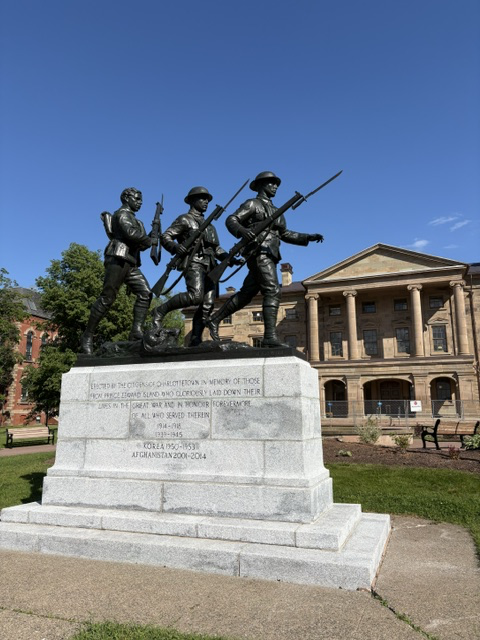
Veterans Memorial
While walking through Charlottetown, we came across this striking monument showing three soldiers moving forward together. With Province House immediately behind it, the memorial sits among the buildings and streets where so much of Prince Edward Island’s political history has unfolded. The monument was originally erected in memory of Prince Edward Islanders who served and […]
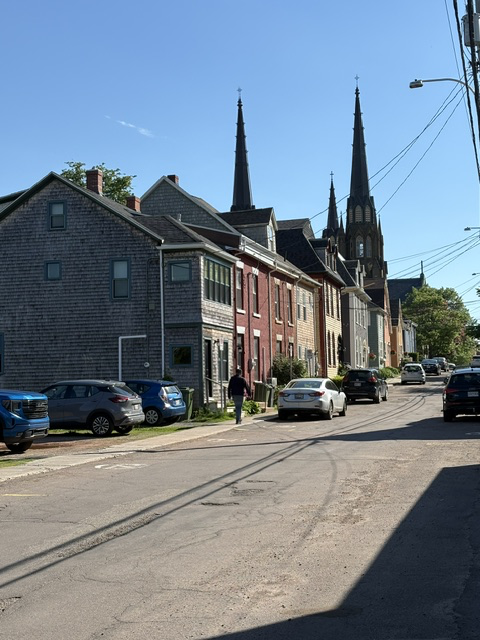
St. Dunstan’s Basilica
Walking through Charlottetown, I could see the twin spires of St. Dunstan’s Basilica rising above the houses long before I reached the church itself. In my photograph, they seem almost to emerge from the neighborhood, towering over the smaller buildings along the street. At approximately 200 feet high, they remain among the highest points on Charlottetown’s skyline. […]
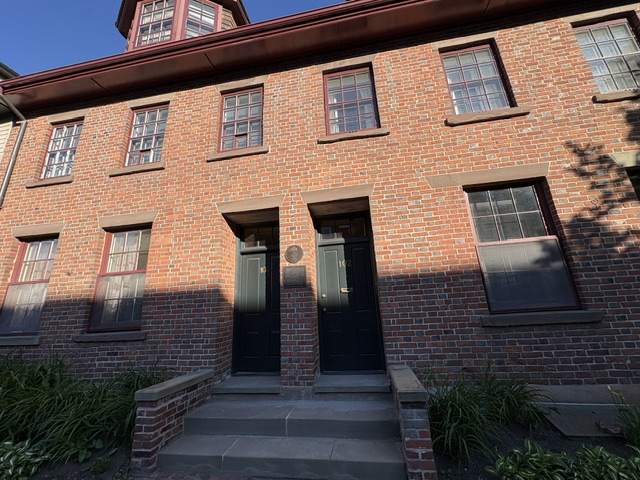
The Gainsford House
While walking along Water Street in Charlottetown, I photographed this substantial brick house without realizing just how old it was. Built between 1832 and 1834, the Gainsford House is the oldest surviving brick residence in Charlottetown and one of the city’s important links to its early 19th-century past. John and Elizabeth Gainsford built the house […]

