The Henri Prunaret History Room
Living in Natick, I have passed through the Morse Institute Library many times, but there are details inside the building that connect directly to the history of the town. One of them is this beautiful entrance to the Henri Prunaret History Room, framed by old brickwork, Gothic arches, and colorful stained glass.
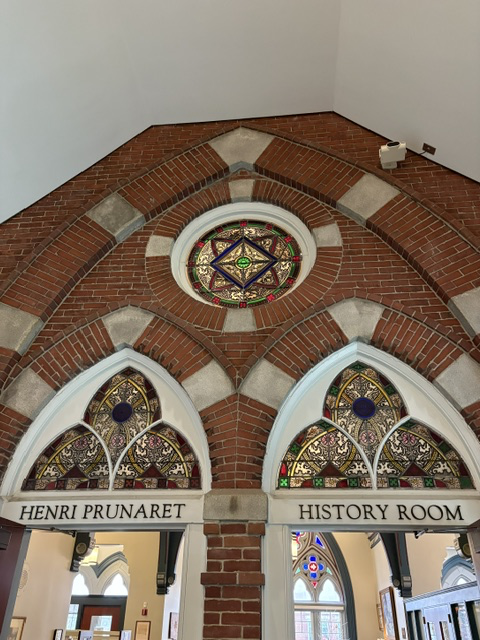
The Morse Institute traces its beginnings to Mary Ann Morse, a Natick resident who died in 1862 and left her estate to the town for the creation of a public library. After the legal and financial issues surrounding her bequest were resolved, the Morse Institute was dedicated on Christmas Day in 1873 and opened with approximately 7,300 books. The original building was constructed of brick with granite Gothic detailing and included black walnut and ash woodwork and elaborate stained-glass windows.
The history of libraries in Natick reaches even further back. Mary Ann Morse’s grandfather, Samuel Morse, maintained a small circulating library of about 100 volumes in his home in the early nineteenth century. The bookcase that once held those books survived and is preserved as part of the library’s historical collection.
The room in my photograph is named for Henri Prunaret, a local historian and preservationist who worked to document and preserve Natick’s historic resources. Naming the History Room for him seems particularly appropriate, as the room continues that work by providing a place where the history of Natick can be researched and remembered.
One of the most beautiful features of the History Room is the stained glass surrounding its entrance. Set within pointed Gothic arches of red brick and contrasting stone, the windows reflect the Gothic character of the original 1873 Morse Institute. The intricate floral and geometric patterns, along with the small circular stained-glass window above the doors, are reminders of the craftsmanship incorporated into a public library more than 150 years ago.
I particularly like that the old entrance and windows have survived. They are more than decoration; they are part of the history of the library itself. There is something especially fitting about entering a room devoted to preserving Natick’s history through a doorway framed by a surviving piece of the library’s own past.
The Morse Institute is a good example of the history that can be found in familiar places. We don’t always have to travel to a historic house or museum to discover it. Sometimes it is right in the center of our own town, preserved in an old brick arch, a stained-glass window, or a room in the local library that we may have walked past many times.
Read More From Nancy
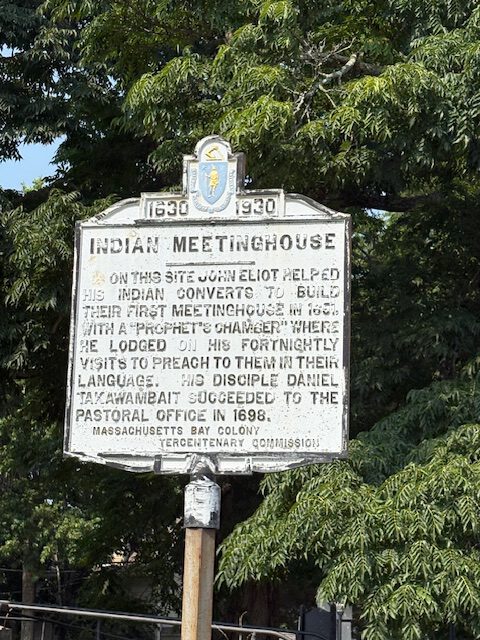
Natick: The First Praying Indian Town
In 1651, missionary Rev. John Eliot established Natick as the first of the “Praying Indian” towns in Massachusetts. He named the town after the Natick American word Natick, translated as a place of hills or a place of searching. He worked closely with local Massachusett and Nipmic people, teaching them Christianity in their native tongue and translating the Bible […]
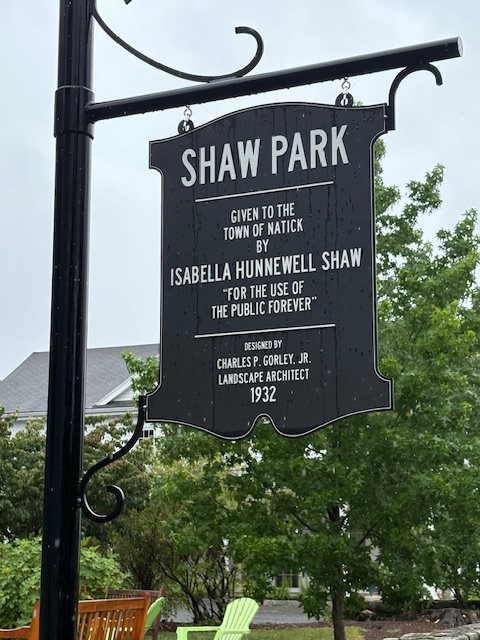
Shaw Park
Shaw Park, located in South Natick, is not a grand park in the monumental sense. Yet, it is a space with a profound sense of intention as captured in the words that accompanied its gift to the town of Natick: “For the use of the Public Forever” These words were written by Isabella Hunnewell Shaw. […]
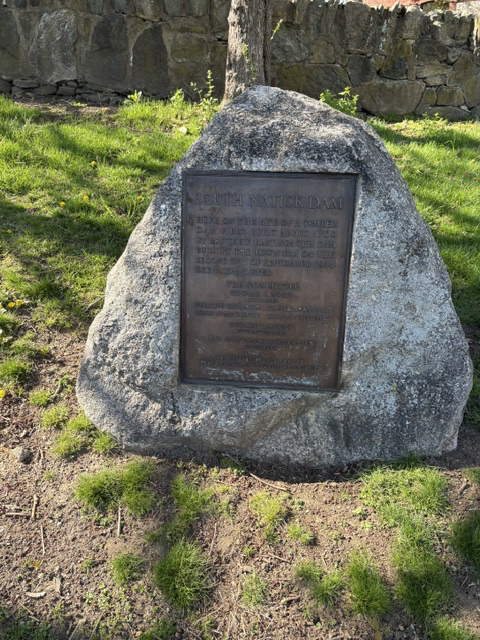
The South Natick Dam
Historic places do not always disappear because they are forgotten. Sometimes they disappear because communities decide how to balance preserving the past with meeting the needs of the future. The South Natick Dam, which has stood on the Charles River for well over a century, is one of those places. Constructed during the nineteenth century, […]

