The First Parish Church of Canton
The white meetinghouse of First Parish Unitarian Universalist Church has stood along Washington Street for two centuries, but the congregation it serves is even older. First Parish was formally gathered in 1717, when Canton was still part of the larger town of Stoughton. Like many early New England religious societies, the parish was closely connected to the civic life of the community as well as its spiritual life.
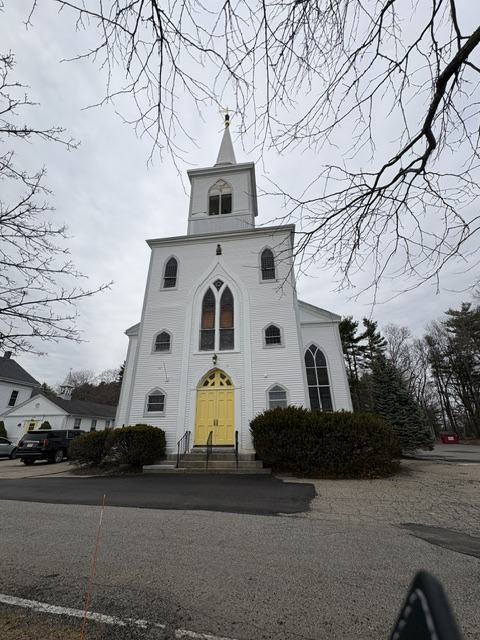
The present sanctuary was completed and dedicated in 1825. Its tall tower pointed Gothic-style windows, and bright yellow doors make it one of the most recognizable historic buildings in Canton. The structure has changed over time as the needs of the congregation evolved. A parish hall was added in 1878, followed by a chapel, offices, and classrooms during the twentieth century.
Inside the tower hangs a bell cast in 1821 by the Revere foundry in Canton. Although Paul Revere had died in 1818, his son Joseph Warren Revere continued the family’s metalworking businesses. The bell connects this religious landmark with Canton’s larger industrial history and with the Revere family’s copper, brass, cannon, and bell-making operation
The church was constructed during a period of theological change throughout New England. In 1828, only three years after the new meetinghouse was completed, the congregation voted to become Unitarian. Members who wished to retain traditional Trinitarian beliefs withdrew and organized an Orthodox Congregational church. This division reflected a much broader transformation taking place in old New England congregations during the early nineteenth century.
Canton also developed a Universalist congregation, whose roots reached back to a series of meetings held in 1806. The Unitarian and Universalist congregations followed separate paths for many years before eventually coming together. Today’s First Parish Unitarian Universalist Church represents the combined inheritance of two of Canton’s oldest religious traditions
The building’s appearance also records its long history. Its narrow-pointed windows and decorative central window evoke the Gothic Revival style that became popular for American churches during the nineteenth century. Above the entrance is a pineapple, traditionally used as a symbol of welcome and hospitality. The tower and steeple have been restored using historic photographs to recover the graceful form associated with the 1825 meetinghouse.
We were looking at a building that connects the colonial origins of the congregation, the theological changes of the nineteenth century, the industrial legacy of the Revere family, and the continuing life of the town. Its yellow doors still open into a sanctuary created for Canton residents two hundred years ago, making First Parish both a historic landmark and a living part of the community.
Read More From Nancy
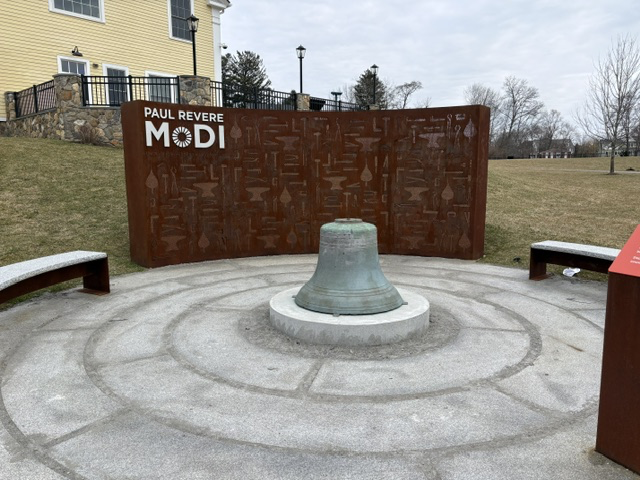
Paul Revere MODI Bell Installation
In Canton, this memorial connects directly to one of the lesser-known parts of Paul Revere’s life. Most people remember Revere for his famous midnight ride during the American Revolution, but later in life he became an important industrialist and manufacturer. Canton was where he established his copper rolling mill and bell foundry in the early 1800s, industries […]
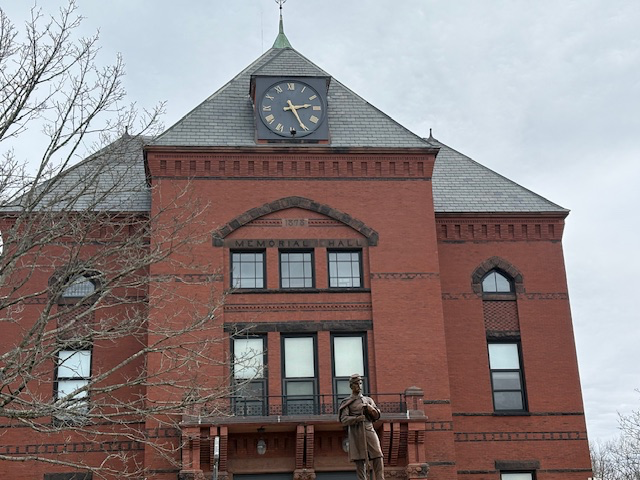
1878 Memorial Hall
Memorial Hall in Canton, dated 1878, was built as a lasting tribute to the town’s Civil War veterans. Like many Massachusetts towns, Canton sent men to serve in the war, and the hall stood as a public expression of remembrance for those who fought and for those who never came home. Rather than creating only a […]
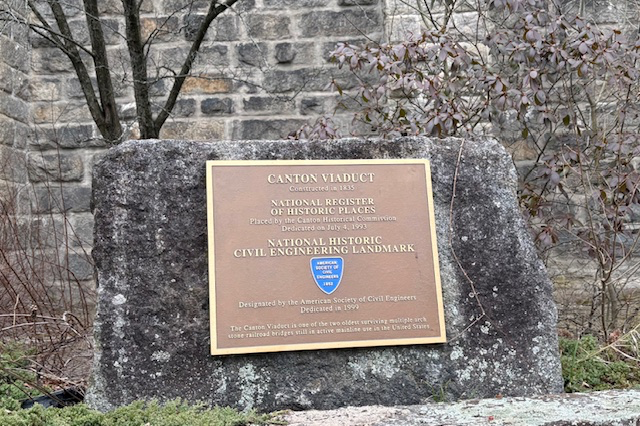
Canton Viaduct
Taking the time to explore a small town often leads to unexpected discoveries. That was certainly true on a drive through Canton. When I read that Canton Viaduct was once the largest railroad viaduct in the world, I knew I wanted to see it for myself. It is quite remarkable that in this quiet New […]

