The Assembly Room at Independence Hall
Inside Independence Hall, green-covered tables and wooden chairs mark the setting where delegates debated two defining documents of American history: the Declaration of Independence and the United States Constitution. The Assembly Room began as a meeting place for Pennsylvania’s colonial legislature before becoming a center of revolutionary government.
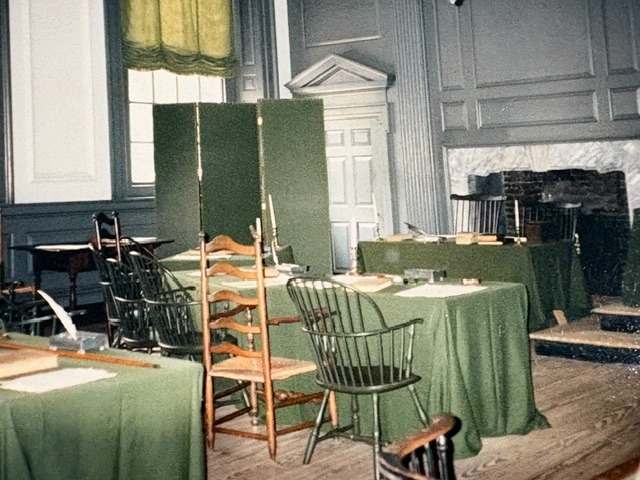
In 1775, the Second Continental Congress gathered here as armed conflict with Britain developed into a struggle over independence. Among its decisions was the appointment of George Washington as commander in chief of the Continental Army.
On July 4, 1776, Congress approved the Declaration of Independence in this room. Its assertion that all people possessed inherent rights offered a powerful statement of principle, even as slavery and restrictions on political participation exposed the distance between those ideals and American life.
Eleven years later, delegates returned for the Constitutional Convention. Meeting through the summer of 1787, they debated representation, executive authority, and the relationship between the states and a national government. Their compromises produced a new framework of government, while also protecting slavery within that framework.
Washington presided over the convention from the chair now known as the Rising Sun chair. Its carved sun prompted Benjamin Franklin to reflect on the uncertainty of the proceedings. At the convention’s conclusion, he expressed his confidence that the sun was rising.
The room’s present furnishings recreate its eighteenth-century working appearance. Most are representative period pieces; the presiding officer’s chair is an original survivor.
The Assembly Room preserves the place where independence and government took written form through argument, negotiation, and consequential choices. The principles expressed here became part of the nation’s continuing struggle over liberty and citizenship.
Read More From Nancy
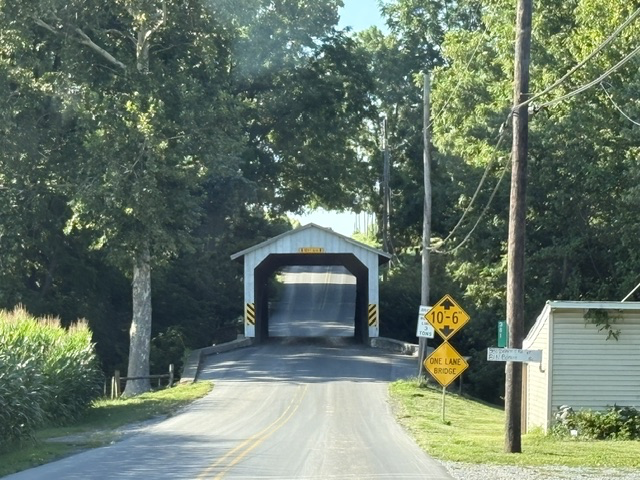
Leaman’s Place Covered Bridge
Leaman’s Place Covered Bridge carries a narrow country road across Pequea Creek in Lancaster County, Pennsylvania. Officially designated Pequea Bridge No. 4, it is also known as Eshelman’s Mill Covered Bridge and Paradise Bridge. Its location near farmland and small rural communities reflects the transportation network that once connected farms, mills and markets throughout the […]
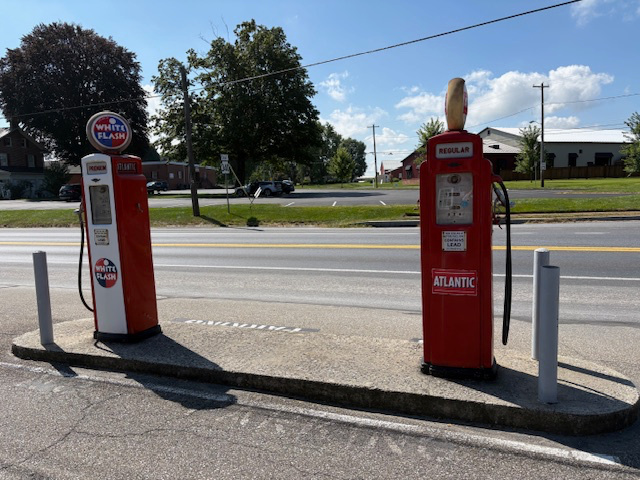
Leaded Gasoline
Curiosity is what drives exploration and it’s the spark that makes me stop, look around, and ask questions. If you’ve ever wondered about something as ordinary as the leaded gas pump, you’re touching on a fascinating (and troubling) piece of 20th-century history. In 1921, General Motors discovered adding lead to gasoline eliminated “knocking” and by […]
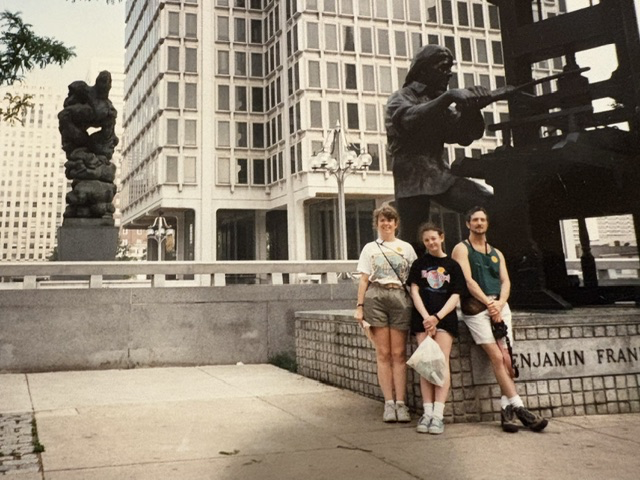
Benjamin Franklin, Craftsman
I like to think of Benjamin Franklin as a Bostonian. He was born in Boston in 1706, attended Boston Latin School and learned the printing trade in his brother’s shop. Yet it was Philadelphia, the city to which he moved as a young man, that became his adopted home and the place where he is […]

