Edward A. Filene Plague
Walking along the fence surrounding the Boston Common, I came across this bronze plaque honoring Edward A. Filene. While many people recognize the Filene name from the famous Boston department store, few realize the tremendous influence he had beyond retail. Filene believed that ordinary working families deserved access to affordable credit and financial opportunity. His vision and financial support helped establish the credit union movement in the United States, forever changing the way millions of Americans save and borrow money.
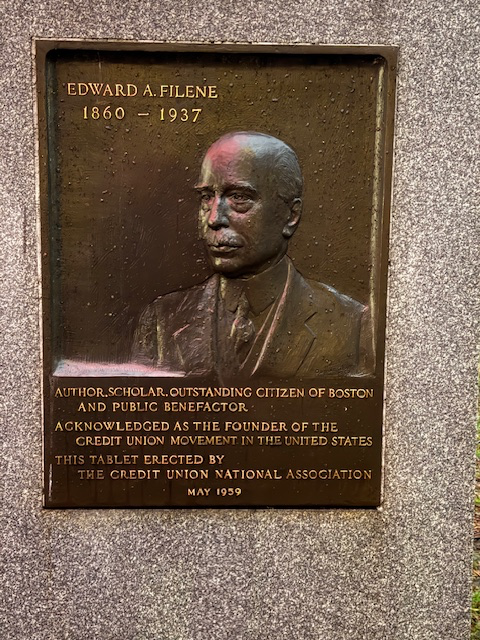
This memorial held a special significance for me. When I was eighteen years old, I worked at the original Filene’s Basement in downtown Boston as part of a business internship. Long before discount retailing became commonplace, Filene’s Basement was famous for its “automatic markdown” system, where prices were reduced according to a fixed schedule until the merchandise sold. It was an exciting place to learn about merchandising, customer service, and the fast-paced world of retail. At the time, I knew the Filene name as a successful Boston business. Only years later did I come to appreciate the remarkable legacy of the man behind it.
Born in Salem, Massachusetts, in 1860, Edward Filene transformed his family’s department store into one of the country’s most innovative retailers. He championed fair treatment of employees, encouraged education and civic responsibility, and believed that business success carried with it an obligation to improve society. His philanthropy supported education, scientific research, public health, and countless civic projects throughout Boston and beyond.
Standing before this plaque, I found myself reflecting on an unexpected connection between my own life and Boston’s history. What began as a summer internship at Filene’s Basement became, many years later, a reminder that the people whose names appear on buildings and memorials often leave a legacy far greater than the businesses they founded. Edward Filene’s greatest achievement was not simply creating a successful department store. It was helping create opportunities that allowed ordinary people to build stronger financial futures, a legacy that continues to benefit communities today.

Read More From Nancy
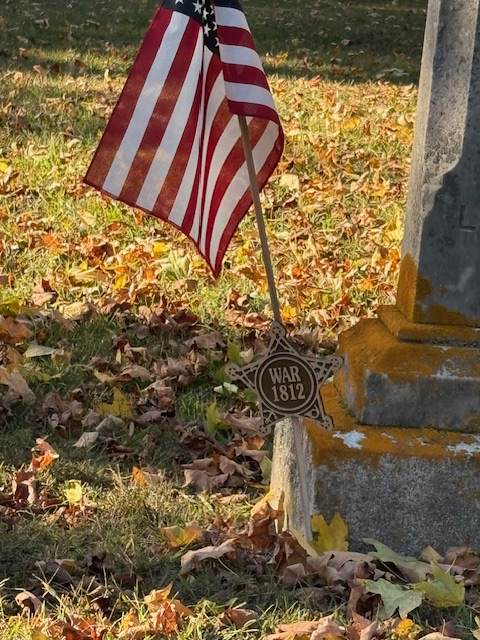
Star of War of 1812
Walking through a local cemetery, I noticed something that made me pause: a five-pointed metal star planted beside a grave holding an American flag. Cast into its surface are the words: War of 1812 I have come to recognize the familiar markers for Revolutionary War patriots and Civil War soldiers. Those appear often in New England cemeteries. But […]
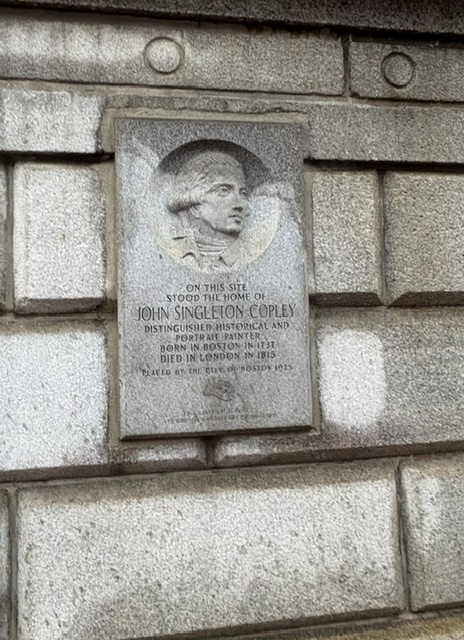
John Singleton Copley
Walking through Boston, I came across this plaque marking the site where the home of John Singleton Copley once stood. The house itself is gone, but the plaque preserves the connection between this location and one of the most important artists of colonial America. Copley was born in Boston in 1738, although the plaque gives […]

Bell System Icon
Walking through Wellesley, with my eyes turned to the ground, I took a moment to notice the iron cover in the sidewalk labeled: “Bell System”, this little iron circle tells a story of a different kind of infrastructure, one that once revolutionized the world. The Bell System was more than just a telephone company it was a […]

