Sir Louis Henry Davies
While walking through Charlottetown, I noticed this plaque commemorating Sir Louis Henry Davies. I didn’t know who he was, but the positions listed beneath his name caught my attention. Here was a man from Prince Edward Island whose career eventually took him to some of the highest offices in Canada.
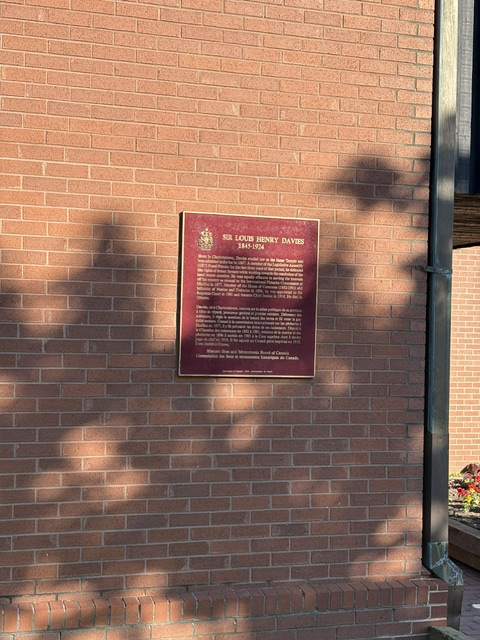
Louis Henry Davies was born in Charlottetown in 1845. His father, Benjamin Davies, was a merchant and shipowner, placing the family within the maritime and commercial world that was so important to 19th-century Charlottetown. Louis studied law, was called to the Prince Edward Island bar in 1866, and soon became involved in both law and politics. His rise was remarkably quick. In 1872, at only twenty-seven, Davies was elected to the Prince Edward Island Legislative Assembly. Four years later, he became Premier of Prince Edward Island, serving from 1876 until 1879.
One of the major issues confronting his government was education. Prince Edward Island, like other parts of Canada, was struggling with questions surrounding publicly funded schools and religious education. Davies helped establish a system of nonsectarian public schools on the Island, an important and, at the time, controversial political achievement.
After provincial politics, Davies moved onto the national stage. He was elected to the House of Commons in 1882 and would represent Prince Edward Island in Ottawa for nearly two decades. When Wilfrid Laurier became prime minister in 1896, Davies entered his cabinet as Minister of Marine and Fisheries. That position placed this man from a small maritime province in the middle of issues involving Canada’s fisheries, shipping and international relations. It also led to one of the most fascinating episodes of his career.
In 1903, Davies was selected as one of Canada’s representatives on the tribunal established to settle the Alaska Boundary dispute. The exact boundary between Alaska and Canada had become increasingly important after the Klondike Gold Rush because Canada wanted reliable access from the Yukon to Pacific ports. The dispute involved Canada, the United States and Britain because Canada still did not have complete control over its own foreign affairs. The tribunal consisted of three Americans, two Canadians—including Davies and one British representative, Lord Alverstone.
The final decision largely favored the American position. Alverstone sided with the Americans on several of the critical questions, leaving the two Canadian commissioners opposed to the result. Davies and fellow Canadian commissioner Allen Bristol Aylesworth refused to sign the tribunal’s decision.
For many Canadians, the episode became about much more than a boundary. There was a feeling that Britain’s desire to maintain good relations with the United States had been given greater importance than Canada’s interests. The controversy became another step in the gradual development of a more independent Canadian voice in international affairs. By then Davies’s own career had taken another important turn. In 1901, he had been appointed to the Supreme Court of Canada, ending his active political career. He served on the Court for more than two decades and in 1918 became Chief Justice of Canada. He remained Chief Justice until his death in 1924.
I like finding plaques like this because sometimes a name that means nothing to me at first opens a much larger story. Louis Henry Davies began his life here in Charlottetown when Prince Edward Island was still a separate British colony. During his lifetime, the Island joined Canada, Canada began asserting a greater degree of independence from Britain, and Davies himself moved from Island politics to the federal government and ultimately to the highest judicial office in the country. All of that history was waiting behind a name on a plaque I happened to notice while walking through Charlottetown.
Read More
Read More From Nancy
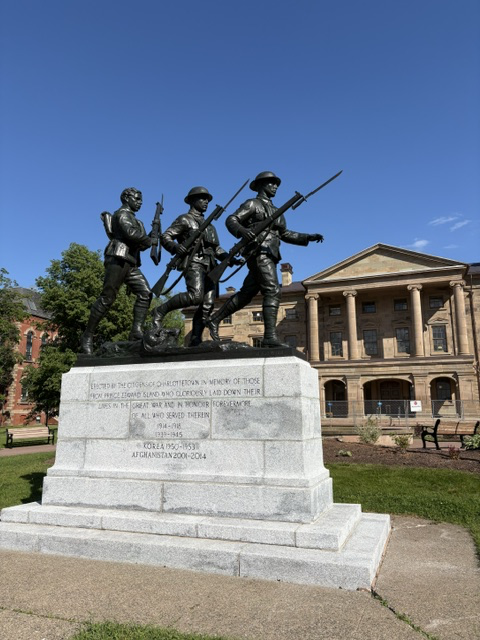
Veterans Memorial
While walking through Charlottetown, we came across this striking monument showing three soldiers moving forward together. With Province House immediately behind it, the memorial sits among the buildings and streets where so much of Prince Edward Island’s political history has unfolded. The monument was originally erected in memory of Prince Edward Islanders who served and […]
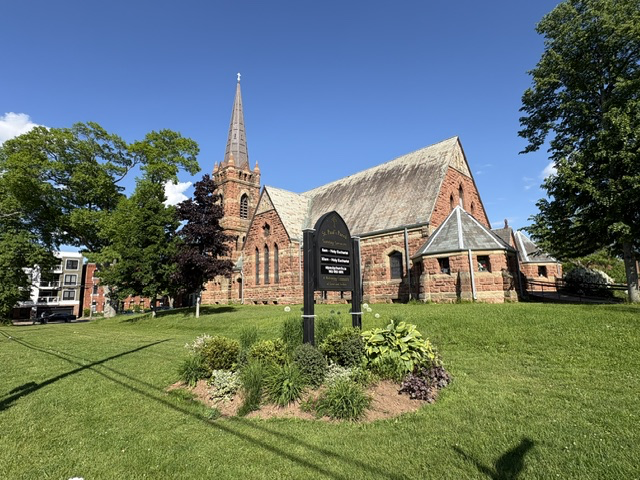
The Kirk of St. James
While walking through Charlottetown, I photographed the Kirk of St. James, a beautiful sandstone Presbyterian church standing on Fitzroy Street. The building caught my attention, but its story reaches far beyond the congregation that worshipped here. It represents the enormous influence Scottish immigrants had on Prince Edward Island. Beginning in the late 18th century and […]
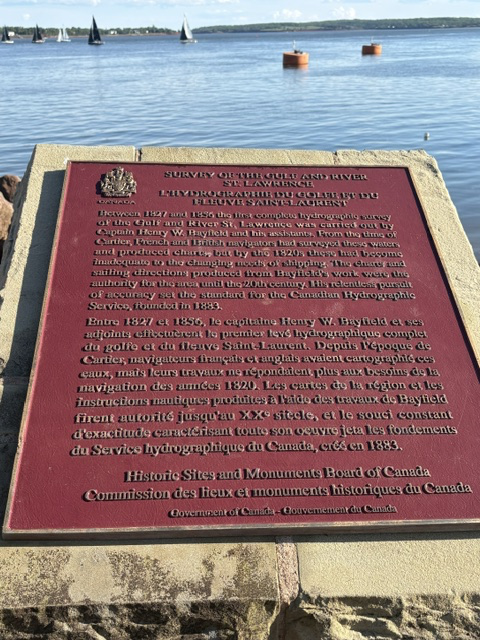
Captain Henry Wolsey Bayfield
Walking along the Charlottetown waterfront, it is easy to simply enjoy the view across the harbor. Sailboats move across the water, the opposite shore seems close by, and today we give little thought to knowing exactly where the channels, shoals and underwater hazards are located. A plaque along the waterfront introduced me to Captain Henry […]

