QF 1-Pounder “Pom-Pom” Naval Cannon
Walking through the Heritage Museum in Hudson, one artifact immediately stood out because of both its size and its historical significance. At first glance, it appears to be simply an old naval cannon. It represents one of the most important advances in military technology during the late nineteenth century.
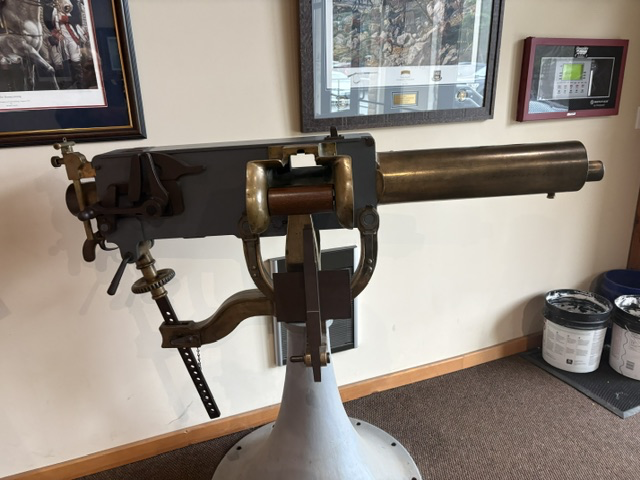
The QF 1-Pounder, better known as the “Pom-Pom“, was designed in 1888 by Hiram Maxim, the inventor of the Maxim machine gun. It was the first successful automatic naval cannon ever produced. Chambered for a 37-millimeter shell, the weapon used the energy of each fired round to eject the spent casing, reload, and fire again without requiring the crew to manually operate the mechanism after every shot. Its rapid, rhythmic report earned it the nickname “Pom-Pom”.
The United States Navy adopted the weapon shortly before the Spanish-American War. This cannon is especially significant because it was one of the first sixteen acquired by the Navy in 1898. It was installed aboard the USS Machias, a gunboat built at Bath Iron Works in Maine.
During the Spanish-American War, the USS Machias participated in operations around Cuba, including the bombardment of Spanish positions at Cabañas on May 12, 1898. This cannon was present during that campaign, making it more than an example of innovative engineering. It is a tangible connection to a moment when the United States was emerging as a modern naval power with an expanding presence on the world stage.
The technology introduced by the Pom-Pom changed naval warfare. Before its development, artillery required crews to reload each round by hand. Automatic operation dramatically increased the rate of fire, making these weapons particularly effective against fast-moving torpedo boats and, in later years, aircraft. Although larger and more sophisticated weapons eventually replaced it, the principles demonstrated by the Pom-Pom influenced naval armament well into the twentieth century.
Museums such as the Heritage Museum preserve objects like this not because they are weapons, but because they represent turning points in engineering, manufacturing, and military history. The QF 1-Pounder reminds us that behind every artifact is a story of invention, service, and the people who believed that technology could solve problems in entirely new ways.

Read More From Nancy
The Medal of Honor
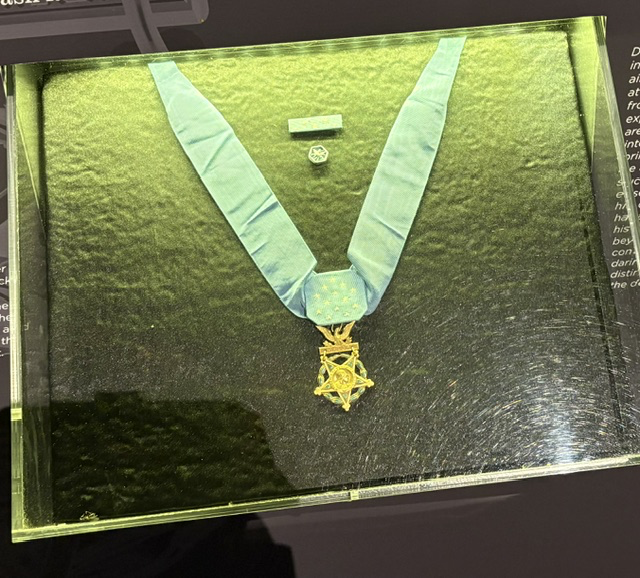
Among all the artifacts displayed at the American Heritage Museum, few carry the emotional weight of the Medal of Honor. Unlike a tank, an aircraft, or a weapon, this small medal represents something that cannot be manufactured or engineered. It symbolizes extraordinary courage in the face of overwhelming danger. Established during the American Civil War […]

American Heritage Museum
Out exploring on a rainy Sunday, let us to the American Heritage Museum in Hudson. From the outside, it doesn’t reveal the depth of what’s inside. Stepping through the doors, the scale and intention of the museum became very clear. This is not a collection of artifacts behind glass, but an immersive walk throughhistory. The museum was developed […]
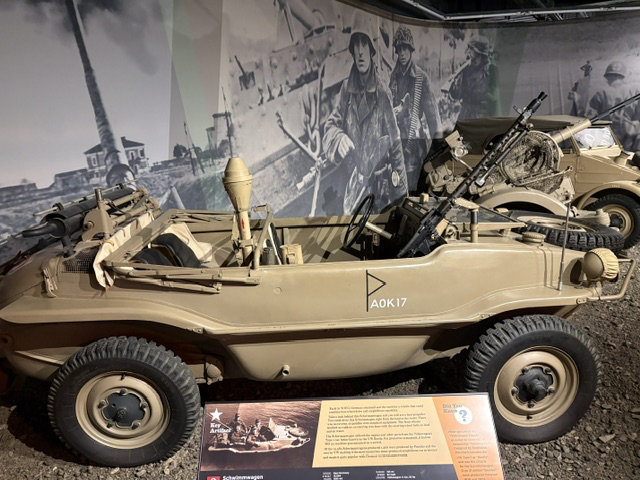
German WWII Kubelwagen
Exploring the exhibits inside the American Heritage Museum in Hudson is far more than a traditional local museum. This museum contains one of the most impressive collections of military vehicles, artifacts and historical exhibits I have seen, presenting world history through the actual machines, stories and experiences of the people who lived through these conflicts. What […]

