Notre-Dame de Paris
When our family traveled to France in 1997, one of the places we visited was Notre-Dame de Paris. Standing on the Île de la Cité in the Seine, the cathedral has occupied the historic and spiritual center of Paris for more than eight centuries. Long before the Eiffel Tower became the city’s most recognizable landmark, the towers, rose windows, and flying buttresses of Notre-Dame defined the Paris skyline.
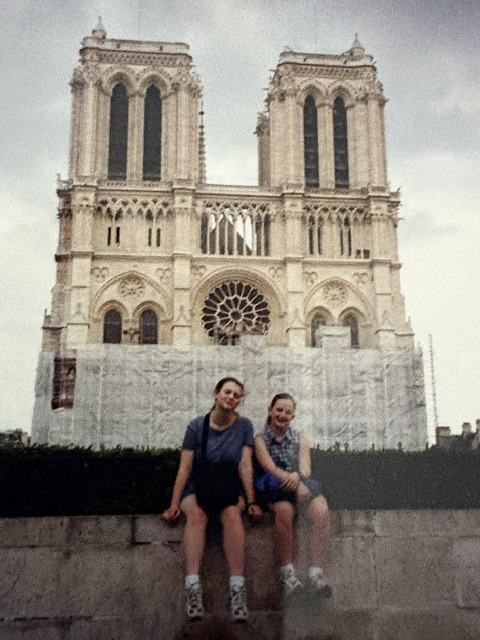
Construction began in 1163 under Bishop Maurice de Sully, who envisioned a cathedral large enough to reflect the growing importance of medieval Paris. The project required generations of builders, stonemasons, sculptors, carpenters, and glassmakers, with major construction continuing into the fourteenth century. The result was one of the great achievements of French Gothic architecture—a building designed to rise higher, admit more light, and create a sense of height and openness that earlier churches could not achieve.
Many of the cathedral’s most familiar features were also important structural innovations. Ribbed vaults carried the weight of the stone ceilings, while exterior flying buttresses transferred that weight away from the walls. Because the walls no longer had to support the building alone, they could be opened for enormous stained-glass windows. Notre-Dame’s three rose windows transformed sunlight into patterns of colored glass, filling the interior with light that was intended to create both beauty and a sense of the sacred.
The western façade facing the cathedral square was designed as a carefully ordered visual account of Christian belief. Three deeply carved portals depict biblical stories, saints, angels, kings, and scenes of judgment. Above them stands the Gallery of Kings, a row of figures representing the kings of ancient Judah. During the French Revolution, many people mistakenly believed that these statues portrayed the kings of France. The figures were pulled down and destroyed as symbols of monarchy. Their nineteenth-century replacements are the ones seen on the cathedral today.
Notre-Dame has witnessed many defining moments in French history. Medieval worshippers gathered there for religious festivals and royal ceremonies. In 1804, Napoleon Bonaparte crowned himself emperor inside the cathedral in the presence of Pope Pius VII. In 1944, its bells rang to celebrate the liberation of Paris from German occupation, and a service of thanksgiving was held there as General Charles de Gaulle entered the restored capital. The cathedral has served not only as a Catholic place of worship but also as a setting in which France has marked victories, mourned national losses, and commemorated important events.
By the early nineteenth century, however, Notre-Dame had suffered from centuries of neglect, alterations, and damage during the French Revolution. Victor Hugo’s 1831 novel Notre-Dame de Paris, known in English as The Hunchback of Notre-Dame, drew public attention to the deteriorating cathedral and helped inspire a movement to preserve it. A major restoration began in 1844 where the stonework was repaired, restored sculptures, added the famous gargoyles and designed the central spire that became part of its familiar silhouette.
When we visited in the late 1990s, Notre-Dame was undergoing another major campaign of cleaning and restoration. Work conducted between 1991 and 2000 removed accumulated pollution and grime from the stone and repaired portions of the façade. Although the protective coverings obscured part of the lower entrance during our visit, they recorded something important about the life of an ancient building. Notre-Dame was not a monument frozen in time. It had always required craftspeople, conservation, and renewal to survive.
Our family visit now belongs to an earlier chapter in the cathedral’s long history, a time after one restoration and before the fire and reconstruction that would capture the attention of the world. Notre-Dame has survived revolution, neglect, war, changing tastes, pollution, and fire. Each generation has inherited the cathedral, altered it, repaired it, and passed it forward. Its history is not simply the story of a medieval building; it is the continuing story of the people who have repeatedly decided that it must endure.

Read More From Nancy

Gravesites of Vincent and Theo Van Gogh
When we traveled as a family, we would try to find places that would spark the interests of our daughters. During a vacation in Paris, one of these special excursions was a train ride to the village of Auvers-sur-Oise, where Vincent Van Gogh spent the final weeks of his life and created many of his most famous paintings […]
Pont Neuf
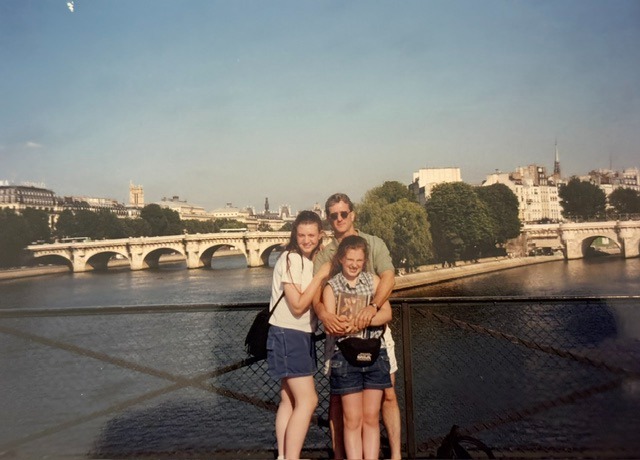
Despite its name, which means “New Bridge”, the Pont Neuf is the oldest surviving bridge in Paris. Crossing the Seine in two sections at the western end of the Île de la Cité, it connects the island with both riverbanks. Its construction introduced a different way of moving through, and looking at, the city. Henri […]
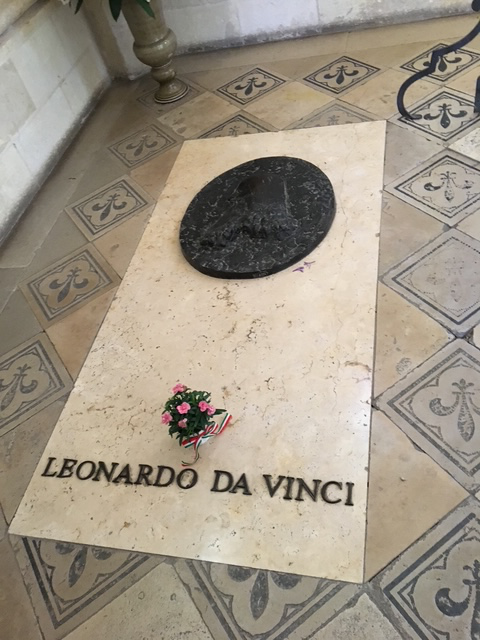
Leonardo’s Grave
High above the Loire River, within the grounds of the Château Royal d’Amboise, stands the elegant Chapel of Saint-Hubert. It is here that visitors come to remember Leonardo da Vinci, not in his native Italy, but in France, where he spent the final years of one of history’s most remarkable lives. By the time Leonardo […]

