John Gilbert Winant
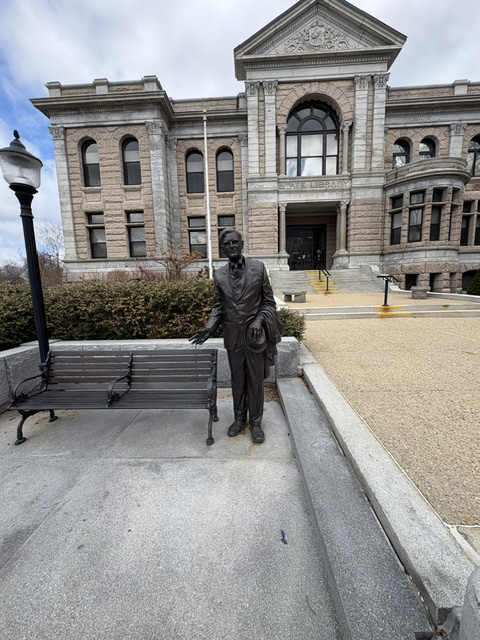
Walking around the New Hampshire State House, I noticed a bronze statue standing quietly beside a simple granite bench. There was no dramatic pose, no military horse, no grand pedestal. Instead, John Gilbert Winant appears to be greeting visitors as though he had simply stopped to talk. It is a fitting tribute because humility was perhaps his greatest characteristic.
Although many people think of Winant as a native son of New Hampshire, he was born in New York City in 1889 into a comfortable upper-middle-class family. His father was successful in real estate, and the family enjoyed a privileged life. Yet it was not New York that shaped him. It was St Paul’s School in Concord. As a teenager he struggled academically but discovered something far more important: a passion for history, public service, and leadership. Abraham Lincoln became his lifelong hero, and Dickens’ writings awakened in him a deep concern for those living in poverty and injustice.
After briefly attending Princeton University, where he never felt at home academically, he returned to St. Paul’ as a history teacher. His students remembered him as inspiring, thoughtful, and deeply interested in helping young people think about their responsibilities as citizens.
Then came World War I.
Winant enlisted in the Army Air Service, trained as a pilot, and eventually commanded the 8th Aero Squadron in France, attaining the rank of captain. The experience changed him profoundly. Like many who served in the Great War, he saw firsthand the enormous human cost of conflict and became convinced that governments existed to improve people’s lives, not merely exercise power.
Returning home after the war, Winant resumed teaching but soon entered politics. He served in both the New Hampshire House and Senate before becoming governor in 1924 at only thirty-five years old, one of the youngest governors in the nation. After losing reelection, he returned in 1930 and again in 1932, leading New Hampshire through the darkest years of the Great Depression. Unlike many politicians of his era, Winant believed the government should actively help people weather difficult times. He reorganized the state’s banking system, modernized government finances, expanded highways to create jobs, supported minimum wage protections for women and children, helped towns avoid bankruptcy, and made New Hampshire the first state to meet its enrollment quota for Franklin Roosevelt’s new Civilian Conservation Corps. He even proposed shorter workweeks so employers could hire more workers rather than laying people off. These were bold ideas in the early 1930s and made him one of America’s leading progressive Republicans.
His reputation reached Washington.
Although Winant was a Republican, President Franklin Roosevelt admired both his integrity and his willingness to put people ahead of politics. Roosevelt selected him to become the first chairman of the newly created Social Security Board in 1935. That meant Winant helped build one of the most significant social programs in American history from the ground up. Every Social Security check issued today traces its origins, in part, to the administrative foundation that Winant helped establish.
When Europe descended into World War II, Roosevelt asked him to serve as ambassador to Great Britain.
His predecessor, Joseph P. Kennedy Sr., had been widely viewed as pessimistic about Britain’s chances of surviving Nazi Germany. Winant’s arrival could not have been more different. Stepping off the airplane in England during the Blitz, he famously declared:
“There is no place I’d rather be than in England.”
Winant quickly became one of Winston Churchill’s closest American friends. He developed a warm relationship with King George VI and Queen Elizabeth and was with Churchill when news arrived that Japan had attacked Pearl Harbor. He served throughout most of World War II, helping coordinate the alliance that ultimately defeated Nazi Germany. His personal life, however, was becoming increasingly difficult.
His marriage to Constance Rivington Russell deteriorated after years of separation brought about by public service. Their three children were grown, and the family relationship had become strained. During the war he developed a romantic relationship with Sarah Churchill, Winston Churchill’s daughter. Although deeply attached to one another, the relationship ultimately ended, leaving Winant heartbroken. At the same time, he suffered serious financial losses, career disappointments after Roosevelt’s death, and growing depression.
Returning to Concord after the war proved harder than anyone expected. A man who had spent decades solving national and international crises suddenly found himself alone, in debt, physically exhausted, and without the public purpose that had defined his life. On November 3, 1947, John Gilbert Winant died by suicide at the age of fifty-eight.
At his funeral, Winston Churchill sent four dozen yellow roses. King George VI and Queen Elizabeth sent their condolences. These gestures reflected the affection and respect Winant had earned across the Atlantic.
Today, this quiet statue reminds visitors of a man who never sought attention. He believed that leadership was measured not by power or fame but by service. The inscription on the nearby bench captures his life’s philosophy:
“…wanting not only for ourselves but for others also, a fairer chance for all people everywhere.”
For many years after his death, John Gilbert Winant’s accomplishments were largely forgotten. His work as governor, architect of Social Security, and ambassador during World War II was overshadowed by the tragedy of his final days. It took nearly seventy years for New Hampshire to fully recognize one of its greatest public servants. That recognition came on June 30, 2017, when this life-sized bronze statue was dedicated on the grounds of the New Hampshire State Library, directly across from the State House where Winant once served as governor.

Read More From Nancy
The Soldiers and Sailors Memorial Arch
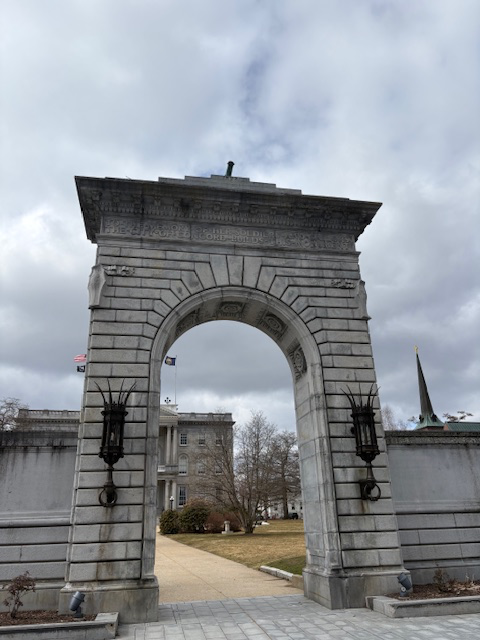
At the front of the New Hampshire State House lawn stands the granite arch that quietly frames everything beyond it: The Soldiers and Sailors Memorial Arch. The State House itself was completed in 1819, built of locally quarried granite and designed to reflect both permanence and simplicity. It remains the oldest state capital in the United States […]
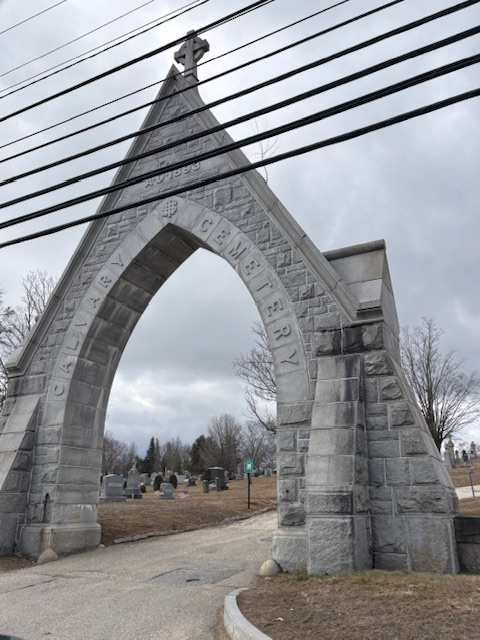
Calgary Cemetery Arch
At the entrance of the older section of Calvary Cemetery in Concord stands a striking granite arch. Carved from the same kind of stone that defines so much of New England, the arch rises with quiet dignity. Its pointed form and cross at the top marks it as a place of faith and remembrance. The arch creates a […]
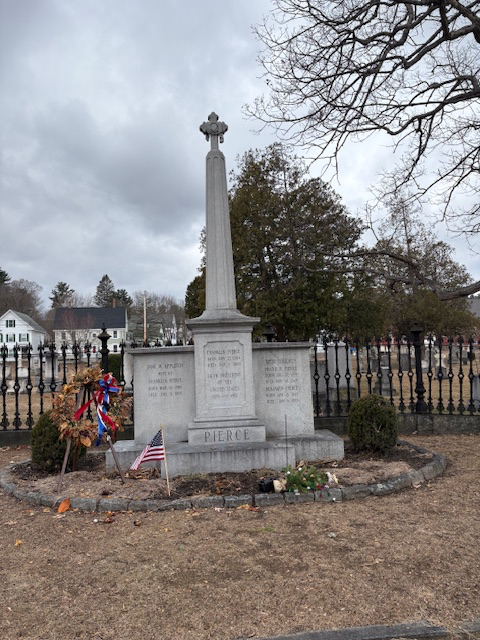
Pierce Gravesite
Tucked within the quiet grounds of the Old North Cemetery in Concord lies the gravesite of Franklin Pierce, more personal than presidential. Pierce, the 14th President of the United States, was born in New Hampshire and remained deeply connected to Concord throughout his life. This graveside does not have the grandeur that you might expect for a […]

