Jardim Municipal da Povoacao Sao Miguel
In the center of Povoação on São Miguel, we came across this beautifully maintained municipal garden, filled with colorful flower beds, carefully clipped trees, benches, and the distinctive black-and-white Portuguese pavement beneath our feet. The garden has an interesting history of its own. It dates from the 1940s and was created as part of the rebuilding of the historic center of Povoação following a destructive earthquake in 1935. What today appears to be an established traditional town garden was therefore part of an effort to restore and reshape the community after a natural disaster.
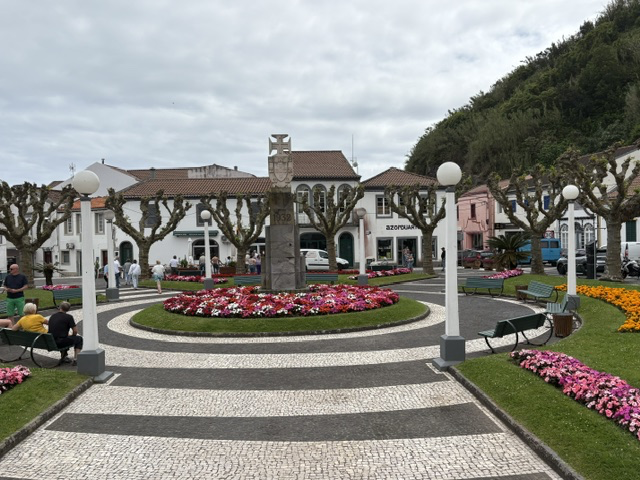
Povoação is particularly significant in the history of São Miguel. This was the area where the first Portuguese settlers established themselves on the island during the fifteenth century. In fact, the name Povoação essentially means “settlement,” reflecting its place in the story of the colonization of São Miguel. That history explains the stone monument standing at the center of my photograph. Known as the Padrão dos Descobrimentos, or Monument to the Discoveries, it is topped by the Portuguese shield and the Cross of Christ—the same distinctive cross associated with Portuguese exploration and displayed on the sails of Portuguese ships during the Age of Discovery.
The monument bears the date 1432. When it was erected, 1432 was accepted as the official date for the discovery of the Azores. Later historical research challenged that date, and 1427 is now more commonly associated with the Portuguese discovery of the archipelago. The monument therefore preserves not only the story of Portuguese exploration but also an earlier interpretation of that history.
Even the garden’s bandstand carries the Cross of Christ as a decorative motif, deliberately connecting this pleasant civic space with Povoação’s identity as the first settlement on São Miguel. Yet beneath the flowers and patterned walkways is a much larger story. This is a town that traces its beginnings to the earliest European settlement of São Miguel, and the garden was created centuries later as part of its recovery from an earthquake. The monument standing among the flowers ties those different chapters together—discovery, settlement, destruction, rebuilding, and the continuing life of this small Azorean town.
Read More From Nancy
Belém Tower
While exploring Lisbon, we visited the Torre de Belém, standing along the Tagus River near the place from which many of Portugal’s great voyages of exploration began. Built between 1514 and 1519 during the reign of King Manuel I, the tower was originally part of Lisbon’s defensive system, positioned to help protect the entrance to […]
The Miracle of Santo Cristo dos Milagres
When we arrived in the Azores in May 2025, we had no idea we were stepping into one of the islands’ most sacred and remarkable celebrations. The streets of Ponta Delgada were closed to traffic, storefronts shuttered, and the city was blanketed in flowers. What we thought was an ordinary weekend turned out to be […]
Sanctuary of Fátima
On our travels through Portugal, I wanted to visit the Shrine of Fátima. Having grown up Catholic, I couldn’t be this close and not make the journey to a place I had heard about since childhood. Fátima is one of the most important Catholic pilgrimage destinations in the world, with millions of people traveling here […]

