Guglielmo Marconi
Guglielmo Marconi was born in Bologna, Italy, in 1874. As a young man, he became convinced that recently discovered electromagnetic waves could be used to send messages without wires. Working with simple equipment on his family’s property, he began experimenting with the transmission of wireless signals.
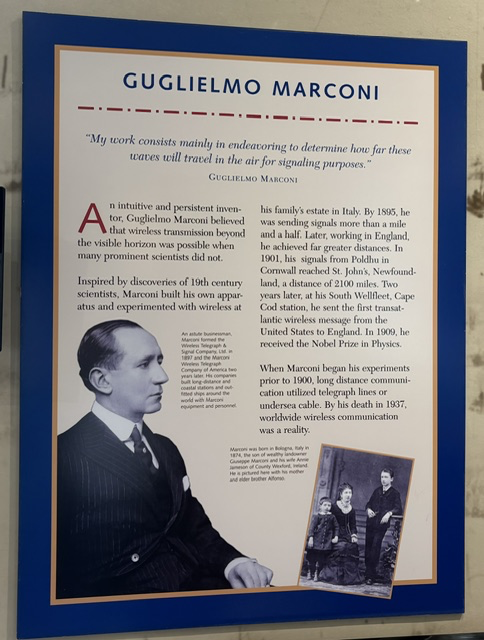
By 1895, Marconi had succeeded in sending a signal more than a mile and over a hill, demonstrating that wireless waves could travel beyond an unobstructed line of sight. He later moved his work to England, where he received support for further experimentation and continued increasing the distance over which messages could be sent.
In December 1901, Marconi received signals at St. John’s, Newfoundland, that had been transmitted from Poldhu in Cornwall, England. The successful experiment demonstrated that wireless signals could cross the Atlantic Ocean.
Marconi then developed a wireless station in South Wellfleet on Cape Cod. In January 1903, the station transmitted a message from President Theodore Roosevelt to Britain’s King Edward VII, establishing the first two-way wireless communication between the United States and Europe.
Marconi shared the 1909 Nobel Prize in Physics for his contributions to wireless telegraphy. By the time of his death in 1937, the technology that began with his early experiments had developed into a worldwide communications network. His work also led to the construction of the wireless receiving station in Chatham in 1914. The station later became Chatham Radio/WCC, connecting ships and people throughout the world for much of the 20th century.
Read More From Nancy
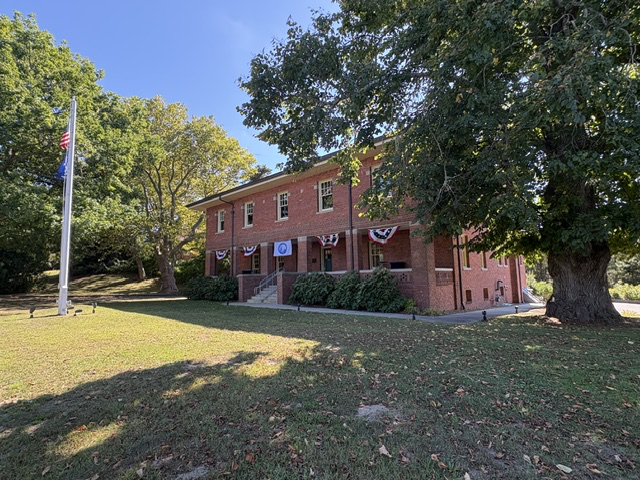
Hotel Nautilus
The building known as Hotel Nautilus was constructed in 1914 as part of the Marconi Wireless Telegraph Company of America’s receiving station in Chatham. Although its name suggests a traditional hotel, its original purpose was to provide housing for the unmarried employees who worked at the station. The Chatham facility was designed as more than […]
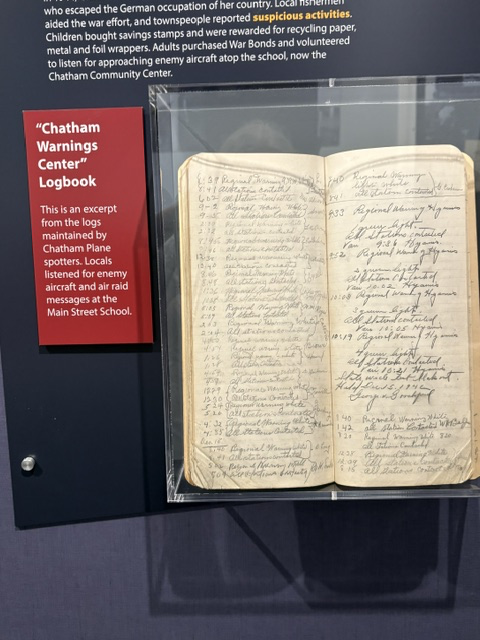
Home Front Artifacts
During World War II, the war effort extended far beyond the battlefields of Europe and the Pacific. In towns throughout the United States, ordinary citizens were asked to remain alert, conserve essential supplies, raise money and contribute whatever they could to support the country. Two artifacts preserved at the Marconi-RCA Wireless Museum: the Chatham Warning […]
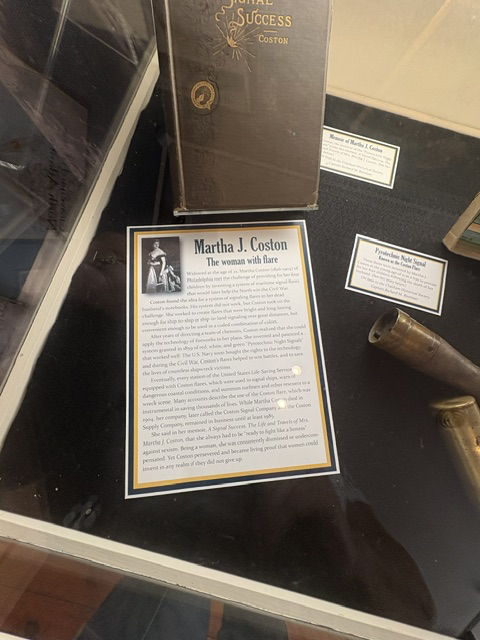
Martha J. Coston and the Signals That Saved Lives
Before radio, ships traveling at night had few reliable ways to communicate with one another or with people on shore. Flags could not be seen in darkness, and lanterns lacked the brightness and distinctive patterns needed to carry clear messages across long distances. Martha J. Coston helped solve this problem by developing a system of […]

