Gandhi’s Worldly Remains
This small collection of personal belongings is preserved at Gandhi Smriti, the memorial established in the former Birla House in New Delhi. Identified by the museum as Gandhi’s “Worldly Remains”, the display contains only a handful of practical objects: his walking staff, reading glasses and case, pocket watch, gardening sickle, pumice stone, and simple eating utensils.
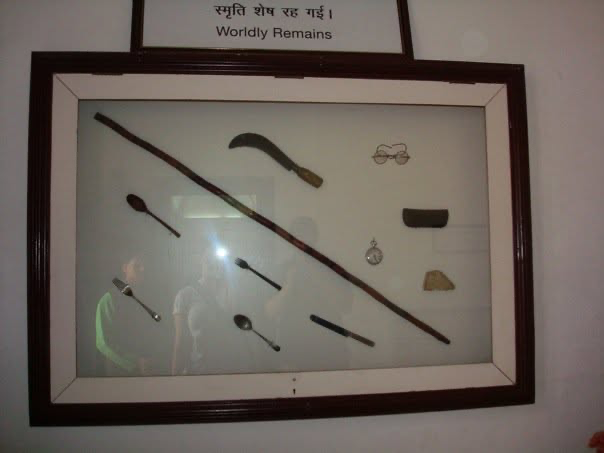
The modest collection reflects Gandhi’s commitment to aparigraha, the principle of non-possession. He believed that people should take only what they genuinely needed and should regard whatever they possessed as something held in trust rather than owned for personal enrichment. His simplicity was therefore more than a matter of appearance. It was part of a deliberate moral discipline that influenced how he dressed, ate, traveled, and organized his daily life.
Each object served an ordinary purpose. His staff supported him during the walks that were central to both his daily routine and his public campaigns. His spectacles allowed him to read and write the letters, articles, and appeals through which he communicated with people throughout India and around the world. His pocket watch helped regulate a demanding schedule of prayer, correspondence, meetings, and political discussions. The gardening tool, pumice stone, and wooden utensils belonged to the quieter routines of everyday life.
Gandhi stayed at Birla House during the final 144 days of his life, a period of tremendous upheaval following Indian independence and the partition of India and Pakistan in 1947. While the new nations celebrated their freedom from British rule, religious violence displaced and killed hundreds of thousands of people. Gandhi spent his final months appealing for peace between Hindus, Muslims, and Sikhs. He met with political leaders, refugees, and members of the public, while using prayer meetings and fasting to call for an end to the bloodshed.
On January 30, 1948, Gandhi left his room and walked across the grounds toward his evening prayer meeting. He was assassinated by Nathuram Godse, a Hindu nationalist who opposed Gandhi’s efforts toward reconciliation with Muslims. Gandhi’s death transformed Birla House from a private residence into one of the most important memorial sites in modern India.
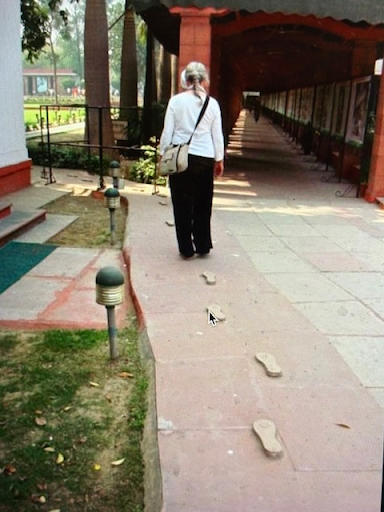
The Government of India acquired the property in 1971, and Gandhi Smriti opened to the public in 1973. His room has been preserved, and a marked path follows the route of his final walk to the place where he was killed. The display of his belongings adds a quieter dimension to that history. It allows visitors to encounter Gandhi not only as the leader of India’s independence movement and an international symbol of nonviolent resistance, but also as a man who attempted to make his daily life consistent with his beliefs.
There is a striking contrast between the small number of objects Gandhi left behind and the enormous influence of his life. He possessed little, yet his ideas inspired civil rights and freedom movements far beyond India. These ordinary belongings demonstrate that his commitment to simplicity was not merely something he asked of others. It was a principle he sought to practice in the smallest details of his own life.
Read More From Nancy
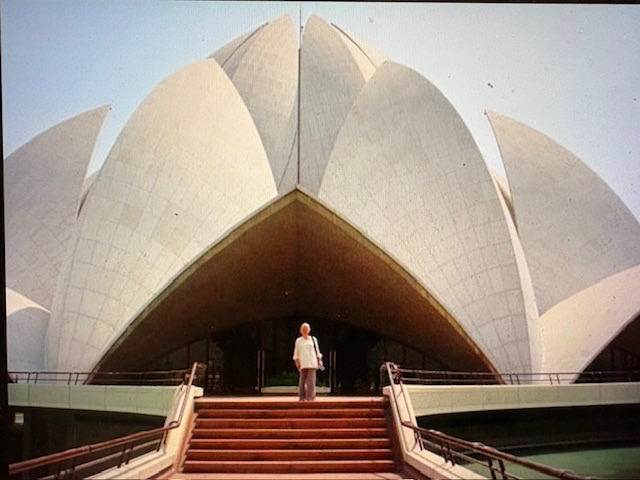
Lotus Temple
The Lotus Temple in Delhi is one of those places that has stayed with me long after I visited it. This is a place where silence surrounds you. In a city as vibrant, crowded and sensory-rich as Delhi, the stillness of this temple was powerful. Completed in 1986, the Lotus Temple is a Baha’i House […]
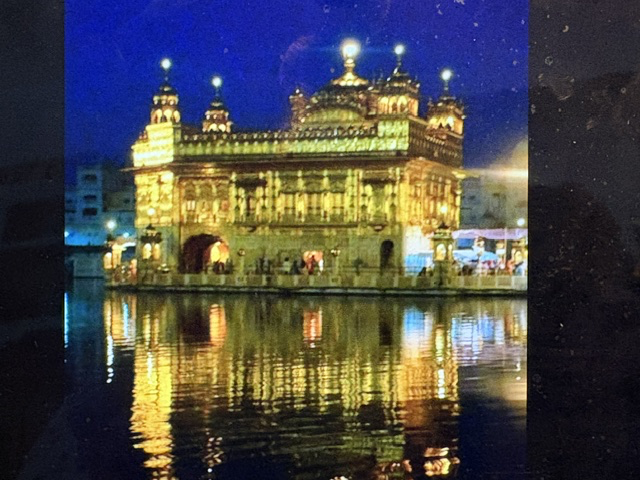
The Golden Temple
On both of my travels to India, I made the journey to the Golden Temple. Also known as Harmandir Sahib, this is the holiest site in the Sikh religion, and visiting it is one of the memorable spiritual and cultural experiences of my time in India. Visiting the temple at night was especially unforgettable. The illuminated gold structure […]
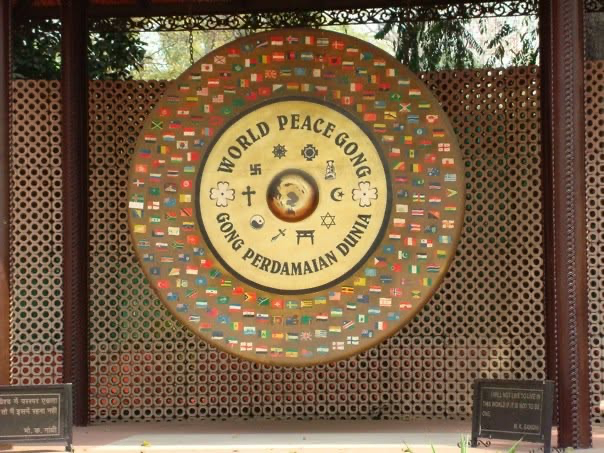
World Peace Gong
During our visit to Gandhi Smriti in New Delhi, one monument immediately drew my attention. Surrounded by the flags of nations from around the world and the symbols of many of the world’s major religions, the World Peace Gong stands as an international symbol of peace, cooperation, and mutual respect. The World Peace Gong was […]

