Fused Metal from the Great Fire of 1877
Resting quietly in King’s Square is a misshapen mass of metal that could easily be mistaken for an ordinary rock. It is a collection of metal objects fused together by the intense heat of the Great Fire of 1877. Recovered from the ruins of a Saint John hardware store, it provides a tangible connection to one of the most destructive events in the city’s history.
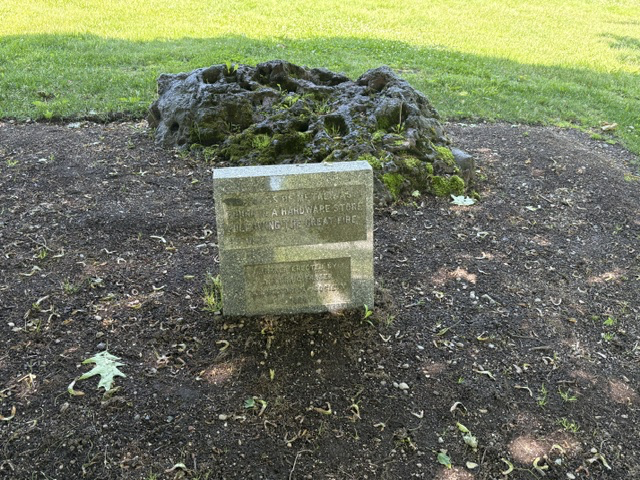
The fire began on June 20, 1877, in a storehouse near York Point, close to present-day Market Square. Strong winds and dry conditions carried the flames rapidly through streets lined with wooden buildings. Warehouses and wharves filled with lumber, rope, tar, and other combustible materials helped feed the fire as it moved through Saint John’s commercial and residential districts.
The fire burned out of control for approximately nine hours. By the time it ended, more than 200 acres of the city had been devastated and approximately 1,600 buildings had been destroyed. Homes, businesses, churches, banks, hotels, records, photographs, and personal possessions disappeared in the flames. Twenty-one people died, and thousands of residents were left without homes.
King’s Square became part of the city’s response to the disaster. Refugees gathered there as the fire spread, carrying whatever possessions they had been able to save. In the days that followed, temporary shelters and businesses were established within the square, turning the public park into an improvised community for people who had lost nearly everything.
The fused metal offers a sense of the tremendous temperatures reached inside the burning buildings. Tools and other hardware that had once been separate, recognizable objects melted and collapsed into a single hardened mass. Unlike a photograph or written account, it is a physical remnant of the fire itself: material permanently changed by the disaster.
Encountering this object in King’s Square revealed how something that appears so unremarkable can hold an extraordinary story. The fused metal preserves both the destructive power of the Great Fire and the scale of what Saint John’s residents endured. Placed in the same square that once sheltered the homeless, it remains a quiet witness to the disaster and to the city that rose from its ruins.
Read More From Nancy
Inside the Saint John City Market
While visiting Saint John, we stopped at the City Market for lunch. What began as a place to find something to eat also allowed us to participate in a tradition that reaches back to the city’s founding. Saint John’s 1785 royal charter authorized the operation of public markets, and vendors have gathered inside the present […]
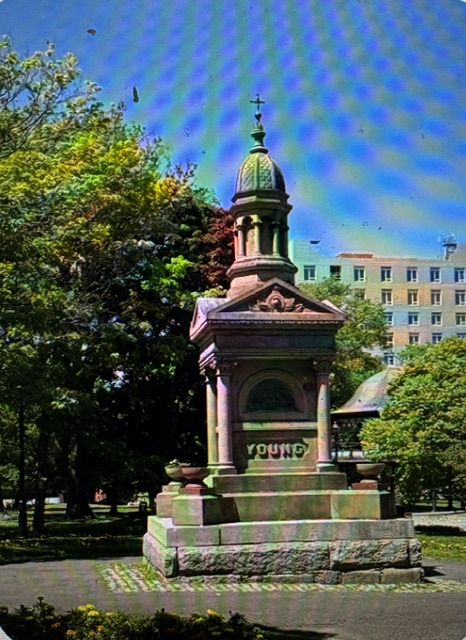
Young Memorial
The Young Memorial in King’s Square remembers an ordinary young man whose final act became part of Saint John’s civic history. John Frederick Young was only nineteen years old when he drowned in Courtenay Bay in 1890 while attempting to rescue ten-year-old Frederick E. “Freddie” Mundee. Young was a factory worker who had come to […]
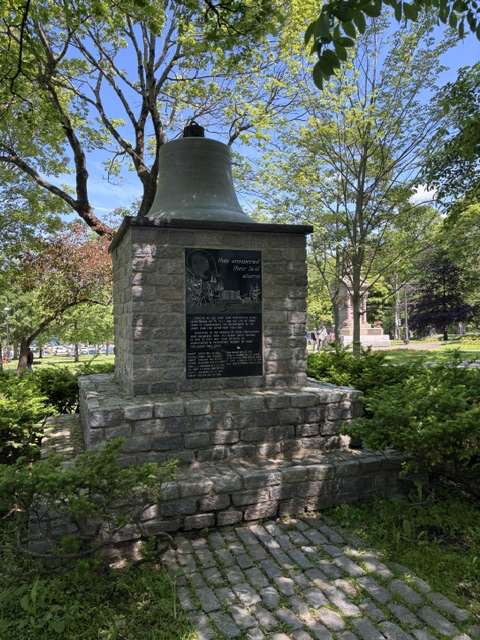
Last Alarm Bell Monument
A large bronze bell stands silently in King’s Square as a memorial to Saint John firefighters who died while serving their community. Known as the Last Alarm Bell Monument, it was erected in 1986 to commemorate the two-hundredth anniversary of the Saint John Fire Department. The department was established in 1786, only one year after […]

