Dungeness
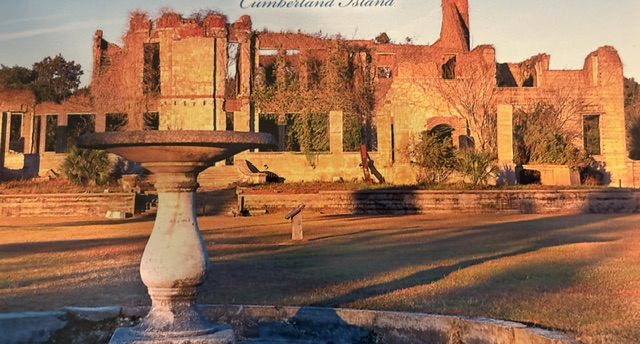
Here is truly a house with a story. When we traveled to Cumberland Island for the day, one of the places that captured my attention was the ruins of Dungeness. Even without its walls and roof intact, the remains give a sense of how grand this estate once was. Today, wild horses wander freely through the landscape, sometimes walking among the ruins and across the lawns that once surrounded one of the great homes of the Carnegie family.
The story of Dungeness begins long before the Carnegies. Revolutionary War hero General Nathanael Greene acquired land on Cumberland Island in the 1780s. After his death, his widow, Catharine Greene, and her second husband, Phineas Miller, built a large house here and named it Dungeness. The estate became part of the plantation world of the antebellum South, where wealth and daily life were supported in significant part by the labor of enslaved people.
By the late 19th century, the earlier house was gone, but Cumberland Island attracted another extraordinarily wealthy American family. In the 1880s, Thomas M. Carnegie, the younger brother and business partner of industrialist Andrew Carnegie, and his wife Lucy purchased property on the island. They built a new Dungeness on the site, completing their enormous winter home in 1884.
Thomas Carnegie died only two years later, but Lucy continued developing the estate and made Cumberland Island an important gathering place for the Carnegie family. Dungeness eventually grew to nearly 60 rooms and was surrounded by gardens, fountains, recreation areas, outbuildings, and other structures necessary to support the family and its many guests. Other Carnegie homes were eventually constructed elsewhere on Cumberland Island for their children.
The family’s time at Dungeness gradually came to an end, and by the 1920s the mansion was used less frequently. Then, in 1959, a fire swept through the abandoned house. Rather than rebuilding it, the family left the stone and brick walls standing. Those are the ruins we encountered on our visit. What makes Dungeness so compelling today is the combination of human history and nature. The grand rooms are gone. Trees and vegetation have grown around the walls. Open sky appears where ceilings once separated one floor from another. The fountain and terraces remain as reminders that these grounds were once carefully designed and maintained.
Cumberland Island is home to a population of free-roaming horses. Their exact origins are not completely documented, although horses have been present on the island for centuries. Unlike managed herds on some other public lands, Cumberland’s horses are considered feral and are not provided food, water, veterinary care, or population control by the National Park Service. They move through the island’s maritime forests, beaches, marshes, and historic landscapes on their own.
There is something almost surreal about seeing them around Dungeness. A place that was once defined by an enormous mansion, servants, formal gardens, wealth, and carefully ordered social life is now open to the weather, vegetation, and animals that wander through it. The house itself is gone, but its ruins may tell the story even better. Standing among them, with wild horses crossing the landscape, it is impossible not to think about how dramatically a place can change while traces of all the lives lived there remain.