Conscientious Objectors Memorial
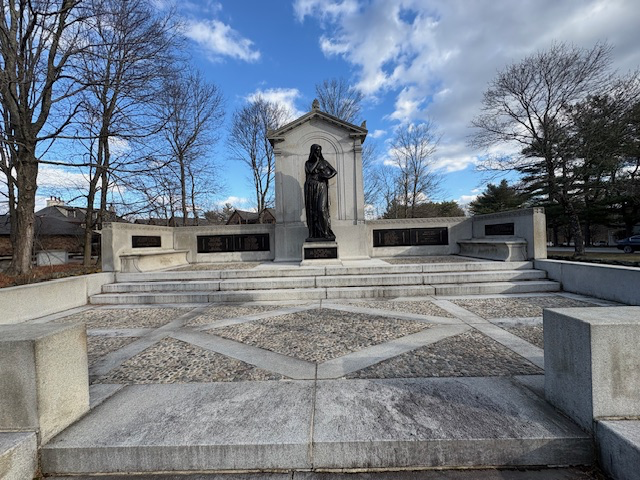
Among the many memorials that stand throughout New England, few are as unique as this one. Rather than honoring soldiers, political leaders, or pioneers, this monument remembers men and women whose lives were devoted to a different calling, the pursuit of peace.
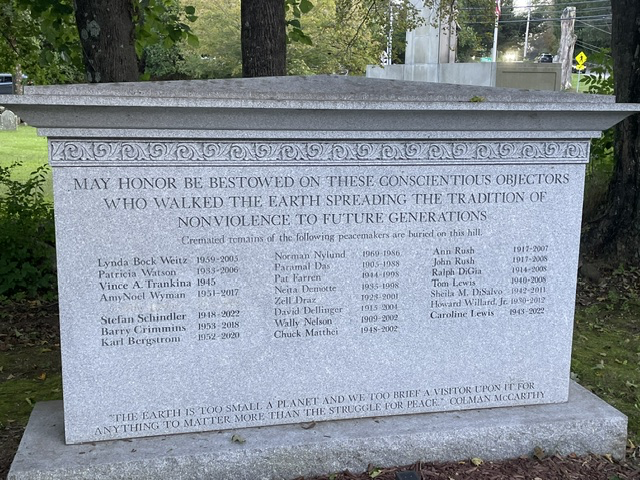
Its inscription reads:
“May honor be bestowed on these conscientious objectors who walked the earth spreading the tradition of nonviolence to future generations.”
Below those words are the names of individuals whose cremated remains are buried beneath this hill, each remembered not for victories won on a battlefield, but for lives dedicated to reconciliation, compassion, and the belief that conflicts can be resolved without violence.
The people commemorated here came from many different backgrounds. Some were conscientious objectors who refused military service because of deeply held religious or moral convictions. Others devoted their lives to social justice, humanitarian work, education, or community activism. While their individual stories differ, they shared a common belief that lasting peace begins not with governments but with individual choices.
Conscientious objection has a long history in America. During every major conflict, there have been individuals whose religious beliefs or moral convictions prevented them from participating in war. Rather than serving in combat, many chose alternative forms of national service, working in hospitals, conservation projects, disaster relief, or humanitarian efforts. Their decisions were often misunderstood and, at times, unpopular, yet they remained committed to living according to their conscience.
The quotation engraved at the base of the monument captures the spirit of the memorial:
“There is too small a planet and we too brief a visitor upon it for anything to matter more than the struggle for peace.” — Colman McCarthy
Unlike many memorials that focus on a single event or a particular moment in history, this one looks forward as much as it looks back. It asks visitors not simply to remember the individuals buried here, but to consider the ideals they embraced. Peace, the memorial suggests, is not merely the absence of war. It is something that must be practiced every day through acts of understanding, compassion, and respect.
We often think of monuments as honoring military service or political achievement. This memorial honors something quieter but no less courageous. The willingness to live according to one’s deepest convictions, even when doing so required sacrifice or invited criticism
Read More From Nancy
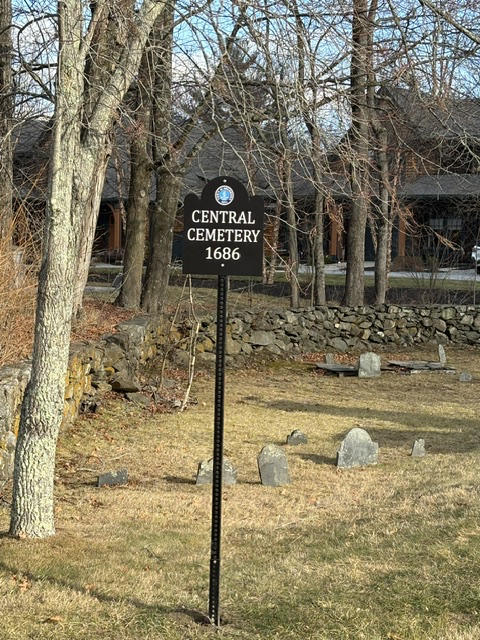
Central Cemetery
In the center of Sherborn, tucked behind an old fieldstone wall, is one of the town’s earliest burial grounds. The simple sign identifies Central Cemetery with the date 1686, immediately connecting this quiet patch of land with the earliest generations of Sherborn. Sherborn itself had been incorporated only in 1674. During the years that followed […]
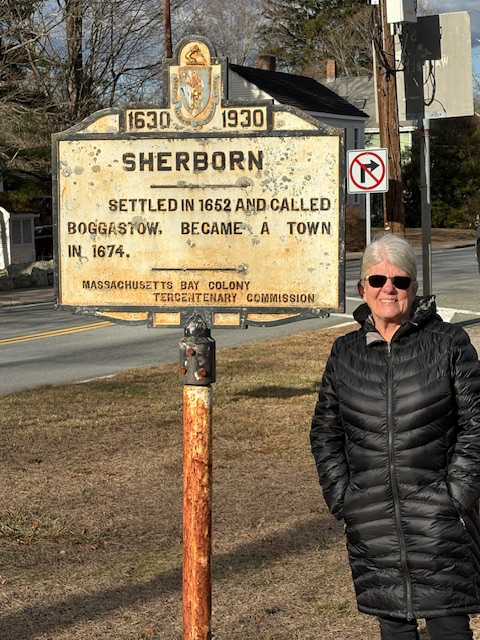
Boggestow
Before it was called Sherborn, the area was known as Boggestow, a native place name that likely described the landscape, interpreted as “rocky” or “hilly” land. The region was inhabited by the Massachusett people, specifically bands connected to the Nipmuc and other Algonquian-speaking tribes of central Massachusetts. The Massachusett were part of a larger network of Native communities living throughout eastern and central […]
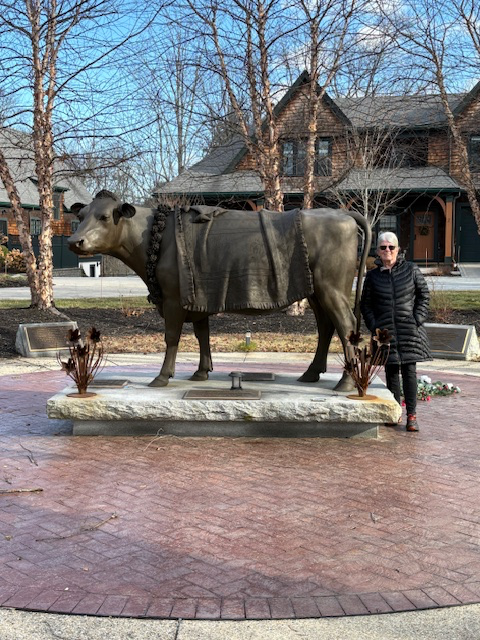
Emily the Cow
In Sherborn, this memorial stands for a cow whose life became a symbol of compassion in our time. Emily’s story belongs to the late twentieth century. After escaping from a slaughterhouse in 1995, she was taken in by the Peace Abbey, a sanctuary devoted to nonviolence, humanitarian causes and animal welfare. There she lived out the remainder of […]

