A Neighborhood Within the City
We traveled to Girona specifically to explore its Jewish Quarter, known in Catalan as the Call. Although we had seen photographs of its narrow streets and stone passageways, the aerial view in the Museum of Jewish History helped us understand the neighborhood in a different way. From above, the Call appears woven into the densely built center of medieval Girona, stretching along the hillside above the Onyar River and surrounded by tiled roofs, churches, walls and centuries of later construction.
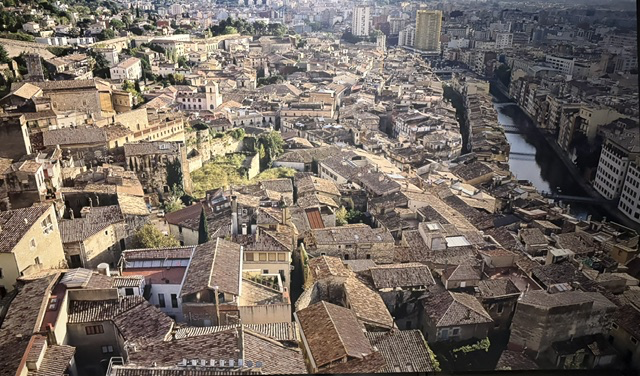
A Jewish community was established in Girona by at least the ninth century. Beginning in the middle of the 11th century, Jewish families increasingly settled around Carrer de la Força, which became the principal street of the Call. This street followed the route of the ancient Roman road through Girona and connected the Jewish neighborhood to the larger life of the city.
For much of the medieval period, the Call was not entirely separated from the surrounding population. Jewish and Christian families lived near one another, conducted business together and participated in the economic life of Girona. Jewish residents worked as merchants, artisans, property owners, physicians, scholars and moneylenders. Surviving records document their purchases, marriages, loans, inheritances and disagreements, providing glimpses into the ordinary lives of people who once occupied these streets.
The Call contained far more than private homes. It was a complete community with synagogues, schools, charitable institutions, a hospital, gathering places and a mikveh used for ritual immersion. The synagogue served not only as a place of prayer but also as a center for study, meetings and communal affairs. The neighborhood’s religious and educational institutions allowed Jewish traditions to be maintained and passed from one generation to the next.
Homes within the Call varied according to the circumstances of the families who lived in them. Many were narrow, single-family dwellings built upward because space within the neighborhood was limited. Others were larger residences with interior courtyards, gardens, terraces, decorated windows and stone staircases. Water was collected in cisterns, and small courtyards brought air and light into buildings surrounded by closely packed structures.
Girona also became an important center of Jewish scholarship. Among the community’s best-known figures was Moses ben Nahman, commonly known as Nahmanides or the Ramban. Born in Girona in 1194, he became a respected rabbi, physician, philosopher, biblical commentator and scholar of Jewish law. He was associated with the circle of Jewish thinkers who helped make Girona an important center for the study of Kabbalah during the 12th and 13th centuries.
The physical form of the Call changed as conditions for Jewish residents became more restrictive. During the late 14th century, violence and increasing social pressure disrupted the relative coexistence that had once characterized parts of the city. The attacks of 1391 affected Jewish communities throughout the Iberian Peninsula, including Girona. Some residents were killed, some converted to Christianity and others left the city.
Those who remained were increasingly confined to a smaller section of the Call. Walls and gates separated the neighborhood more clearly from surrounding Christian areas, and its population was restricted primarily to the western side of Carrer de la Força. As more people were required to live within a reduced area, homes became increasingly crowded and passages between buildings grew narrower and more irregular.
In 1492, Ferdinand and Isabella ordered practicing Jews to leave the kingdoms under their rule unless they converted to Christianity. Girona’s remaining Jewish residents were forced to abandon their homes, businesses, synagogue and community institutions. The final synagogue complex was sold, and the former Jewish Quarter gradually became part of the surrounding Christian city.
The Jewish presence largely disappeared from public view as buildings changed ownership, houses were remodeled and religious objects were removed. Synagogues were converted to other uses, entrances were altered and mezuzahs were taken from the doorposts. Yet the basic pattern of the Call survived within Girona’s Old City.
Walking through the neighborhood today, its steep stairways, arched passages, confined courtyards and narrow stone lanes provide a sense of its medieval form. The buildings no longer function as a separate Jewish community, but archaeological discoveries, municipal records and the collections of the Museum of Jewish History have helped restore the history of the people who once lived within them.
The aerial photograph reveals the Call as a physical part of Girona, while the museum displays help identify the community that gave the neighborhood its distinctive character. Together, they show how streets and buildings can continue to preserve the structure of a community long after its residents are gone.
Read More From Nancy
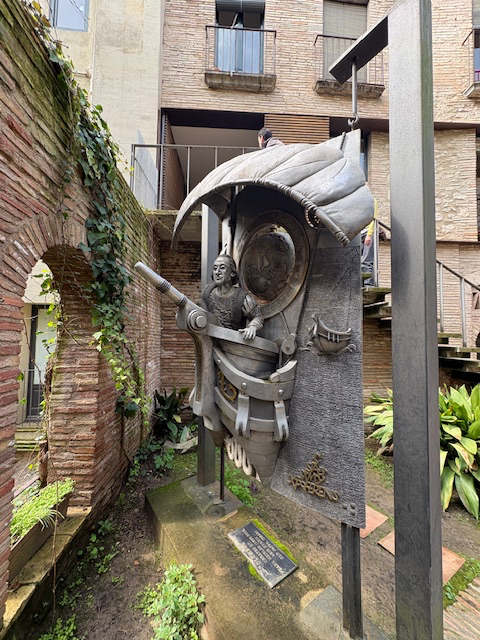
Columbus Sculpture
There is a gift that certain artists have, the ability to capture a moment so completely that the story is understood before it is explained. That is how I felt standing before the Columbus sculpture at the Museum of Jewish History in Girona. Created by Frank Meisler in 1994, this is not a single image, but […]
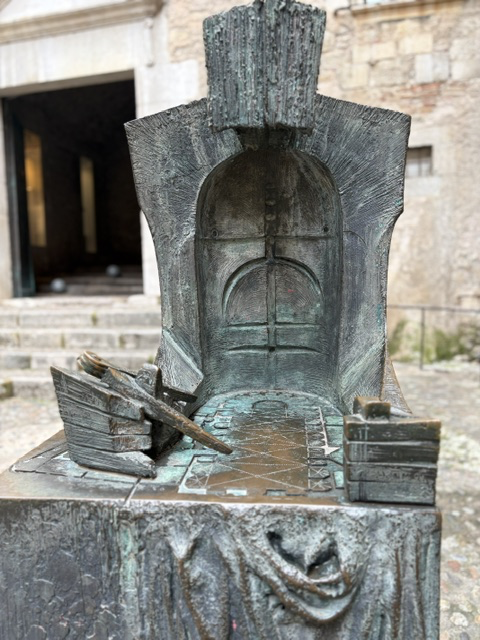
Studio of Modest Urgell
A bronze sculpture outside this stone building recreates the intimate world of an artist’s studio. Within its small architectural setting are the tools and furnishings associated with creative work, inviting passersby to look more closely. A plaque on the nearby wall explains the reason for its placement: Catalan painter and writer Modest Urgell i Inglada […]
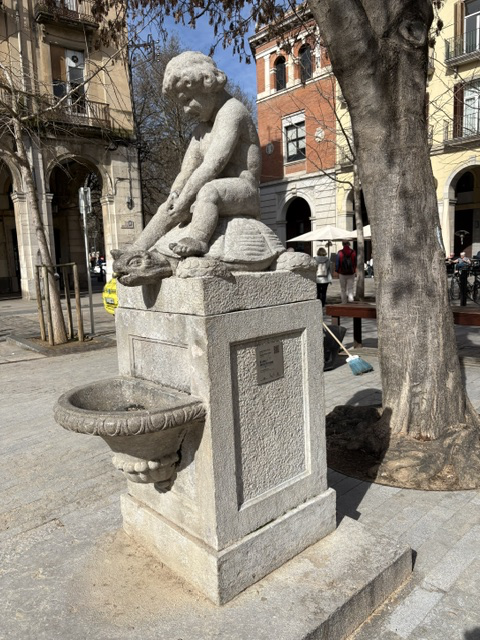
The Boy and Turtle Fountain
While exploring Plaça de la Independència in Girona, we noticed this small and playful fountain beneath the trees. Officially known as the Font del Nen de la Tortuga, it depicts a young boy seated in an unusual position on the back of a sea turtle. Water originally flowed from the turtle’s mouth into the decorative […]

