The Winged Victory of Samothrace
Of course, our family vacation in France had to include a visit to the Louvre. We explored its galleries and encountered many of its celebrated works, but this photograph captures our approach to one of the museum’s most dramatic masterpieces: the Winged Victory of Samothrace.
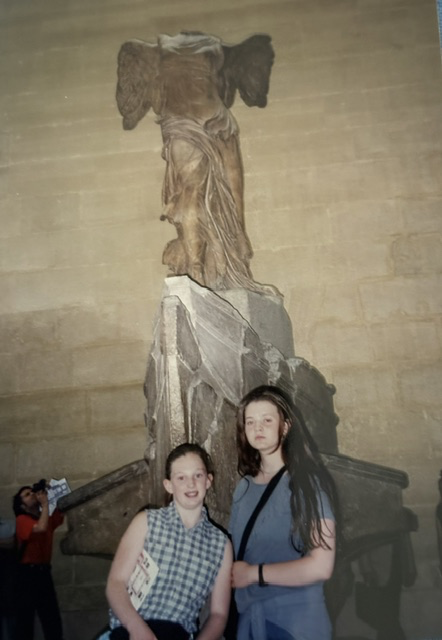
Created around 200–175 BC, the marble sculpture represents Nike, the ancient Greek goddess of victory. She originally stood within the Sanctuary of the Great Gods on the Greek island of Samothrace, where she was presented as an offering to the gods. Although the event it commemorated is uncertain, its naval imagery suggests that it celebrated a victory at sea.
Nike stands on the carved stone prow of a ship. Her wings extend behind her while her clothing appears to be driven against her body by the wind and sea. The sculptor transformed solid marble into something that seems filled with movement. Even without her head and arms, the figure conveys strength, forward motion, and triumph.
The statue was discovered on Samothrace in 1863 by Charles Champoiseau, a French diplomat and amateur archaeologist. It was transported to the Louvre in sections and gradually reconstructed as additional fragments were identified. In 1883, it was placed at the top of the Daru staircase, where its elevated position recalls the way it was originally intended to be viewed from below and at a distance.
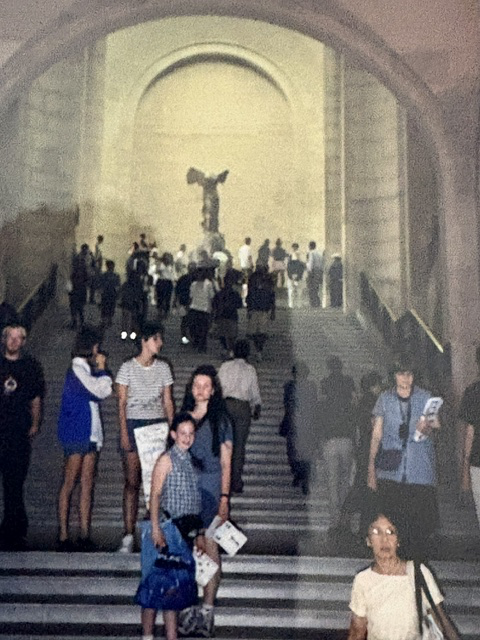
The statue’s position at the top of the Daru staircase makes the approach part of the experience. Our photographs capture our daughters beneath the Winged Victory, bringing our family visit together with a work created more than two thousand years ago.

Read More From Nancy
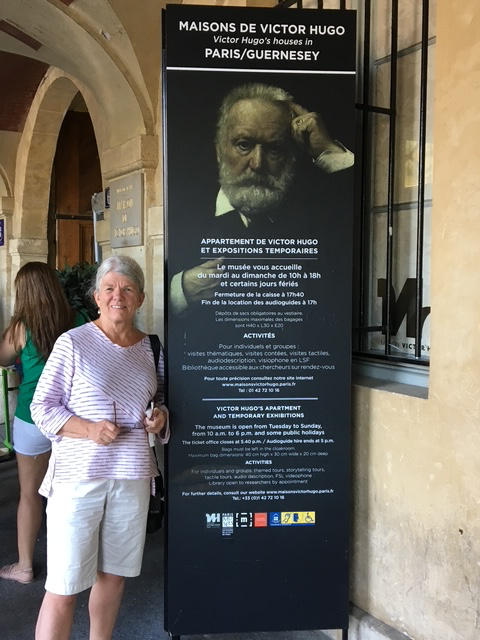
Home of Victor Hugo
The home of Victor Hugo offers a rare opportunity to step directly into the life of one of France’s greatest literary figures. This apartment is where Hugo lived from 1832 to 1848, some of his most productive and significant periods of his career. It was here that he wrote, entertained and lived as a central figure in […]
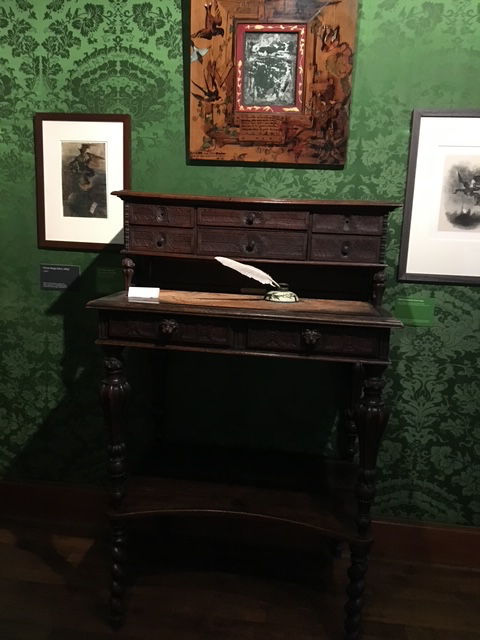
Victor Hugo’s Standing Desk
Victor Hugo was known for writing while standing, and this desk was arranged to accommodate that lifelong habit. Rather than being made as a single piece, it was assembled from existing furniture: a small secretary with drawers was placed upon a narrow table or shelf, raising the writing surface to the height Hugo required. The […]
A Royal Sanctuary for Sacred Relics
Within the medieval royal palace on the Île de la Cité, Sainte-Chapelle served a purpose that was both religious and royal. Louis IX commissioned it to house objects venerated as relics of Christ’s Passion, creating a sanctuary that placed these treasures at the heart of the French monarchy. In 1239, Louis acquired the Crown of […]

