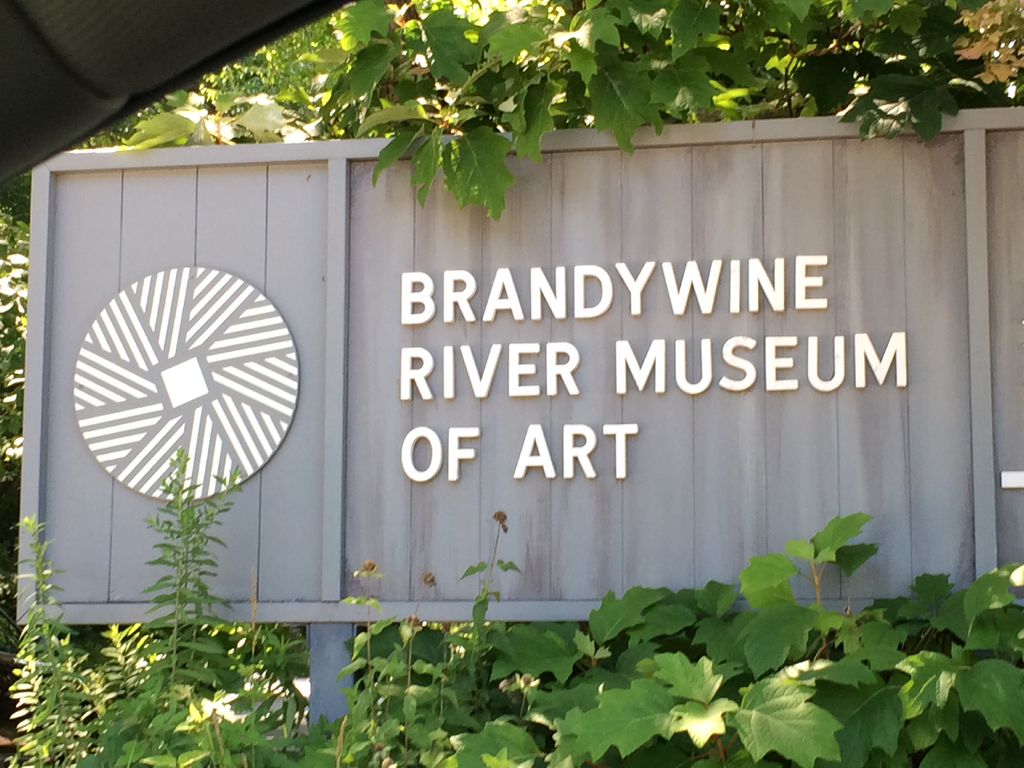
Brandywine Museum of Art
The couple of times I have found myself near Chadds Ford, I have tried to return to the Brandywine Museum of Art. There are museums that are interesting to visit once, and others that continue to draw us back. For me, Brandywine belongs to the latter group. The museum stands beside Brandywine Creek in Hoffman’s Mill, a nineteenth-century gristmill that was preserved and transformed into an art museum. It opened in 1971 and became known for its collection of American art, particularly the work of the Wyeth family. The historic mill, the surrounding countryside, and the art displayed inside seem naturally connected, allowing visitors to experience the landscape as well as the paintings it inspired.
Andrew Wyeth is often associated with Maine, where he spent his summers and created some of his best-known paintings. His family roots, however, run deeply through Chadds Ford. His father, N. C. Wyeth, settled here in 1911 after establishing himself as one of America’s leading illustrators. He built a home and studio where his children grew up surrounded by art, stories, and the rural Pennsylvania landscape. Andrew remained closely connected to the area throughout his life, painting its fields, buildings, interiors, and residents for more than seven decades. His son Jamie continued the family’s artistic tradition.
The museum’s collection brings together the work of these three generations. N. C. Wyeth’s dramatic illustrations, Andrew Wyeth’s quiet and often mysterious realism, and Jamie Wyeth’s distinctive paintings reveal both their individual visions and the artistic inheritance they shared. Yet the museum offers more than paintings hanging on gallery walls. It preserves the places where the Wyeth’s lived and worked, making it possible to explore the relationship between the art and the landscape from which it emerged.
I especially enjoy visiting Andrew Wyeth’s studio. The converted schoolhouse served as his principal Pennsylvania workspace from 1940 until shortly before his death in 2009. Preserved much as he left it, the studio contains the objects, photographs, books, paints, and working materials that surrounded him. Unlike a formal gallery, it offers the feeling of entering the private space where observation slowly became art.
Returning to Brandywine has reminded me that the Wyeth story cannot be separated from place. Maine gave Andrew Wyeth one landscape to explore, but Chadds Ford was his home ground and the center of his family’s artistic legacy. At Brandywine, the paintings, studios, historic mill, and countryside remain connected, allowing us to experience not only the finished art but also the world from which it grew.