Rodin Museum
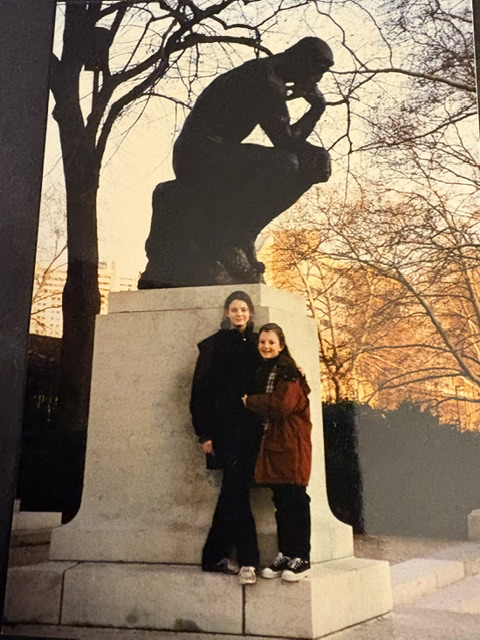
Sometimes our homeschooling adventures took us a little farther from home. During one Christmas break, I packed up the girls, and we headed out on a road trip to explore Philadelphia. Philadelphia was perfect for the way we approached homeschooling. It was a city where history, art, architecture and American culture were all within reach. There was so much to explore that the city itself became our classroom. One of our stops was the Rodin Museum, where I took this photograph of Emily and Erin standing beneath one of the most recognizable sculptures in the world—Auguste Rodin’s The Thinker.
The Philadelphia Museum has a remarkable story of its own. It opened in 1929 and holds one of the largest collections of Rodin’s work outside France. The collection was assembled largely through the efforts of Jules E. Mastbaum, a Philadelphia businessman and philanthropist who began collecting Rodin’s work in the 1920s. His original intention was not simply to create a private collection. He wanted the people of Philadelphia to be able to experience Rodin’s work.
Mastbaum died in 1926, before his vision was completed, but his family carried it forward. The museum opened three years later along Philadelphia’s Benjamin Franklin Parkway, the grand avenue that also leads to the Philadelphia Museum of Art. The museum building and its gardens were designed to create an environment appropriate for Rodin’s sculptures. French architect Paul Cret designed the building, while landscape architect Jacques Gréber contributed to the surrounding garden. Even before entering the museum, visitors encounter Rodin’s work outdoors. Here, outside was The Thinker.
Rodin originally conceived the figure around 1880 as part of a much larger commission called The Gates of Hell, inspired in part by Dante’s Divine Comedy. The seated figure eventually took on an independent life, becoming one of the most recognized sculptures in the world. What began as one figure within an enormous composition became a universal image of thought, contemplation and intellectual struggle.
At the time, it was another stop on one of our homeschooling adventures. We explored the museum, looked at the sculpture and continued to whatever Philadelphia had waiting for us next. But photographs like this remind me of what we were really trying to accomplish. Homeschooling gave us the freedom to make places like Philadelphia part of their education. Art did not have to be a photograph in a textbook. History did not have to remain on a page. We could get in the car, travel to the places where those stories were preserved, and stand directly in front of them.
That Christmas break, Philadelphia became our classroom, and The Thinker was part of the lesson. There would be many more museums, historic houses, monuments and road trips over the years. Each one added something different. We could never know which experiences would stay with our daughters or how they would eventually interpret everything we exposed them to. Our job was simply to keep opening the doors. And sometimes that meant packing the car during Christmas vacation and heading to Philadelphia to see what we could discover.