Pau Gil — The Man Behind Hospital de Sant Pau
While visiting the Hospital de Sant Pau in Barcelona, I stopped to photograph this statue. Surrounded by the extraordinary architecture and decoration of the hospital, it would be easy to walk past without asking who this man was. But in many ways, the entire complex exists because of him.
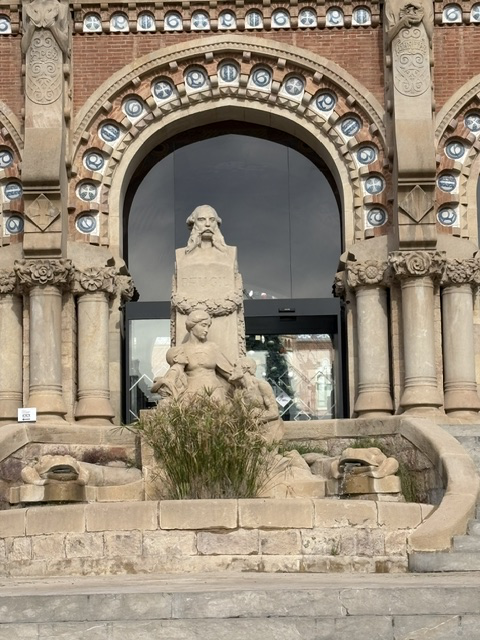
The statue honors Pau Gil i Serra, a Catalan banker and businessman who was born in Barcelona but spent much of his adult life in Paris. When he prepared his will in 1892, at about the age of 75, he made an extraordinary decision: he directed that roughly half of his fortune be used to build a new hospital in his native Barcelona. His bequest amounted to several million pesetas, an enormous sum at the time.
Why a hospital? Gil’s will gives us an important part of the answer. He specifically wanted his money used to create a civil hospital for the poor. Barcelona’s population was growing rapidly, while its centuries-old Hospital de la Santa Creu had become overcrowded and outdated. Medicine and ideas about sanitation were changing as well, and the city desperately needed a modern hospital. Gil wanted the institution created with his money to incorporate the newest developments in medicine, technology and hospital design.
We do not appear to know of a personal illness or tragedy that led Gil to make this choice. What his will does tell us is that this was a very deliberate act of philanthropy. He could have left his fortune simply to his family or other institutions. Instead, he chose to use a substantial part of it to provide medical care for people who could not afford it.
Gil died in Paris in 1896, so he never saw what his gift would become. His bequest helped make possible the extraordinary hospital complex designed by Lluís Domènech i Montaner. Rather than create a single enormous institutional building, the architect designed separate pavilions surrounded by gardens and connected by underground tunnels. Natural light, fresh air, sanitation and open space were all considered part of creating a better environment for patients.
Gil also stipulated that the new hospital be dedicated to Saint Paul—Sant Pau, his own patron saint. His name therefore became permanently attached to the institution. Even the decorative details throughout the complex preserve his memory; the letters P and G appear repeatedly in the buildings, referring to Pau Gil.
Gil’s contribution was not forgotten. His statue was given a prominent place at the hospital, where visitors still encounter him today. We can admire the hospital’s mosaics, towers, gardens and remarkable architecture, but behind all of it was the decision of one man to leave much of his fortune to care for people he would never know. Pau Gil’s greatest monument is not the statue. It is the hospital.