St. Dunstan’s Basilica
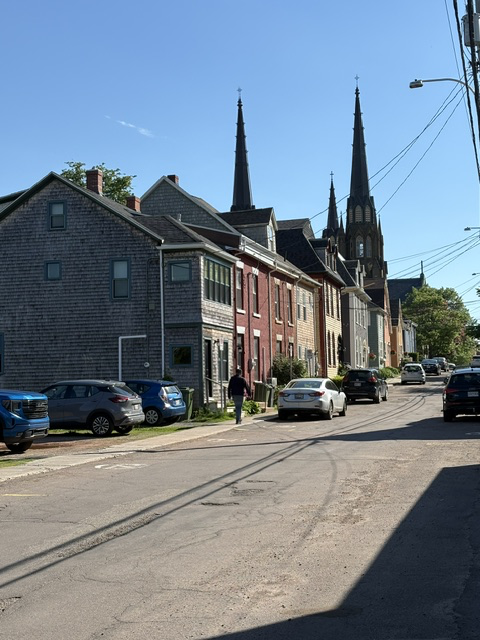
Walking through Charlottetown, I could see the twin spires of St. Dunstan’s Basilica rising above the houses long before I reached the church itself. In my photograph, they seem almost to emerge from the neighborhood, towering over the smaller buildings along the street. At approximately 200 feet high, they remain among the highest points on Charlottetown’s skyline.
The story of St. Dunstan’s on this site begins in 1816, when a small wooden chapel was built and dedicated to St. Dunstan, the 10th-century Archbishop of Canterbury. When Charlottetown became an episcopal see in 1829, that modest chapel became a cathedral, and Angus Bernard MacEachern became the first bishop of the new Diocese of Charlottetown, the first Roman Catholic diocese established in the Maritime Provinces.
The Catholic community on Prince Edward Island had much deeper roots. French Catholic missionaries had ministered to early settlers in the 18th century, while Scottish Catholics began arriving in significant numbers during the 1770s. MacEachern himself had come from Scotland, eventually traveling enormous distances to minister to scattered Catholic communities across Prince Edward Island and beyond. St. Dunstan’s became the center of that growing Catholic community.
As the congregation grew, so did its church. The original chapel was replaced by a larger wooden cathedral in 1843. By the end of the 19th century, even that was no longer adequate. Quebec architect François-Xavier Berlinguet was commissioned to design a much more ambitious stone cathedral in the French-inspired High Victorian Gothic Revival style. Its cornerstone was laid in 1896, and the building was completed in 1907.
On March 7, 1913, a fire that began in the sanctuary devastated the cathedral. Much of the magnificent building was destroyed, although portions of the stone walls and façade survived. Remarkably, plans to rebuild began before the fire had even been completely extinguished. Catholics from throughout Prince Edward Island contributed to the reconstruction, joined by members of the wider community.
Scottish architect John Marshall Hunter was brought in to rebuild the cathedral. Rather than simply reproduce what had been lost, he created a new English Gothic-inspired interior within the surviving exterior walls. The fourth St. Dunstan’s Cathedral was completed and formally dedicated in 1919.
Ten years later, in 1929, on the centennial of the Diocese of Charlottetown, the cathedral was elevated to the status of a basilica. In 1990, the Canadian government designated St. Dunstan’s a National Historic Site, recognizing it as an outstanding example of High Victorian Gothic Revival architecture.
There are extraordinary architectural details throughout the building, but from Hillsborough Street it is the twin spires that dominate the view. The church was deliberately designed to draw the eye upward, with its towers, pinnacles, pointed Gothic forms and elaborate stone carving. Even among Charlottetown’s many historic buildings, St. Dunstan’s has a presence unlike anything around it.
The churches on this site have witnessed the city grow from a small colonial community through Confederation and into the provincial capital we were exploring. The present basilica has survived fire, reconstruction and more than a century of change, while its twin spires still rise above Hillsborough Street, marking the Charlottetown skyline.
Read More From Nancy
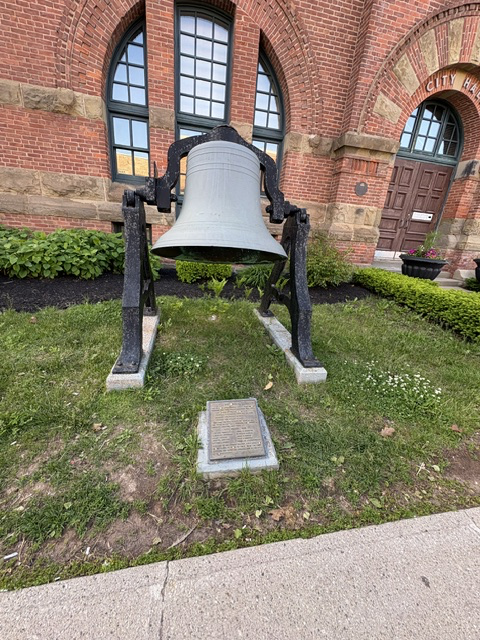
The Big Bell
Outside Charlottetown City Hall stands an enormous bell. At first it might seem like simply another artifact preserved from the city’s past, but this bell belongs to Charlottetown’s long history of fighting fires. Before telephones, radios and modern emergency dispatch systems, bells played an essential role in protecting a city. When fire broke out, the […]
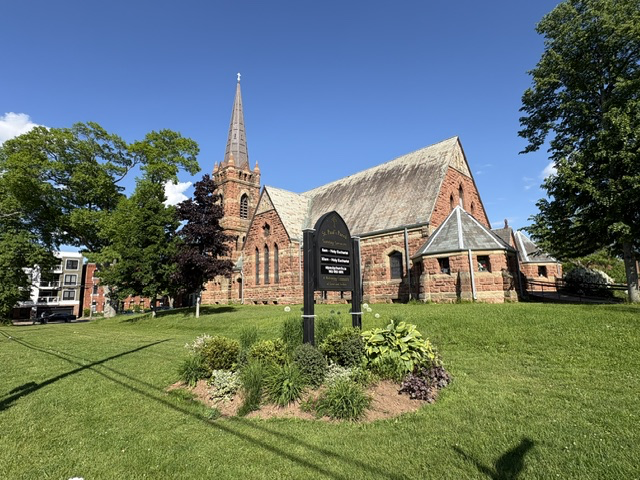
The Kirk of St. James
While walking through Charlottetown, I photographed the Kirk of St. James, a beautiful sandstone Presbyterian church standing on Fitzroy Street. The building caught my attention, but its story reaches far beyond the congregation that worshipped here. It represents the enormous influence Scottish immigrants had on Prince Edward Island. Beginning in the late 18th century and […]
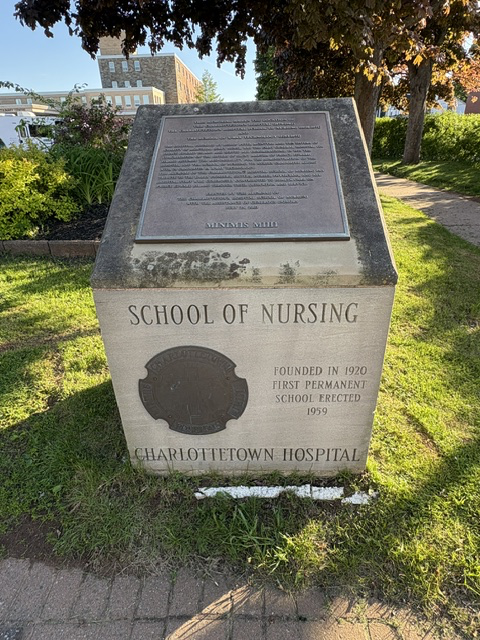
Hospital School of Nursing
While walking through Charlottetown, we came across this monument marking a place where generations of Prince Edward Island nurses began their careers. It commemorates the Charlottetown Hospital School of Nursing, which operated from 1891 until 1969. The nursing school began in 1891 in connection with the Charlottetown Hospital. At a time when professional nursing education […]

