Alexander von Humboldt
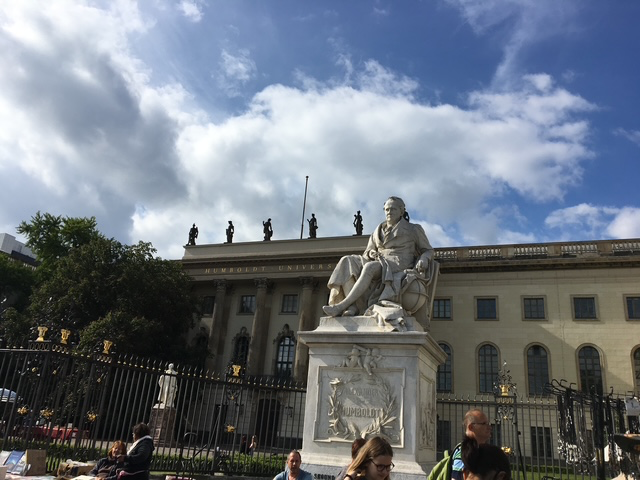
While walking along Unter den Linden in Berlin, we came across this imposing statue in front of Humboldt University. It honors Alexander von Humboldt, one of the great scientists, explorers and thinkers of the 19th century. His name was familiar to me, but seeing his monument in front of the university that bears the Humboldt name made me want to understand more about the man and why he was considered important enough to be remembered here.
Born in Berlin in 1769, Humboldt possessed an extraordinary curiosity about the natural world. He studied geology, botany, geography, astronomy, climate and other sciences at a time when these subjects were often considered independently. Humboldt increasingly came to believe that nature could only be understood by studying the relationships among its many parts.
His opportunity to test those ideas came during an extraordinary five-year expedition through the Americas between 1799 and 1804. Traveling with French botanist Aimé Bonpland, Humboldt explored areas of present-day Venezuela, Colombia, Ecuador, Peru, Cuba and Mexico. He climbed mountains, traveled rivers, collected thousands of plant specimens and made detailed measurements of temperature, altitude, atmospheric pressure and magnetism. He even attempted to climb Chimborazo in Ecuador, then believed to be the world’s highest mountain, reaching an altitude remarkable for the period.
What distinguished Humboldt was what he did with all of those observations. He noticed that plants growing at particular elevations in South America resembled vegetation found in similar climatic conditions elsewhere in the world. He recognized relationships among altitude, temperature, climate and vegetation and began describing nature as an interconnected system rather than a collection of unrelated species and landscapes. These ideas helped establish foundations for what would eventually become ecology, biogeography and environmental science.
Humboldt was also remarkably perceptive about the effects human beings could have on their environment. After observing the consequences of deforestation and agricultural practices during his travels, he wrote about how human activity could alter local climate, water supplies and ecosystems. Ideas that seem very contemporary today were already occupying his attention more than two centuries ago.
He became one of the most famous intellectual figures of his time. His books brought distant landscapes and scientific discoveries to readers throughout Europe and the Americas, and his work influenced generations of scientists and explorers. Charles Darwin was among those inspired by Humboldt’s writings; reading about Humboldt’s travels helped fuel Darwin’s own desire to explore the natural world.
Humboldt was interested in people as well as landscapes. During his travels through the Americas, he witnessed slavery and colonial exploitation and became an outspoken critic of both. He condemned slavery in his writings and challenged some of the racial assumptions common among Europeans of his era. His scientific curiosity was accompanied by a belief that knowledge should extend beyond national and cultural boundaries.
His influence became so widespread that his name was placed on the map across much of the world. Mountains, rivers, towns, counties, plants and animals were named for him, as was the Humboldt Current, the great cold ocean current flowing northward along the western coast of South America.
The monument in my photograph was created by German sculptor Reinhold Begas and unveiled in 1883. Humboldt is shown seated, holding a plant, with a globe beside him. These are appropriate symbols for a man who spent his life observing the natural world and trying to understand how its different parts were connected.
Behind him stands Humboldt University, adding another dimension to the photograph. The university was founded in 1810 largely through the vision of Alexander’s older brother, Wilhelm von Humboldt, an educator and statesman who believed that universities should combine teaching with independent research. A companion statue of Wilhelm stands on the opposite side of the entrance. In 1949, the university was renamed Humboldt University in honor of the two brothers.
What I like about this monument is that it led me beyond the statue itself. Alexander von Humboldt was not simply an explorer who traveled to distant places collecting specimens. He was searching for patterns and connections, trying to understand nature at a time when science was becoming increasingly specialized. Standing in front of the university that carries his name, the monument seems particularly appropriate. More than two centuries after his great journey through the Americas, Humboldt’s belief that observation, exploration and curiosity could reveal the connections within our world remains one of his most enduring legacies.