The Woolworth Building
There is so much to see and do in New York City that sometimes the buildings themselves become the destination. One day Marty and I took a tour of the Woolworth Building at 233 Broadway. I had seen its distinctive tower as part of the Manhattan skyline, but walking through its doors revealed a building whose interior is every bit as remarkable as its exterior.
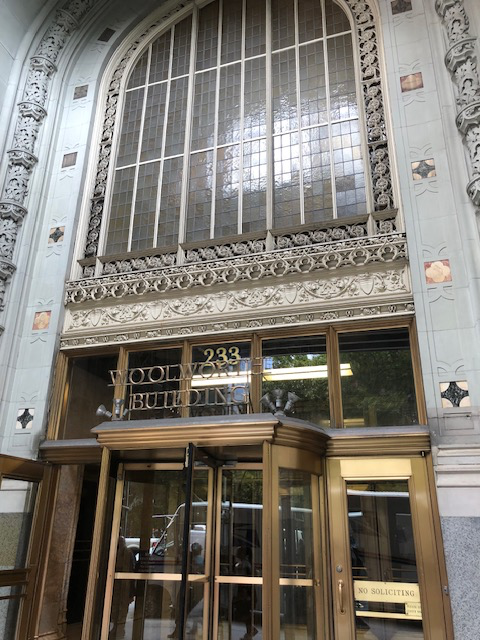
Frank W. Woolworth commissioned architect Cass Gilbert to design the building in 1910 as the new headquarters for his rapidly expanding F. W. Woolworth Company. Woolworth had built his fortune through his five-and-ten-cent stores, turning inexpensive everyday merchandise into an enormous retail empire. By 1912, the company had grown to nearly 600 stores in 37 states, along with an expanding international business.
Gilbert’s challenge was to create something far more ambitious than an ordinary office building. Woolworth wanted a headquarters that would announce the success of his company to the world. The result was a skyscraper rising approximately 792 feet above Broadway, an almost unimaginable height at the time.
Building something that tall in Lower Manhattan presented enormous engineering challenges. The visible tower is supported by a steel skeleton, but perhaps the most impressive engineering is hidden underground. Workers had to descend through approximately 115 feet of sand and unstable material before reaching bedrock. The foundation used 69 massive concrete piers to transfer the tremendous weight of the building to solid rock below. Contemporary descriptions estimated the finished building’s weight at about 125,000 tons.
Construction moved remarkably quickly. Photographs preserved by the Library of Congress show the foundations underway in March 1911 and the steel tower rising over Manhattan in 1912. By April 1913, little more than two years after those foundations were being constructed, the building was ready to open.
Gilbert then wrapped this thoroughly modern steel skyscraper in an architectural vocabulary borrowed from medieval Gothic cathedrals. The exterior was covered with light-colored architectural terra cotta and decorated with Gothic arches, tracery, pinnacles and other elaborate details. The result made the immense tower appear lighter and more vertical, drawing the eye continually upward toward its gilded roof.
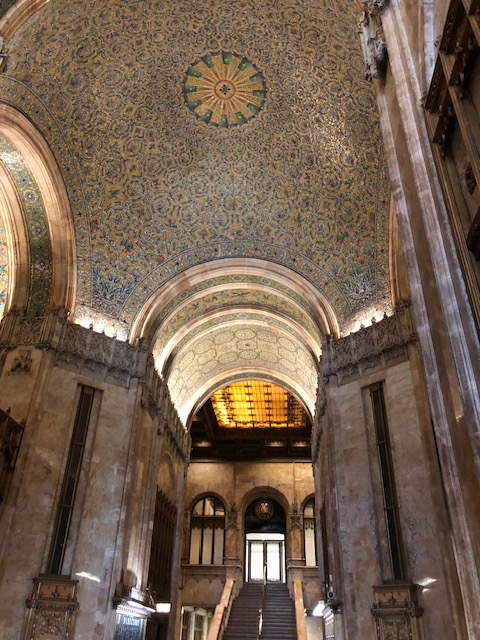
That same idea continues inside, which is what makes touring the building so fascinating. Entering the lobby feels almost like entering a cathedral. The soaring vaulted ceilings are covered with intricate mosaics in rich blues, greens and golds. Marble, bronze, stained glass, sculpted ornament and Gothic arches appear throughout the space. It is easy to understand why the Woolworth Building became known as the “Cathedral of Commerce”.
But Gilbert also allowed some humor into all that grandeur. Among the lobby’s sculptural details are caricatures connected with the people who created the building. Cass Gilbert is depicted holding a model of the Woolworth Building, while Frank Woolworth is portrayed counting his money. They are small details that could easily be overlooked amid the elaborate decoration, but they make the lobby much more personal.
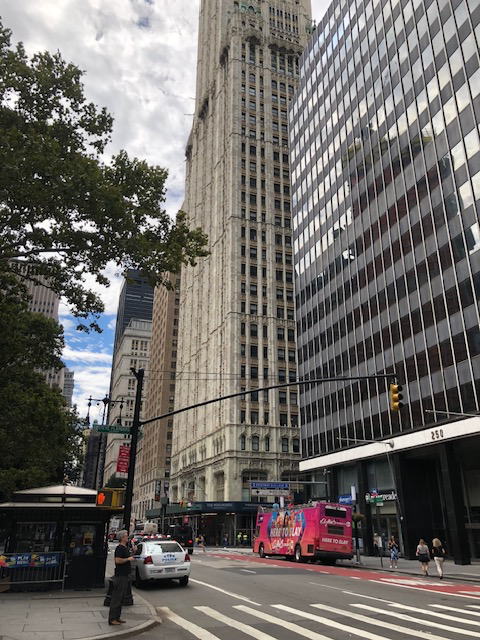
At that moment it became the tallest building in the world, a distinction it would hold until the skyscraper race of the late 1920s produced even taller towers. The Library of Congress describes the building as a triumph of American building technology and notes that its more than 5,000 windows were illuminated at its ceremonial opening.
From the street, the Woolworth Building is one of New York’s great early skyscrapers. But standing beneath those magnificent mosaic ceilings gave us an entirely different appreciation for it. More than a century after it opened, it remains a wonderful example of a moment when architecture, engineering, art and American ambition all came together in one extraordinary building.

Read More From Nancy
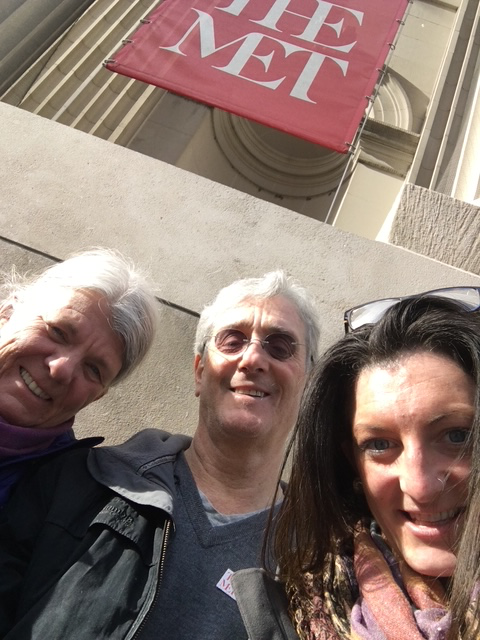
The Metropolitan Museum of Art
The Metropolitan Museum of Art has been part of many of our visits to New York City over the years. Sometimes we have gone for a particular exhibition we wanted to see, while other visits have simply been opportunities to wander through the galleries and see where they would take us. With a museum as […]
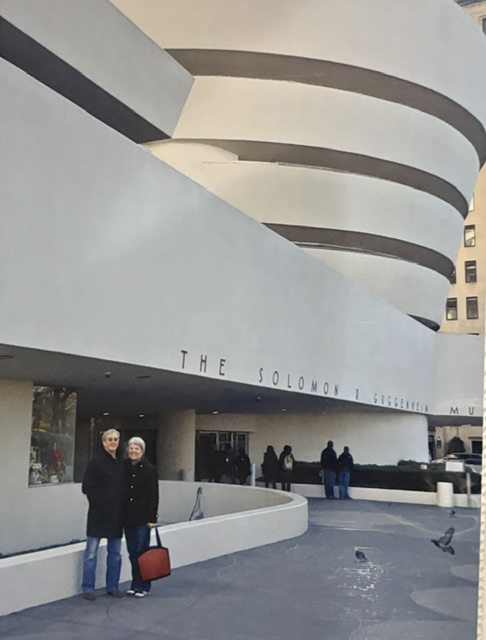
Guggenheim Museum
There are museums we visit because of what is hanging on the walls, and then there are museums where the building itself is part of what we have come to experience. The Solomon R. Guggenheim Museum in New York City is certainly one of those places. What makes a visit to the Guggenheim so distinctive […]
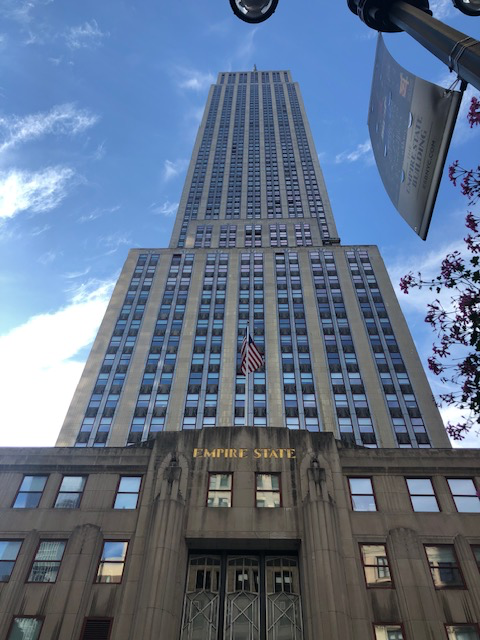
The Empire State Building
Some buildings become so familiar that we almost stop thinking about the remarkable stories behind them. The Empire State Building is one of those places. We have visited it many times over the years and have gone to the top more than once, but each time I stand at its base and look upward, its […]

