Nebelwerfer Rocket Launcher
Walking through the Heritage Museum, I expected to see familiar artillery pieces and military vehicles. What I did not expect was to encounter one of the most recognizable, and feared, weapons of the Second World War. With its cluster of six launch tubes mounted on a two-wheeled carriage, the German Nebelwerfer looks unlike any conventional cannon.
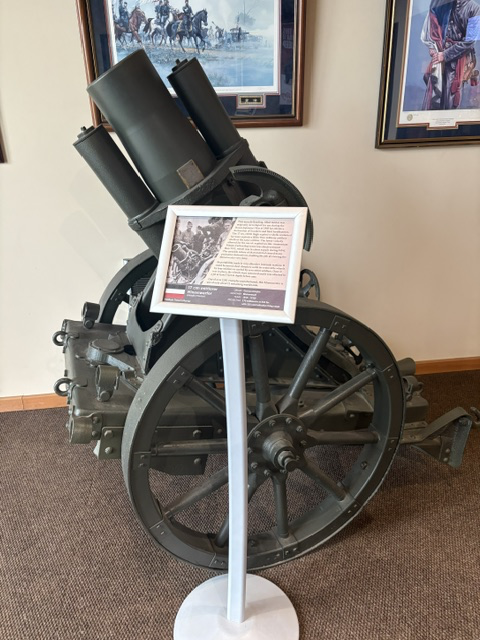
The first Nebelwerfers were developed by Germany during the 1930s as weapons for delivering smoke and chemical munitions, which explains the name “Nebelwerfer,” meaning “smoke thrower.” As the war progressed, engineers discovered that the launcher was even more effective firing high-explosive rockets. By the time Germany invaded the Soviet Union in 1941, the Nebelwerfer had become one of the Wehrmacht’s most effective support weapons.
Each launcher fired six spin-stabilized rockets in rapid succession. Within seconds, an entire battery could blanket enemy positions with explosives over a wide area. Although the rockets were less accurate than conventional artillery, they compensated with overwhelming firepower and psychological effect.
Perhaps the Nebelwerfer’s greatest weapon was its sound. As the rockets accelerated away from the launcher, they produced a distinctive high-pitched shriek that Allied soldiers never forgot. American troops nicknamed it the “Screaming Meemie,” while British forces often referred to it simply as the “Moaning Minnie.” Veterans recalled that hearing the rocket’s launch was often more terrifying than the explosions themselves because the eerie sound warned that destruction was only moments away.
Like many wartime innovations, the Nebelwerfer reflected a shift in military thinking. Instead of relying on precise artillery fire, commanders could quickly saturate an area with multiple rockets, disrupting enemy formations before an attack. The concept would later influence the development of rocket artillery systems used by many nations throughout the Cold War and into the present day.
Museums preserve artifacts like the Nebelwerfer not to celebrate war but to help us understand the rapid pace of technological innovation during times of conflict. Looking at this launcher today, it serves as a reminder that engineering advances can change the course of history, while also reminding us of the tremendous human cost that often accompanies those advances.
Read More From Nancy
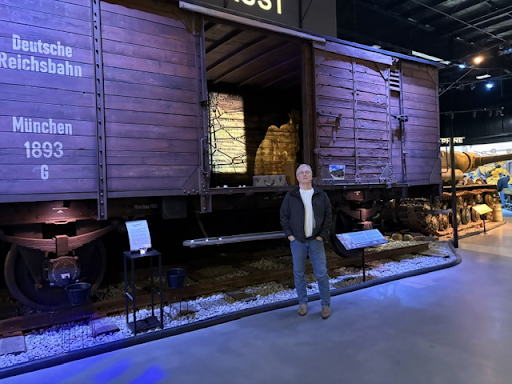
The Deutsche Reichsbahn Car: A Witness to the Holocaust
The American Heritage Museum in Hudson, Massachusetts, is best known for its remarkable collection of tanks and military vehicles, but one exhibit stopped us in our tracks for an entirely different reason. In the World War II gallery stands a restored German Deutsche Reichsbahn freight car—an ordinary-looking rail car that represents one of history’s darkest […]
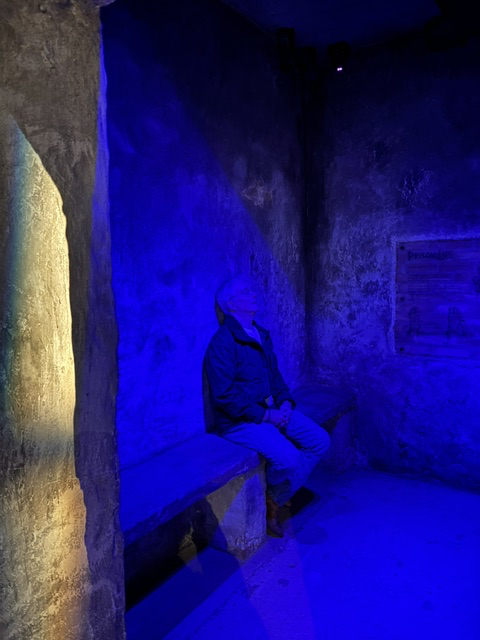
Prisoners of War in Vietnam
The American Heritage Museum in Hudson contains an extensive collection of military vehicles and artifacts, but one of its most affecting displays focuses on American prisoners of war held in North Vietnam. The thoughtfully constructed exhibition moves beyond weapons and military strategy to examine the individual experience of captivity. At its center is a reconstruction […]
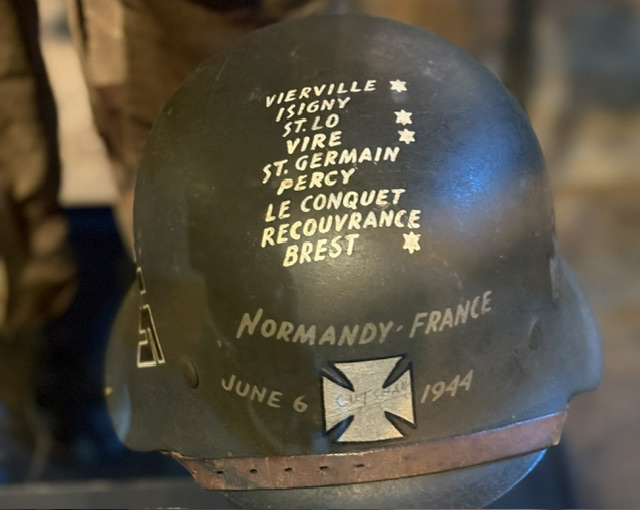
The Journey Written on a Helmet
This German M-42 combat helmet, displayed at the American Heritage Museum, tells a story that extends beyond the battlefield. Sometime after its capture, the helmet was carefully personalized, likely by an American serviceman or possibly a German prisoner of war Painted on its surface are the names of towns and cities associated with the Allied […]

