Sachsenhausen After 1945 — Under Soviet Administration
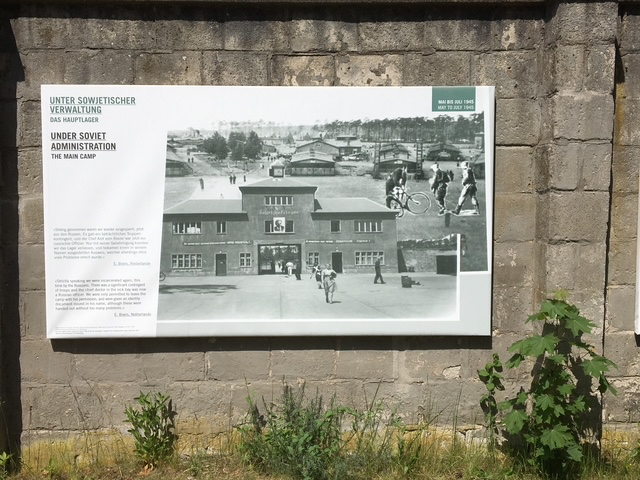
One of the things that surprised me during our visit to Sachsenhausen was discovering that the history of imprisonment here did not end when Nazi Germany collapsed in 1945. This interpretive panel, mounted against one of the old walls, tells a second and very different chapter of the site’s history. Its heading reads, “Under Soviet Administration,” covering the years from 1945 to 1950.
Soviet and Polish troops reached Sachsenhausen on April 22 and 23, 1945, liberating approximately 3,000 sick and exhausted prisoners who had been left behind when the SS evacuated most of the camp. After everything that had happened here since the Nazis established Sachsenhausen in 1936, it would be natural to think that liberation marked the end of the site’s use as a place of confinement.
Only a few months later, in August 1945, the Soviet secret police established Special Camp No. 7 on part of the former Sachsenhausen concentration camp. It was one of several special camps created by the Soviet occupation authorities in eastern Germany. In 1948, Sachsenhausen was redesignated Special Camp No. 1 and became the largest of these Soviet detention camps.
The people imprisoned here represented a complicated mixture. Some were former Nazi officials, members of Nazi organizations and people accused of participating in the Nazi regime. But others were detained because Soviet authorities considered them politically dangerous or hostile to the occupation. Among them were people accused of anti-Soviet activity, young people suspected of belonging to resistance organizations, and individuals who were arrested and interned without having been convicted through normal judicial proceedings.
The conditions were severe. Prisoners were largely isolated from the outside world, and families often had little or no information about what had happened to those who had been taken away. Food was inadequate, sanitation was poor and disease spread through the overcrowded camp. Unlike the Nazi concentration camp, the Soviet special camp was not organized around a system of extermination through forced labor, but the conditions nevertheless resulted in an enormous loss of life.
Between 1945 and 1950, approximately 60,000 people were imprisoned in the Soviet special camp at Sachsenhausen. About 12,000 died, primarily from hunger, disease and the consequences of the terrible conditions in which they were confined.
The photograph incorporated into the panel makes this history particularly interesting. We are looking at the familiar buildings and grounds of Sachsenhausen, but at a different moment in their history. The Nazi concentration camp had ceased to exist, yet the same landscape was once again enclosed and being used to hold thousands of prisoners.
The Soviet special camp finally closed in the spring of 1950. Some prisoners were released, while others were transferred to prisons in the newly established German Democratic Republic, or East Germany.
For decades, this Soviet chapter of Sachsenhausen’s history received far less attention than the history of the Nazi concentration camp. After German reunification, historians were able to investigate Soviet records more fully, archaeological work was undertaken, and the stories of those imprisoned between 1945 and 1950 became a more visible part of the memorial.
What makes Sachsenhausen such a complicated place to explore is that several histories occupy the same ground. Nothing about the Soviet special camp diminishes or equates itself with the enormous crimes committed at Sachsenhausen under the Nazi regime. They were different systems, created for different purposes and operating in different historical circumstances. But both histories happened here, and understanding the site means acknowledging both.
The buildings remained. The authorities changed. And Sachsenhausen entered another chapter of its difficult history.