Standing Lincoln
While exploring Chicago, we came across this larger-than-life figure of Abraham Lincoln standing quietly before an elaborate chair. There is no dramatic gesture and no attempt to portray Lincoln triumphantly. Instead, his head is slightly bowed and his expression contemplative, as though we have encountered him in the private moment just before he rises to address an audience.
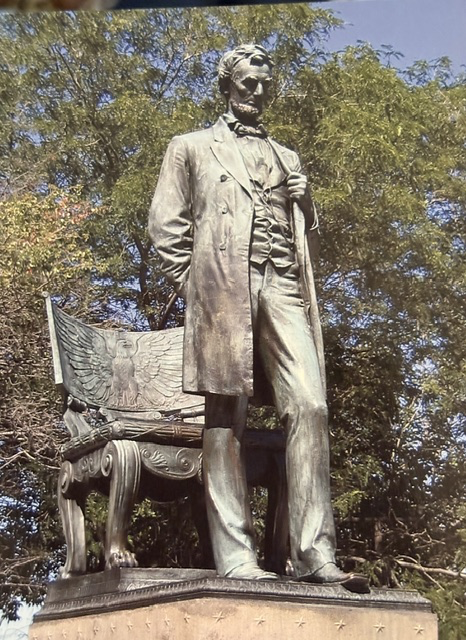
The monument was created by Augustus Saint-Gaudens, one of America’s most important sculptors of the nineteenth century. Funding came from Chicago lumber merchant Eli Bates, who left $40,000 in his will for a monument to Lincoln in the park that already bore the president’s name. The bronze sculpture was installed in Lincoln Park in 1887
Saint-Gaudens worked hard to create a Lincoln who appeared human rather than idealized. For Lincoln’s face, he studied photographs as well as the life mask made by sculptor Leonard Volk in 1860. He also had an unusual personal connection to his subject: as a young man, Saint-Gaudens had seen Lincoln during the president’s funeral procession in New York in 1865.
The chair behind Lincoln is an important part of the composition. Decorated with an eagle, it represents the authority of the presidency. Yet Lincoln is not sitting upon it. He stands in front of it, seemingly gathering his thoughts before speaking. Saint-Gaudens created a president who carries enormous authority but still appears recognizably human.
The architectural setting was designed with architect Stanford White, giving the sculpture a classical setting without overwhelming the figure itself. When the monument was dedicated on October 22, 1887, approximately 10,000 people attended. Among them was Abraham Lincoln II, the president’s grandson and namesake, who unveiled the statue.
The sculpture was immediately recognized as something exceptional. Rather than relying upon the heroic poses common to nineteenth-century public monuments, Saint-Gaudens captured Lincoln in a moment of introspection. The City of Chicago describes the monument as one of the oldest and most important pieces of public sculpture in the city and notes its influence on a generation of American sculptors.
Its influence eventually extended far beyond Chicago. Versions of Saint-Gaudens’s Standing Lincoln can be found elsewhere, and a reduced bronze version is part of the collection of the Metropolitan Museum of Art. The original, however, remains here in Lincoln Park, where it has stood for well over a century.
Looking back at my photograph, what strikes me is how successfully Saint-Gaudens avoided turning Lincoln simply into a symbol. The chair, eagle and monumental scale remind us that this was the President of the United States during one of the country’s defining crises. But Lincoln himself appears thoughtful, burdened and almost solitary. Perhaps that is why the sculpture has endured as one of the most admired representations of Lincoln. It commemorates the president, but it also asks us to look at the man.
Read More From Nancy
A Writing Table in the Lincoln Home
In the furnished interior of Abraham and Mary Lincoln’s Springfield home, a marble-topped octagonal table holds books, papers, and a portable wooden writing desk. Chairs drawn beside it suggest the overlapping uses of a household table: a place to read, write, converse, or attend to correspondence. The portable desk is an especially revealing detail. Such […]
The Receiving Vault
At the base of a hillside in Oak Ridge Cemetery, a stone receiving vault marks the first resting place of Abraham Lincoln after his return to Springfield. Its modest entrance preserves a chapter of national mourning that preceded the construction of the larger Lincoln Tomb nearby. Following his assassination in April 1865, Lincoln’s body traveled […]

