Abraham Lincoln’s Tomb
When we visited Abraham Lincoln’s Tomb in Oak Ridge Cemetery in Springfield, the monument itself was impressive, the 117-foot granite obelisk, the figure of Lincoln, and the great bronze groups representing the infantry, cavalry, artillery and navy of the Civil War. But there is another story here that I find even more fascinating: the extraordinary lengths eventually taken to protect Lincoln’s body.
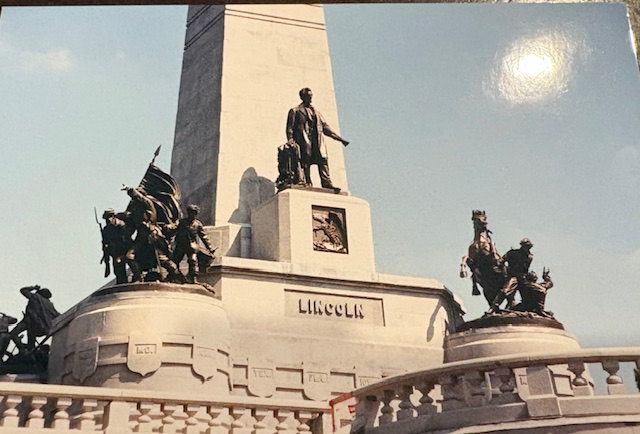
After Lincoln was assassinated in April 1865, his body made the long journey home from Washington aboard the funeral train. On May 4, after passing through Springfield one final time, Lincoln and his son Willie were placed in a temporary receiving vault at Oak Ridge Cemetery. Construction of the great tomb began in 1869, and Lincoln’s remains were moved into the partially completed monument in 1871. The tomb was formally dedicated in 1874.
But only two years later, something almost unbelievable happened. On election night, November 7, 1876, a group of counterfeiters attempted to steal Lincoln’s body. Their plan was to remove the coffin, hide the remains, and use Lincoln’s body as leverage. They reportedly hoped to obtain money and the release of one of their imprisoned associates. The plot was discovered, and the attempt failed.
The attempted theft changed the way Lincoln’s remains were protected. His coffin was subsequently concealed within the tomb rather than simply being left where visitors might assume it was. For years, only a small number of people knew exactly where the body had been placed. The story did not end there. By the end of the 19th century, the enormous monument itself had developed structural problems because of uneven settling, and the tomb underwent a major reconstruction beginning in 1899.
In 1901, Lincoln’s coffin was moved for the final time. Robert Todd Lincoln, the president’s only surviving son, wanted to make certain that no one would ever again be able to disturb his father’s remains. Lincoln’s casket was therefore placed approximately ten feet beneath the floor of the burial chamber and enclosed within a massive concrete vault.
Knowing that history changes the way I look at this old photograph. What appears to be simply an impressive presidential monument is the final chapter of a much longer story. Lincoln’s body traveled halfway across the country after his assassination, rested in a temporary vault, was moved into his new tomb, became the target of body snatchers, was secretly protected, and was ultimately placed deep beneath the monument in concrete.
The monument itself also tells a story. Designed by sculptor Larkin G. Mead, it places Lincoln above four great military groupings representing the branches of the armed forces that fought to preserve the Union. Lincoln stands at the center of the memorial, surrounded symbolically by the men who fought during the Civil War.
I have visited many gravesites and monuments, and often what interests me most is discovering that there is far more to them than what we see standing in front of them. Lincoln’s Tomb is one of those places. It was created to honor a president whose death had shaken the nation, but its subsequent history reveals just how determined Americans became to protect both his remains and his memory.
Read More From Nancy
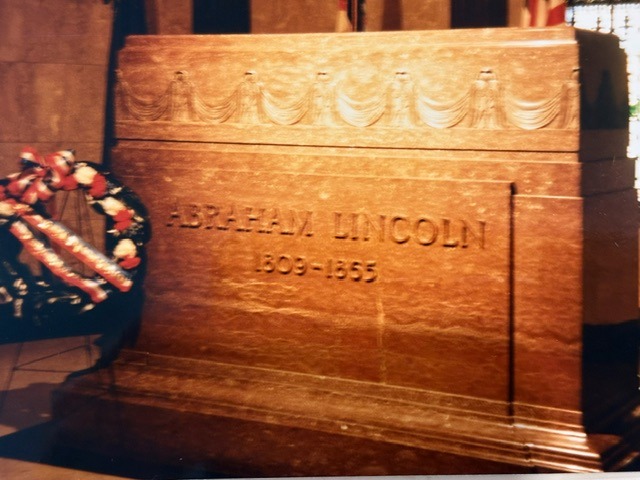
Lincoln’s Tomb
Inside Lincoln’s Tomb at Oak Ridge Cemetery, a red granite cenotaph bears the inscription “Abraham Lincoln, 1809–1865.” This monument marks his gravesite, but his coffin rests ten feet beneath the burial chamber’s marble floor. That separation reflects an extraordinary history of attempted theft and the determination to protect his remains. On November 7, 1876, a […]
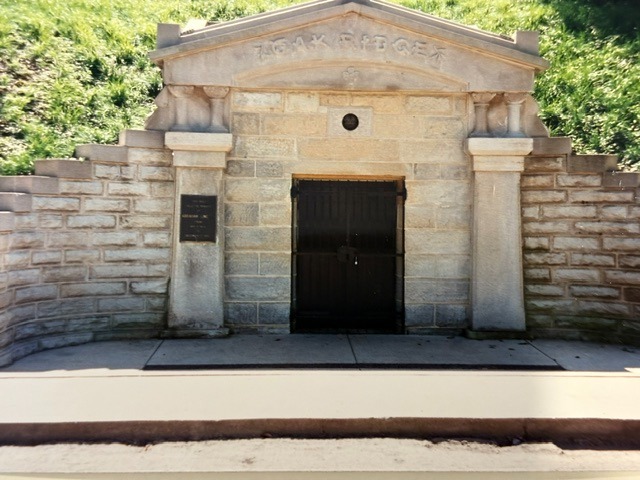
The Receiving Vault
At the base of a hillside in Oak Ridge Cemetery, a stone receiving vault marks the first resting place of Abraham Lincoln after his return to Springfield. Its modest entrance preserves a chapter of national mourning that preceded the construction of the larger Lincoln Tomb nearby. Following his assassination in April 1865, Lincoln’s body traveled […]

